

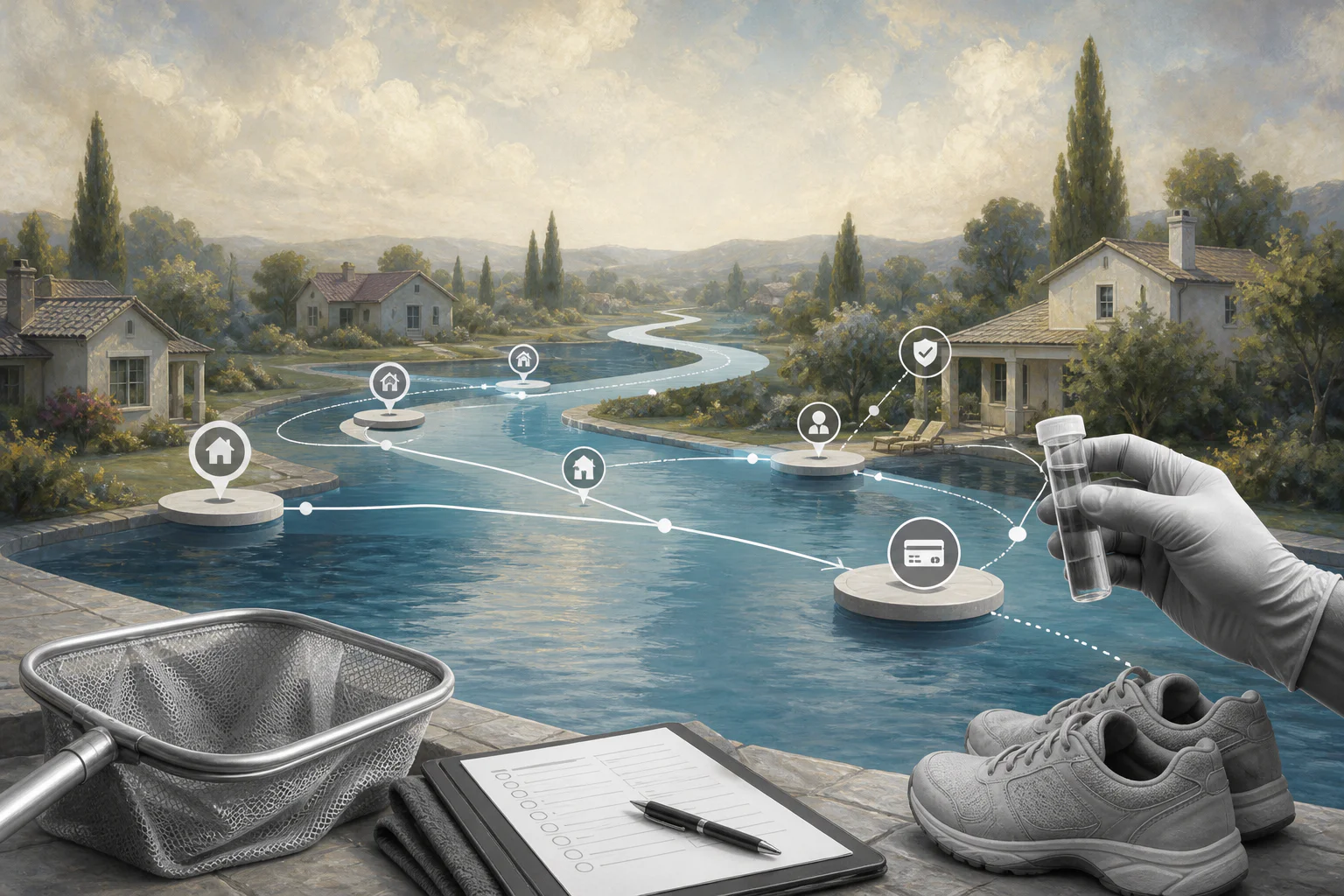
You can test pool cleaning demand before buying a truck, hiring technicians, or building custom software.
If you want to start a pool cleaning business, the old path is expensive: buy a truck, stock chemicals, hire helpers, and hope enough homeowners sign up. A leaner path is to sell the service first, build a small network of independent pool technicians, and use a branded platform to coordinate requests, quotes, routes, payments, and payouts.
Pool cleaning is attractive because it is local, recurring, and operationally simple when the route is designed well. Customers do not want algae, cloudy water, broken schedules, or surprise chemical costs. They want a reliable weekly visit, a clear price, and proof the work was done.
This guide shows how to launch with minimal capital, validate demand before heavy investment, and use Workhint as the operating foundation for a branded pool service business.
What’s in this article?
- Why pool cleaning works as a local service business
- What you need to launch without staff
- How to price weekly service and one-time cleanups
- How to get your first customers
- How Workhint helps run the business from request to payout
- A first 7-day launch plan and final checklist
Why This Business Works
A pool cleaning business works because the need repeats. A homeowner might delay a one-time home project, but pool water still needs testing, brushing, skimming, chemical balancing, and basic equipment checks. In pool-heavy markets, that creates recurring weekly or biweekly service demand.
The strongest version of this business is not random one-off jobs across a wide area. It is a route business. The more customers you group by neighborhood, the less time technicians spend driving and the more profitable each service block becomes.
The provider-network model makes the launch lighter. Instead of hiring employees immediately, you can recruit experienced independent pool technicians, certify their requirements, define service standards, and send them jobs through a branded customer platform. You focus on demand, trust, pricing, and operations while avoiding premature payroll and vehicle costs.
What You Need To Launch
Before you invest heavily, build the first version of the business around a simple offer: weekly residential pool maintenance in one launch area. Avoid complicated repairs, commercial pools, remodels, and equipment installation until you understand local demand and licensing requirements.
Licensing varies by location. Many markets require a basic business registration, insurance, and local permits. Some states or municipalities require pool operator certification for certain work, and repair work may require separate licensing. Check your city, county, and state rules before accepting paid jobs.
| Startup item | Lean launch approach | Estimated range |
|---|---|---|
| Business registration and permits | Register the business and confirm local rules | $100-$700 |
| Insurance | General liability before paid work begins | $500-$1,500 annually |
| Training or certification | Complete required or credibility-building pool training | $300-$700 |
| Branded platform | Customer requests, quotes, scheduling, payments, and provider payouts | Start lean |
| Basic tools and test supplies | Only what is needed for validation or provider standards | $500-$1,500 |
| Marketing | Landing page, local SEO, neighborhood outreach, and referral offers | $200-$1,000 |
If independent technicians provide their own approved tools and transportation, the founder can keep the first launch focused on the platform, insurance, licensing, service standards, customer acquisition, and provider onboarding. Buy vehicles, bulk chemicals, and backup equipment only after routes prove demand.
How To Price It
Pool cleaning pricing depends on pool size, service frequency, chemicals, route density, and whether you include light maintenance checks. The simplest launch model is a recurring weekly package, plus a one-time cleanup for neglected pools.
| Offer | What it includes | Example price |
|---|---|---|
| Weekly basic service | Skim, brush, empty baskets, test water, simple chemical balance | $120-$180 per month |
| Weekly premium service | Basic service plus photo proof, filter check, priority scheduling | $180-$300 per month |
| One-time cleanup | Green pool or heavy debris visit priced by condition | $150-$500+ |
| Seasonal opening or closing | Market-dependent preparation service | $200-$600+ |
Do not copy another company’s price without checking your margins. Chemical costs, travel time, technician payout, customer support, and callbacks can erase profit. Start with simple packages, track actual job time, and raise prices before your route becomes hard to serve.
How To Get First Customers
Start in one pool-dense neighborhood. Build a basic landing page, claim a Google Business Profile, join local homeowner groups, and ask real estate agents, property managers, Airbnb hosts, and pool builders for referrals.
Your first pitch should be specific: weekly pool service with online requests, clear quotes, scheduled visits, photo proof, and online payment. That sounds more reliable than a casual cleaner with a phone number and no system.
Offer a limited launch route instead of serving the whole city. For example, take the first 20 weekly accounts within a defined service area. That creates urgency, improves route density, and helps you validate whether customers will buy before you expand.
How Workhint Helps Launch It
Workhint helps you launch the pool cleaning business as a branded service platform, not just manage it after it exists. A customer visits your branded portal, enters pool size, location, access notes, photos, and service frequency, then receives a quote or booking request.
Inside Workhint, you can onboard independent pool technicians, collect insurance or certification documents, define approved service areas, and assign jobs based on location, availability, and service type. The technician receives the job, follows the checklist, uploads service proof, notes chemical readings, and marks the visit complete from the field.
The customer gets a clean service record and can approve recurring visits, pay invoices online, and leave feedback. The owner sees requests, schedules, routes, customer messages, provider payouts, exceptions, and reports in one operating system. That lets you validate a route-based pool business before building custom software, hiring dispatchers, or buying a fleet.
First 7-Day Launch Plan
- Day 1: Choose one launch area, one customer type, and one simple weekly maintenance offer.
- Day 2: Set up the branded Workhint platform with customer intake, service packages, and basic quote fields.
- Day 3: Configure scheduling, technician assignment, service checklist, photo proof, payments, and provider payouts.
- Day 4: Recruit three to five independent pool technicians or service partners and verify their requirements.
- Day 5: Contact homeowners, property managers, Airbnb hosts, pool builders, and local real estate agents.
- Day 6: Route the first requests through the platform and test quote approval, scheduling, and service handoff.
- Day 7: Review demand, pricing, route density, technician readiness, and customer objections before investing more.
Final Launch Checklist
- Pick a launch neighborhood with enough pools to build route density.
- Confirm business registration, insurance, permits, and certification requirements.
- Create a simple weekly service offer and one-time cleanup option.
- Configure a branded Workhint portal for requests, quotes, scheduling, payments, and payouts.
- Recruit independent technicians before promising broad availability.
- Create a standard checklist for every pool visit.
- Collect customer access notes, pool photos, gate instructions, and service preferences.
- Validate demand before buying vehicles, hiring employees, or stocking large chemical inventory.
FAQ
How much does it cost to start a pool cleaning business?
A lean launch can often start in the low thousands if you already have transportation and use independent technicians. Costs rise when you buy a truck, carry large chemical inventory, purchase professional equipment, or hire staff before demand is proven.
Do I need a license to clean pools?
Rules vary by state, city, and service type. Basic residential cleaning may require business registration and insurance, while commercial pools, repairs, plumbing, or chemical handling may require additional certification or licenses.
Can I start a pool cleaning business with no employees?
Yes, if you structure it as a branded platform with independent technicians or service partners. You still need clear standards, contracts, insurance review, scheduling, payment, and quality control.
How do pool cleaning businesses make money?
Most make money through recurring weekly or biweekly maintenance packages. One-time cleanups, seasonal services, filter cleaning, and approved add-ons can increase revenue once the core route is stable.
What should I avoid buying at the beginning?
Avoid buying a dedicated truck, expensive backup equipment, large chemical stock, or office space before you know customers will pay. Validate demand, build routes, and invest after the numbers justify it.
How do I get my first pool cleaning customers?
Start with one local service area. Use homeowner groups, Google Business Profile, referrals from property managers and pool builders, direct mail to pool-heavy neighborhoods, and a simple online booking page.
Conclusion
A pool cleaning business does not need to start as a truck-heavy company with employees and complicated overhead. It can start as a focused local service platform: one offer, one launch area, a small provider network, and a system that handles requests, schedules, service proof, payments, and payouts. For a route-based service network, service marketplace software can organize customer subscriptions, provider onboarding, route assignments, visit proof, issue escalation, and payments.
Use the first week to prove demand. Once customers are paying and technicians can deliver consistently, you can expand routes, add service tiers, and invest in owned assets from a stronger position.
Leave a Reply