

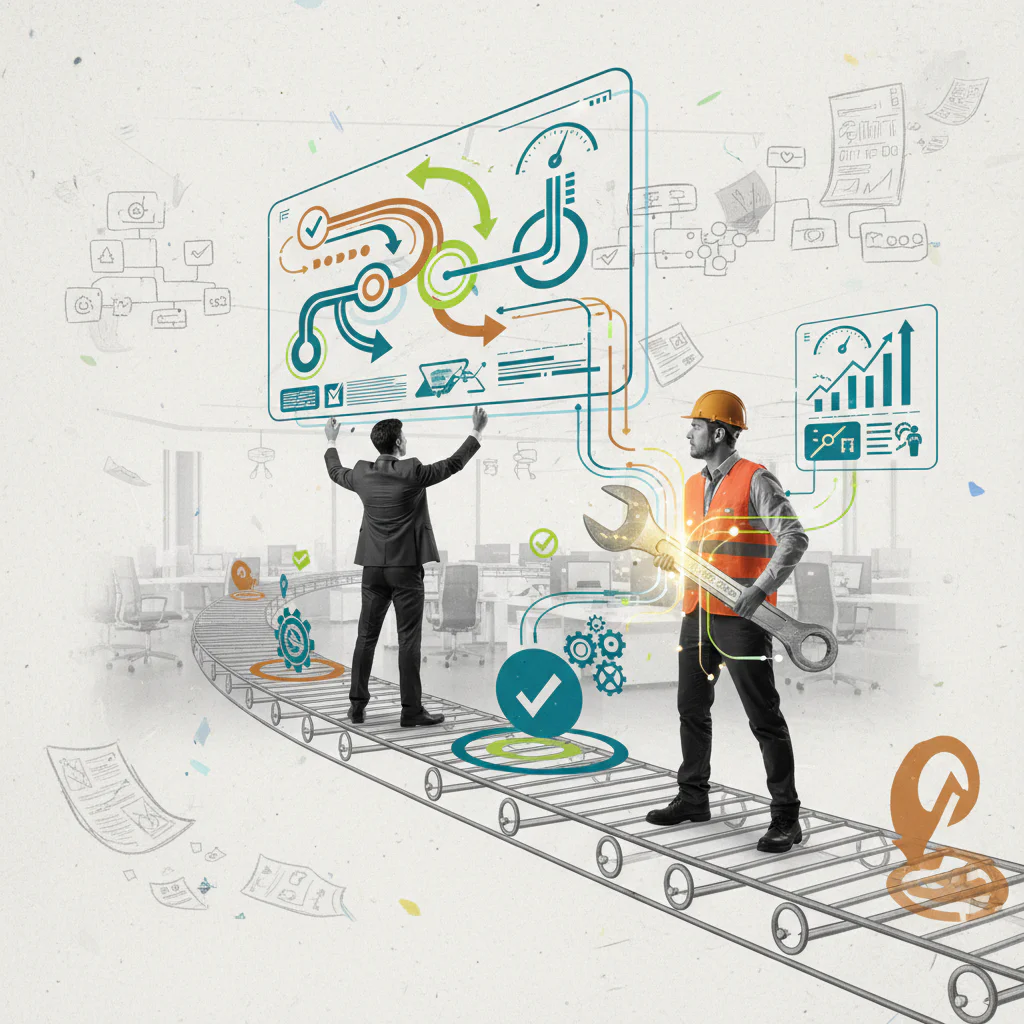
You feel the grind of tangled processes—discover why improvement feels impossible and what really matters.
Imagine a team spread across time zones, each person waiting for the next piece of a project like a baton passed in a relay that never quite reaches the hand of the runner. The friction you feel is not a lack of talent or a missing tool; it is the invisible gap where ownership blurs and visibility fades. When a decision is made in one corner and the execution lives in another, the handoff becomes a guessing game and momentum stalls. I have watched startups scale from a kitchen table to a global operation only to discover that the real bottleneck is the story they tell each other about who is responsible for what. Naming that silent slowdown gives you a lever to pull. In the next section we will trace how the assumption that “someone will take care of it” erodes trust and how a simple shift in language can restore flow.
Why invisible gaps cripple flow
When a remote team passes work like a baton, the moment the hand leaves one person and does not land cleanly in the next, the race stalls. The missing link is rarely a tool or a skill; it is the unspoken assumption about who owns the next step. A startup that grew from a kitchen table to a global operation discovered that every delay traced back to a story they told each other about responsibility. By naming that silent slowdown, leaders gain a lever they can pull. The first lever is visibility: a shared board that shows where each piece sits, who is waiting, and what decision rests in the air. Companies such as Science Exchange illustrate how integrated operational analytics turn that invisible gap into a dashboard of accountability, turning guesswork into a clear path forward.
How a shift in language restores ownership
The phrase someone will take care of it sounds helpful until it becomes a blanket for avoidance. Replacing vague promises with precise statements changes the culture of a workflow. Instead of saying the task will be handled, the team names the person, the deadline, and the expected outcome. This simple linguistic shift creates a contract in the air that people feel compelled to honor. Platforms that enable dynamic process adaptation, like FlowWright, embed that clarity into the system, prompting the right question at the right moment: who is responsible now? The result is a cascade of accountability that restores trust, because each member sees the impact of their commitment and feels the momentum of a relay that never drops the baton.
What data driven feedback loops look like
Continuous monitoring is more than a buzz phrase; it is the heartbeat of a healthy workflow. When each step reports its status, the whole system learns where friction builds and where speed thrives. Operational insight emerges from aggregating those tiny signals into a narrative that guides improvement. A practical example comes from communication hubs such as Moxo, which combine messaging with analytics to surface real time performance data. Teams can ask simple questions: which handoff took longer than expected, which decision point caused a reroute, and how often does a bottleneck repeat? Answering those questions fuels a feedback loop where adjustments are made before the slowdown becomes a crisis. Over time the workflow evolves from a series of isolated actions to an intelligent organism that self corrects, keeping momentum alive and trust intact.
The lingering coordination gap
When work is passed through informal emails, spreadsheets, or ad hoc messages, ownership often becomes unclear and visibility fades. A decision made in one inbox may never be reflected in the execution record, so the next participant works without a reliable signal of what has been approved. This ambiguity persists because there is no shared ledger that records each handoff, no consistent place where responsibility is logged, and no automatic trace that links intent to action. A centralized work system supplies that ledger: it records requests, assignments, status updates, and outcomes in a single source of truth, making the flow of work observable and accountable without requiring manual reconciliation. Workhint, for example, is a centralized work system that embodies this structural approach, linking the moments of coordination to a persistent record. By anchoring work in a common platform, the pattern of hidden gaps diminishes and execution can progress with continuous visibility.
When the grind of tangled processes feels inevitable, the answer is not a new tool but a simple act of naming the gap. By turning the invisible pause into a spoken promise, the team creates a map that anyone can read without guessing. The quiet insight that reshapes flow is this: clarity of ownership is the lever that turns friction into forward motion. Carry that lever with you, and you will watch a chaotic relay become a steady march, each step aware of the next. The work you do now carries a calm certainty that the handoff will land, and that certainty fuels trust. Let the question of why improvement seemed impossible dissolve, and let the small habit of naming responsibility guide every future change.
Leave a Reply