


Vendor compliance breaks down when approval is treated as the finish line instead of the start of ongoing control.
Vendor compliance management is the ongoing process of making sure active suppliers continue to meet the tax, insurance, regulatory, contractual, security, and policy requirements that apply to their work. It starts before onboarding, but the real operating challenge begins after the vendor is live.
Quick answer
Vendor compliance management keeps suppliers compliant throughout the relationship by defining requirements, collecting evidence, assigning owners, monitoring expirations, reviewing changes, and responding when a vendor falls out of compliance. A strong process connects procurement, finance, legal, security, compliance, and the business owner in one auditable workflow.
What’s in this article?
- What vendor compliance management includes
- The difference between onboarding, risk assessment, and compliance management
- A practical cadence for monitoring active vendors
- A checklist for evidence, renewals, exceptions, and audit readiness
- How Workhint fits when vendor compliance work needs to scale
Why vendor compliance management matters
Vendors change after approval. Insurance policies expire, contracts renew, bank details change, certifications lapse, sanctions lists update, ownership changes, and the vendor may start touching new systems or customer data. A vendor that was acceptable at onboarding can become non-compliant six months later without anyone noticing.
That is why vendor compliance cannot live only in an onboarding checklist. It needs a recurring operating process. Amazon Business describes vendor compliance as a systematic way to ensure suppliers meet standards for quality, ethics, financial stability, and performance, with ongoing documentation and monitoring after onboarding. The practical point is simple: compliance status is a living condition, not a one-time approval.
What is vendor compliance management?
Vendor compliance management verifies that each vendor meets the requirements attached to its category, risk tier, contract, location, data access, payment setup, and service scope. Those requirements may include tax forms, certificates of insurance, licenses, code-of-conduct acceptance, privacy terms, cybersecurity evidence, sanctions screening, service levels, and renewal reviews.
It is related to vendor risk management, but it is not identical. Risk management asks, “How risky is this vendor?” Compliance management asks, “Is this vendor currently meeting the requirements we already decided apply?” Both are needed, but they create different workflows.
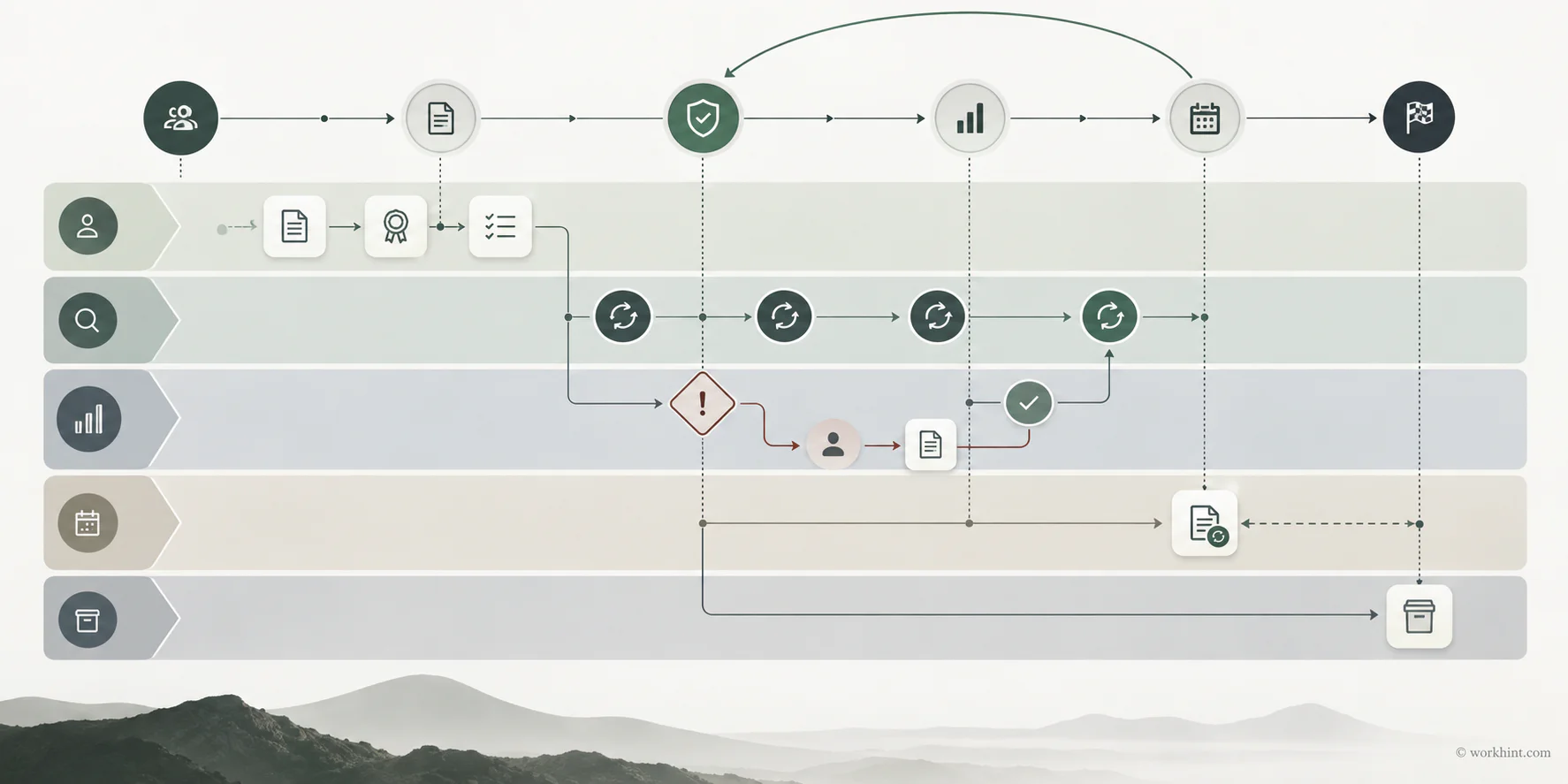
Vendor compliance management cadence
| Cadence | What to check | Typical owner |
|---|---|---|
| At onboarding | Required documents, tax forms, contract clauses, risk tier, payment setup, security review, and approval record | Procurement or vendor management |
| Monthly | Expiring insurance, missing documents, sanctions or restricted-party status, blocked payments, and unresolved exceptions | Compliance, finance, or vendor operations |
| Quarterly | High-risk vendor status, open incidents, performance obligations, access changes, and business owner confirmation | Business owner and risk lead |
| At renewal | Contract terms, policy changes, updated certificates, security evidence, spend level, scope changes, and approval to continue | Legal, procurement, and business owner |
| At offboarding | Access removal, final payments, data return or deletion, document retention, and final compliance record | IT, finance, and vendor owner |
Vendor compliance checklist
A usable vendor compliance checklist should not ask every supplier for the same paperwork. It should route requirements by risk and service type. A low-risk office supply vendor should not follow the same path as a vendor processing customer information or operating inside a regulated environment.
- Define vendor categories. Group vendors by service type, geography, spend, data access, operational criticality, and regulatory exposure.
- Assign required evidence. Decide which documents each category needs, such as W-9 or W-8 forms, certificates of insurance, licenses, SOC 2 reports, security questionnaires, privacy terms, or code-of-conduct acknowledgments.
- Name the internal owner. Every active vendor needs one business owner who can confirm scope, performance, continued need, and escalation decisions.
- Set renewal rules. Track issue dates, expiration dates, review frequency, reminder timing, and what happens if evidence is not renewed.
- Block risky actions when needed. If a required document is missing or expired, decide whether the control blocks onboarding, payment, access, renewal, or only triggers review.
- Record exceptions. Exceptions should show who approved the risk, why, for how long, and what follow-up is required.
- Review at contract renewal. Renewal is the natural moment to confirm whether requirements, scope, access, and risk tier are still correct.
Where compliance often fails
The most common failure is fragmented ownership. Procurement collects the supplier profile, finance owns payment records, legal owns contract terms, security owns access review, and the business owner manages day-to-day performance. If those teams work from separate inboxes and spreadsheets, nobody sees the full compliance state.
The second failure is treating missing evidence as an administrative issue. Some missing documents are minor. Others should stop payment, block system access, pause renewal, or require legal review. The process needs clear severity rules so every overdue item does not become a debate.
The third failure is weak audit history. A compliance team should be able to answer what was required, what was received, who reviewed it, what changed, which exceptions were approved, and what action was taken. If that history is scattered across email threads, audit readiness becomes a cleanup project instead of a normal operating state.
Compliance-sensitive vendor work
Some vendors need deeper controls. If a vendor handles customer information, security and privacy reviews should be tied to the approval workflow. The FTC Safeguards Rule guidance says covered businesses should oversee service providers and require appropriate safeguards by contract. If a vendor relationship creates sanctions risk, teams should use official resources such as the OFAC sanctions lists and keep a record of screening results. Requirements vary by company, industry, and country, so legal or compliance counsel should review higher-risk programs.
Where Workhint fits
Workhint helps teams turn vendor compliance management into a live operating system instead of a shared spreadsheet. A team can use vendor management software to route vendor intake, assign document owners, collect evidence, trigger approvals, set renewal reminders, escalate missing items, track exceptions, and keep the audit trail connected to the vendor record.
The useful part is not just storing files. It is connecting the work around the files: who requested the vendor, which risk tier applies, which reviewers are required, whether payments or access should be blocked, and what needs to happen before renewal.
FAQ
What is vendor compliance management?
Vendor compliance management is the ongoing process of verifying that active vendors meet the tax, insurance, regulatory, contractual, security, and internal policy requirements that apply to them.
Who owns vendor compliance management?
Ownership is usually shared across procurement, finance, legal, security, compliance, and the business owner. The process works best when each step has a task owner and every vendor has one accountable relationship owner.
What documents are usually tracked?
Common records include tax forms, insurance certificates, contracts, licenses, security questionnaires, privacy terms, certifications, sanctions screening evidence, and code-of-conduct acknowledgments. The exact list should depend on vendor risk and service type.
How often should vendor compliance be reviewed?
High-risk vendors should be reviewed more often than low-risk vendors. Many teams use monthly exception checks, quarterly high-risk reviews, annual document refreshes, and full reassessment at contract renewal.
Conclusion
Vendor compliance management is not just a checklist. It is the operating rhythm that keeps approved suppliers current, documented, monitored, and accountable. The strongest process defines requirements by vendor type, assigns clear owners, tracks evidence over time, escalates exceptions, and preserves a clean audit history. That is what turns vendor compliance from a last-minute scramble into normal operational control.
Leave a Reply