


A good statement of work turns vague project intent into deliverables, approval rules, payment terms, and a shared delivery record.
A statement of work template helps a business define what a contractor, vendor, agency, or service provider will deliver before work begins. It is useful because it forces the hard questions early: what is in scope, what is excluded, who approves the work, when deliverables are due, how changes are handled, and when payment is released.
Stanford’s procurement guidance describes a statement of work as the contract document that captures business terms such as price, timing, scope, and the work performed by a supplier or independent contractor. Government contracting guidance from Acquisition.gov also highlights practical SOW elements such as work description, location, period of performance, deliverable schedule, performance standards, and special requirements.
What’s included
- A practical statement of work template
- Guidance on how to use each section
- An example approval workflow
- Common mistakes to avoid
- Where Workhint fits
- Frequently asked questions
How to use this statement of work template
Use this template before a project starts, not after work is already moving. The project owner should draft the business need and deliverables. Legal or procurement should review terms. Finance should confirm budget and payment terms. The vendor or contractor should confirm the scope, timeline, assumptions, and acceptance criteria.
The strongest SOWs focus on outcomes. Federal Acquisition Regulation guidance for performance work statements says work should be described in terms of required results rather than how the work is performed whenever practical. That principle applies well outside government: describe what must be delivered, not every hour-by-hour activity.
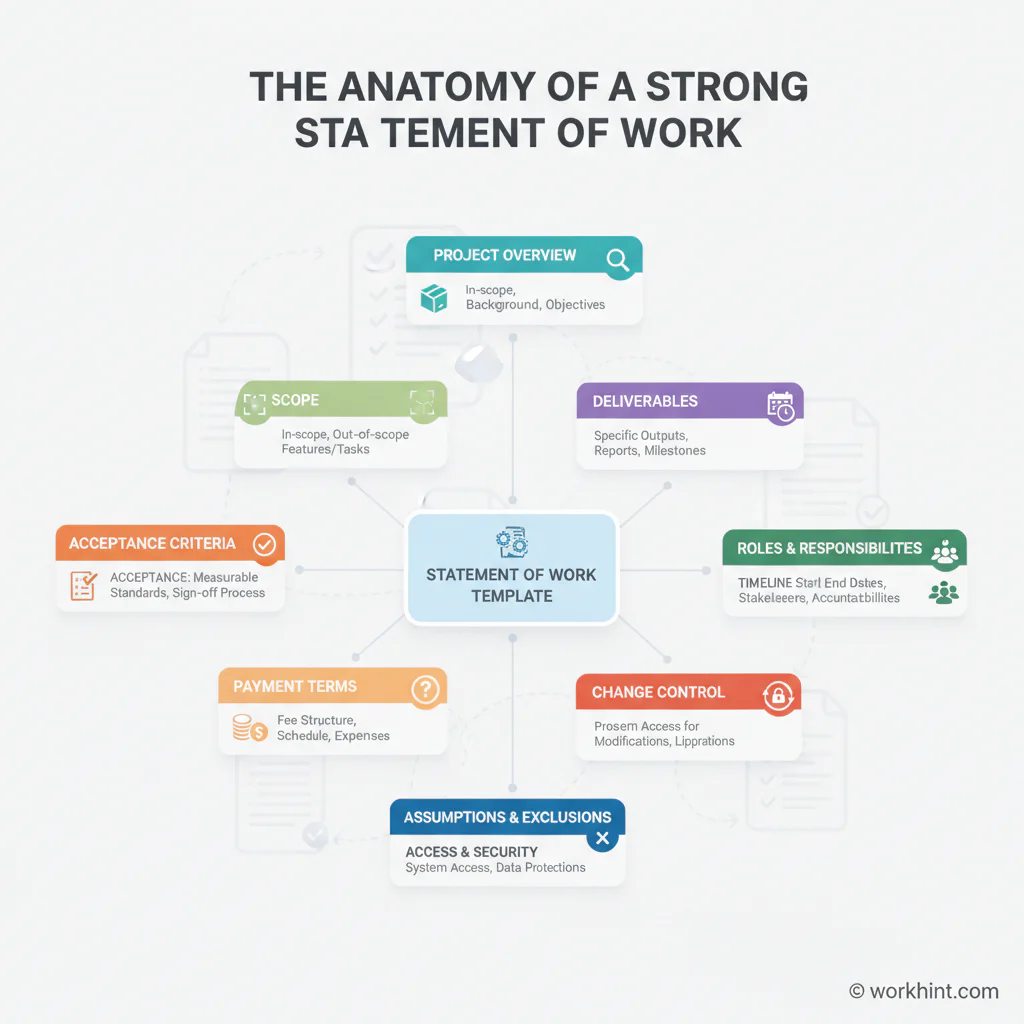
Statement of Work Template
Copy this structure into your document, contract request, vendor portal, or project intake process.
| Section | What to include | Why it matters |
|---|---|---|
| Project overview | Project name, business goal, background, and stakeholders. | Explains why the work exists and who needs the outcome. |
| Scope of work | Specific services, tasks, or outcomes the provider is responsible for. | Prevents disagreement over what the provider was hired to do. |
| Deliverables | Concrete outputs, format, quantity, quality expectations, and due dates. | Makes the work reviewable instead of subjective. |
| Acceptance criteria | How each deliverable will be reviewed, accepted, revised, or rejected. | Creates a fair rule for completion and payment approval. |
| Timeline | Start date, milestones, review windows, final deadline, and dependencies. | Shows when decisions and inputs are needed. |
| Roles and responsibilities | Provider owner, client owner, reviewers, approvers, and escalation contact. | Stops work from stalling when nobody knows who decides. |
| Payment terms | Fee, currency, invoice timing, expense rules, and payment triggers. | Connects payment to accepted work, milestones, or approved time. |
| Assumptions and exclusions | What is assumed, what is not included, and what requires a change request. | Reduces scope creep and surprise obligations. |
| Access and security | Systems, data, permissions, confidentiality, and access end date. | Limits unnecessary exposure and supports clean offboarding. |
| Change control | How scope, timeline, price, or deliverables can be changed. | Gives both sides a way to adjust without creating confusion. |
The University of Mississippi Medical Center SOW template emphasizes that an SOW should include enough detail for someone familiar with the project to determine whether the agreed work was delivered or performed. That is a useful quality test: if a reviewer cannot tell whether the work is complete, the SOW is still too vague.
Example approval workflow
- Step 1: Project owner drafts the business need, deliverables, timeline, and acceptance criteria.
- Step 2: Vendor or contractor confirms scope, assumptions, exclusions, and dependencies.
- Step 3: Legal or procurement reviews contract language, confidentiality, IP, and termination terms.
- Step 4: Finance reviews budget, payment triggers, tax requirements, and invoice routing.
- Step 5: IT or security reviews tool access, data exposure, and access removal date.
- Step 6: Approvers sign, the work starts, and the SOW becomes the reference for delivery reviews.
Common mistakes
The most common mistake is writing an SOW that sounds complete but cannot be used to manage delivery. Phrases like “support marketing,” “improve operations,” or “build dashboard” are too broad unless they include specific outputs and acceptance criteria.
Another mistake is leaving payment disconnected from delivery. If the vendor invoices monthly, define what must be reported each month. If payment depends on milestones, define what counts as milestone completion. If expenses are reimbursable, define what requires approval first.
Finally, do not forget access and offboarding. If the provider needs systems, customer data, documents, or internal channels, the SOW should name what access is needed and when it ends.
Where Workhint fits
Workhint fits when a statement of work needs to become more than a document. A team can turn the SOW into a live workflow with intake, document collection, legal review, finance approval, access requests, deliverable tracking, milestone approvals, invoice routing, and offboarding.
For example, the project owner can submit the SOW request, the vendor can complete scope details, legal can review terms, finance can approve payment rules, and IT can grant project-scoped access. Once work begins, deliverables, approvals, issues, change requests, and payment status can stay connected to the original SOW instead of spreading across email, PDFs, spreadsheets, and chat threads.
FAQ
What is a statement of work?
A statement of work is a project document that defines the work to be performed, deliverables, timeline, payment terms, responsibilities, and acceptance criteria between a client and a provider.
Is a statement of work the same as a contract?
Not always. An SOW is often attached to or incorporated into a contract, master services agreement, vendor agreement, or purchase order. Ask legal or procurement how your organization treats it.
What should a statement of work template include?
It should include project overview, scope, deliverables, acceptance criteria, timeline, roles, payment terms, assumptions, exclusions, access requirements, and change control.
Who should write the SOW?
The project owner should draft the business scope and deliverables. Legal, procurement, finance, IT, and the vendor should review the sections they own before approval.
How detailed should an SOW be?
Detailed enough that a reviewer can tell whether the work was delivered, but not so prescriptive that it controls every method the provider uses unless that level of direction is necessary.
Conclusion
A statement of work template is useful only if it helps people make better decisions before work starts. The best SOWs define the outcome, deliverables, acceptance criteria, timeline, owners, payment rules, exclusions, access, and change process. That gives the client, provider, and internal approvers one shared reference for doing the work, reviewing it, and paying for it cleanly.
Leave a Reply