


A business operating system turns strategy into a rhythm people can actually run every week.
A business operating system is the set of priorities, roles, workflows, metrics, meetings, decisions, and improvement loops that make a company run consistently. It is not a slide deck, a meeting schedule, or a software tool by itself. It is the practical system that tells people what matters, who owns what, how work moves, where decisions happen, and how performance is reviewed.
The term is often associated with EOS, which describes six components of a business: vision, people, data, issues, process, and traction. That framing is useful, but the stronger question for operators is more concrete: how do you turn those ideas into a working company rhythm?
What’s in this article?
- What a business operating system includes
- How to design one without making it bureaucratic
- A practical framework for priorities, workflows, metrics, decisions, and meetings
- Common mistakes that make operating systems fail
- Where Workhint fits when the system needs to become live software
Why a business operating system matters
Companies usually do not break because nobody works hard. They break because work moves through different informal systems: goals in one tool, tasks in another, approvals in email, decisions in meetings, process notes in documents, and metrics in dashboards nobody trusts. The result is execution drift. Teams are busy, but the company cannot reliably answer what is most important, who is accountable, what is blocked, and what changed.
McKinsey’s research on agile organizations emphasizes the need for both a stable backbone and dynamic capability. That is a good way to think about a business operating system. The stable backbone defines the rules of execution. The dynamic layer lets teams adapt without reinventing the company every quarter.
Business operating system framework
A useful business operating system has seven connected layers. Each layer should be simple enough to explain in one page, but specific enough that a team can run work from it.
| Layer | Operating question | Output |
|---|---|---|
| Direction | What are we trying to achieve? | Company priorities, OKRs, or goals |
| Ownership | Who is accountable? | Role map, owner list, escalation paths |
| Workflow | How does work move? | Intake, routing, approvals, handoffs |
| Decisions | Where are choices made? | Decision rights, forums, logs |
| Metrics | How do we know if it works? | Scorecards, health metrics, leading indicators |
| Cadence | When do we inspect and adjust? | Weekly, monthly, and quarterly rhythms |
| Improvement | How does the system get better? | Issue review, retrospectives, process updates |
Start with priorities, not meetings
Many teams try to fix execution by adding meetings. That usually makes the system heavier without making it clearer. Start with the smallest set of priorities the company must protect. OKRs can help because they connect an objective to measurable key results, but the naming matters less than the discipline: every major priority needs an owner, a metric, a review rhythm, and a workflow for the work required to move it.
For each priority, define what will be different in 90 days, what metric proves progress, what tradeoffs are allowed, and what workstreams support it. If a priority cannot be connected to weekly work, it is not yet operational.
Map ownership before mapping process
Processes fail when ownership is vague. Before documenting steps, identify the role that owns the outcome, the people who do the work, the approver who can make tradeoffs, and the teams that must be informed. Atlassian’s DACI framework is useful here because it separates driver, approver, contributors, and informed stakeholders. That prevents a common operating-system failure: everyone is involved, but nobody can decide.
Do this for the work that matters most: customer delivery, hiring, onboarding, vendor approvals, finance requests, product decisions, incident response, and recurring executive reviews. The goal is not to create a perfect org chart. The goal is to remove ambiguity at the points where work slows down.
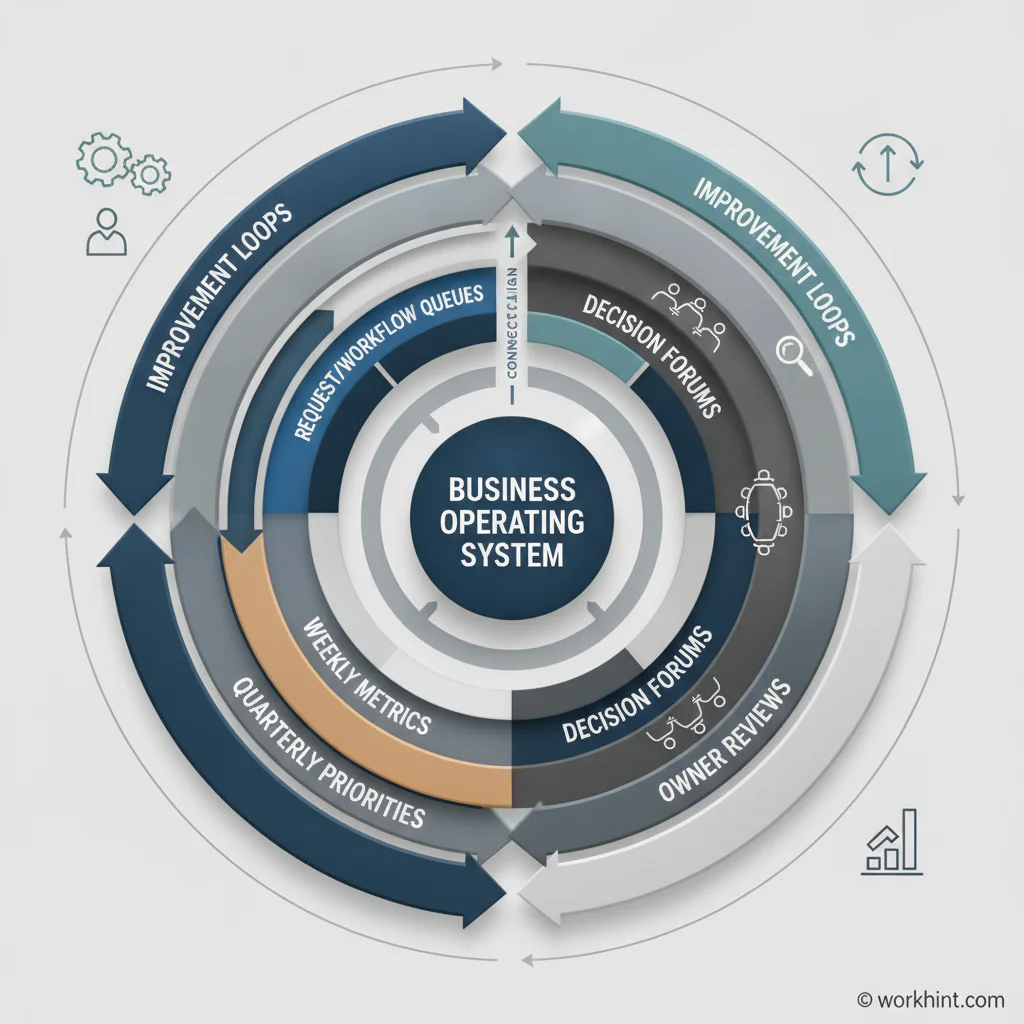
Build the operating cadence
The operating cadence is the heartbeat of the system. It defines when work is planned, reviewed, escalated, and improved. A practical cadence usually has four levels.
- Daily or live flow: Requests, tasks, assignments, approvals, and blockers move through the system as work happens.
- Weekly review: Owners inspect metrics, blockers, aging work, and priority movement.
- Monthly operating review: Leaders review patterns, capacity, handoffs, risks, and process changes.
- Quarterly reset: The company updates priorities, owners, metrics, and operating rules.
The cadence should reduce surprise. If the first time a blocker appears is in a quarterly review, the system is too slow. If every problem requires a new meeting, the system is too vague.
Connect metrics to workflows
A business operating system needs metrics that describe the work, not just the financial outcome. Revenue, margin, and retention matter, but operators also need cycle time, approval time, backlog age, handoff quality, completion rate, capacity, rework, and escalation volume. These are the signals that show where execution is improving or degrading.
Each metric should connect to a workflow owner. If approval time is too slow, who can change the approval path? If request volume exceeds capacity, who can adjust routing or staffing? If rework is rising, who updates the intake form, SOP, or quality check? Metrics without ownership become decoration.
Common mistakes
- Copying a framework without adapting it: EOS, OKRs, scorecards, and operating rhythms are useful, but your company still needs its own work paths and decision rights.
- Documenting processes that are not enforced: A process nobody uses is just a document. Put key steps into the actual workflow.
- Using meetings as the system: Meetings review the system. They should not be the only place the system exists.
- Tracking too many metrics: Start with the few measures that expose priority movement, bottlenecks, quality, and capacity.
- Skipping improvement loops: Every operating system needs a way to update itself when the work changes.
Where Workhint fits
Workhint fits when the business operating system needs to move from documents and meetings into a live operational system. A team can describe the work challenge, then structure the users, roles, workflows, permissions, intake paths, assignments, approvals, dashboards, reminders, and reporting needed to run the system.
That matters because a business operating system is only useful if people can act inside it. Workhint helps turn the operating model into connected workflows: request intake routes to the right owner, approvals follow the right path, metrics reflect live work, and review rhythms are tied to actual execution data rather than manual status chasing.
FAQ
What is a business operating system?
A business operating system is the practical structure a company uses to turn strategy into execution. It includes priorities, roles, workflows, decision rights, metrics, meetings, and improvement loops.
Is a business operating system the same as EOS?
No. EOS is one well-known business operating system framework. A company can use EOS, adapt parts of it, or build its own system around its operating model, workflows, and cadence.
What should a business operating system include first?
Start with company priorities, accountable owners, core workflows, decision rights, operating metrics, and a weekly review rhythm. Add more structure only when the system needs it.
How do you know if the system is working?
You should see fewer unclear owners, faster decisions, cleaner handoffs, earlier blocker detection, more trusted metrics, and a clearer connection between strategic priorities and weekly work.
Conclusion
A business operating system is not about adding management theater. It is about making execution repeatable. The strongest systems connect direction, ownership, workflows, decisions, metrics, cadence, and improvement into one rhythm. Start small, make the work visible, assign real owners, and review the system often enough that it keeps pace with the company.
References: EOS Worldwide on the EOS Model (https://www.eosworldwide.com/eos-model), McKinsey on agile organizations (https://www.mckinsey.com/capabilities/people-and-organizational-performance/our-insights/the-five-trademarks-of-agile-organizations), Atlassian on DACI (https://www.atlassian.com/team-playbook/plays/daci), and What Matters on OKRs (https://www.whatmatters.com/faqs/okr-meaning-definition-example).
Leave a Reply