


International contractors can expand capacity quickly, but only if hiring, onboarding, payment, and compliance live in one disciplined workflow.
Learning how to hire international contractors is no longer a niche HR question. Companies use contractors across engineering, design, research, support, operations, marketing, finance, implementation, and field work because the right specialist may not live near headquarters. The appeal is speed and flexibility. The risk is treating cross-border hiring like a domestic freelance agreement with a different address.
An international contractor relationship touches local labor rules, tax documentation, scope control, currency, security, intellectual property, data access, and payment timing. This is not legal or tax advice; the practical goal is a repeatable workflow operators can use before work begins.
What’s in this article?
- A practical hiring workflow for international contractors
- The documents and decisions to settle before work starts
- An ownership table for HR, legal, finance, IT, and operations
- Common mistakes around payment, access, and classification
Why international contractor hiring needs a workflow
Cross-border work is growing because companies can reach specialized talent without opening every role as a full-time local hire. But the operating burden also rises. Stanford’s global hiring guidance notes that hiring and paying individuals in foreign countries can require understanding local laws and may create a local presence concern.
The IRS also separates worker status questions from payment paperwork. For U.S. businesses, the IRS explains that worker classification depends on behavioral control, financial control, and the relationship of the parties. For foreign payees, IRS W-8 forms help document foreign status when requested by the payer or withholding agent.
That is why the best process starts before sourcing. The team should know what work is being contracted, whether contractor status is appropriate, who approves the engagement, which documents are required, how access will be limited, and how invoices will be paid.
How to hire international contractors
Use this sequence before the first assignment is issued.
1. Define the work as an outcome, not a role
A contractor engagement should start with a defined business outcome: build a landing page, translate a help center, review onboarding calls, implement a workflow, or deliver field inspections. Avoid writing the scope like an employee job description with open-ended duties, fixed internal hours, and manager-controlled daily work.
2. Check whether contractor status is appropriate
Before making an offer, route the proposed engagement through a classification review. The U.S. Department of Labor’s economic reality guidance focuses on whether the worker is economically dependent on the employer or in business for themself. Different countries use different tests, so define the contractor’s independence, scope, payment basis, tools, and deliverables before work begins.
3. Choose the engagement path
Some companies contract directly with the individual. Others use an agent-of-record, employer-of-record, staffing firm, or local partner when the country, duration, role, or compliance burden is higher. Direct contracting can be efficient for low-risk project work; a managed route may fit long-term, sensitive, or unfamiliar country contexts.
4. Prepare the agreement and statement of work
The agreement should cover confidentiality, intellectual property, data handling, payment terms, termination, dispute process, governing law where appropriate, and required documents. The statement of work should define deliverables, milestones, acceptance criteria, review windows, ownership, and invoice triggers.
5. Collect tax, identity, payment, and compliance documents
For U.S. payers, foreign contractor documentation often includes the appropriate W-8 form rather than a W-9. The IRS says Form W-8BEN is submitted when requested by the withholding agent or payer to certify foreign status. Finance or tax advisors should decide which forms apply.
6. Provision access by role and end date
International contractors often work remotely and across time zones, so access needs to be precise. Give only the systems, files, channels, and customer data needed for the assignment. Set an access end date and assign an internal revocation owner.
7. Run the work through milestones, approvals, and payment status
The management layer should be built around milestones, not constant supervision. Contractors need clear outcomes, reference materials, deadlines, review points, and invoice rules. Internal teams need visibility into whether work is blocked, submitted, approved, disputed, or ready for payment.
International contractor hiring checklist
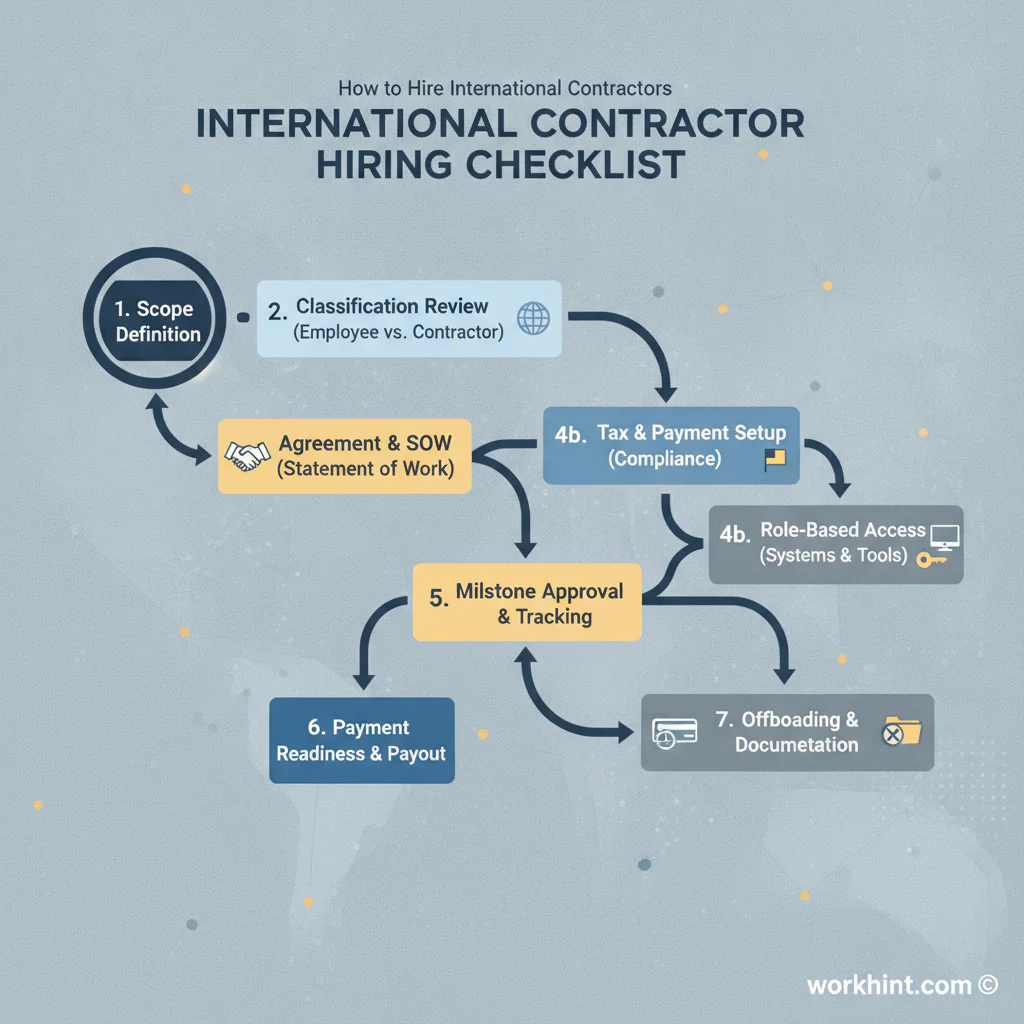
| Step | Owner | What must be true before work starts |
|---|---|---|
| Scope definition | Hiring manager or operations | Deliverables, milestones, acceptance criteria, and start date are documented |
| Classification review | Legal, HR, or people operations | Contractor status is appropriate for the work and country context |
| Agreement and SOW | Legal and business owner | IP, confidentiality, termination, payment, and deliverable terms are signed |
| Tax and payment setup | Finance | Required tax forms, invoice details, currency, payout method, and approval flow are captured |
| Access provisioning | IT or systems owner | Role-based access is granted with an end date and revocation owner |
| Work activation | Project owner | Contractor has the brief, communication path, review cadence, and payment triggers |
Common mistakes to avoid
The first mistake is starting work before the agreement, SOW, and payment setup are complete. That creates avoidable disputes when the contractor invoices or submits work that was never clearly accepted.
The second mistake is managing contractors like employees. Daily schedule control, internal-only tools, open-ended duties, and manager-directed methods can weaken the business case for contractor status. Focus on outcomes, acceptance criteria, and review points.
The third mistake is separating onboarding from payments. If finance does not receive the right tax and banking information early, the contractor may finish the work before the company can pay them cleanly. That damages trust and creates unnecessary operational noise.
The fourth mistake is forgetting offboarding. International contractors may retain access to code repositories, customer files, shared drives, analytics tools, or finance systems long after the engagement ends. Tie offboarding to the contract end date, final approval, and final payment status.
Where Workhint fits
Workhint fits when international contractor hiring needs to become a repeatable operating system instead of a chain of email threads. A team can use Workhint to turn the hiring workflow into role-based intake, classification review, document collection, agreement routing, access requests, milestone tracking, approvals, payment readiness, reminders, reporting, and offboarding.
That matters most when multiple teams share responsibility. HR or operations may own onboarding, legal may own agreement review, finance may own payment setup, IT may own access, and the business owner may own deliverable approval. Workhint gives those owners one workflow around the contractor relationship, so the company can move quickly without losing visibility.
FAQ
Can a U.S. company hire an international contractor?
Yes, but the company should confirm that contractor status is appropriate, use a clear agreement, collect the right tax and payment documentation, and understand country-specific labor, tax, and data requirements before work starts.
What documents are usually needed for international contractors?
Common documents include a contractor agreement, statement of work, confidentiality or IP terms, tax status documentation, identity or business verification where appropriate, payment details, and any country- or industry-specific compliance documents.
Should international contractors be paid hourly or by milestone?
Either can work, but milestone-based payment is often cleaner for project work because it connects compensation to deliverables and acceptance criteria. Hourly work requires clearer controls around invoices, approvals, and contractor status.
How do companies reduce misclassification risk with global contractors?
They define the scope as an independent business outcome, avoid employee-style control, document the relationship, review local rules, and use qualified legal or tax advice for higher-risk countries or long-running engagements.
Conclusion
Hiring international contractors works best when the company treats it as an operating workflow, not just a sourcing shortcut. Define the outcome, review classification, sign the right documents, collect tax and payment information, provision limited access, manage by milestones, and offboard cleanly.
The companies that scale this well are not the ones with the longest checklist. They make the checklist enforceable, visible, and connected to real work. That is the difference between hiring global talent and building a contractor operation the business can trust.
Leave a Reply