


Use this interview scorecard template to compare candidates on evidence, not memory, confidence, or interviewer preference.
An interview scorecard template gives every interviewer the same structure for evaluating candidates. Instead of writing scattered notes and debating vague impressions later, the hiring team agrees on job-related competencies, asks consistent questions, scores responses against defined anchors, and records the evidence behind each rating.
This resource is for founders, HR teams, operations leaders, and hiring managers who need a practical scorecard they can adapt quickly. It is not legal advice. If your hiring process is regulated, high-volume, unionized, or under audit, review your interview materials with qualified HR or legal counsel.
What’s included
- A practical interview scorecard template you can adapt for most business roles.
- A five-point scoring scale with evidence-based rating anchors.
- A simple weighting model for must-have competencies.
- Guidance for using the scorecard before, during, and after interviews.
- Common mistakes that make interview feedback less useful or harder to defend.
Why structured interview scorecards matter
Hiring interviews are easy to overtrust because they feel direct and personal. The problem is that unstructured interviews often reward confidence, similarity, recency, and storytelling more than job fit. The U.S. Office of Personnel Management describes structured interviews as a way to measure job-related competencies by asking candidates about past behavior or hypothetical situations through a standardized process.
The scorecard is the operating layer of that process. It turns the interview plan into a comparable record. The EEOC’s private-sector employer best practices recommend structuring interviews to reduce subjectivity, standardizing questions as much as possible, and avoiding inappropriate questions or comments about protected characteristics. A good scorecard supports that discipline without making the conversation robotic.
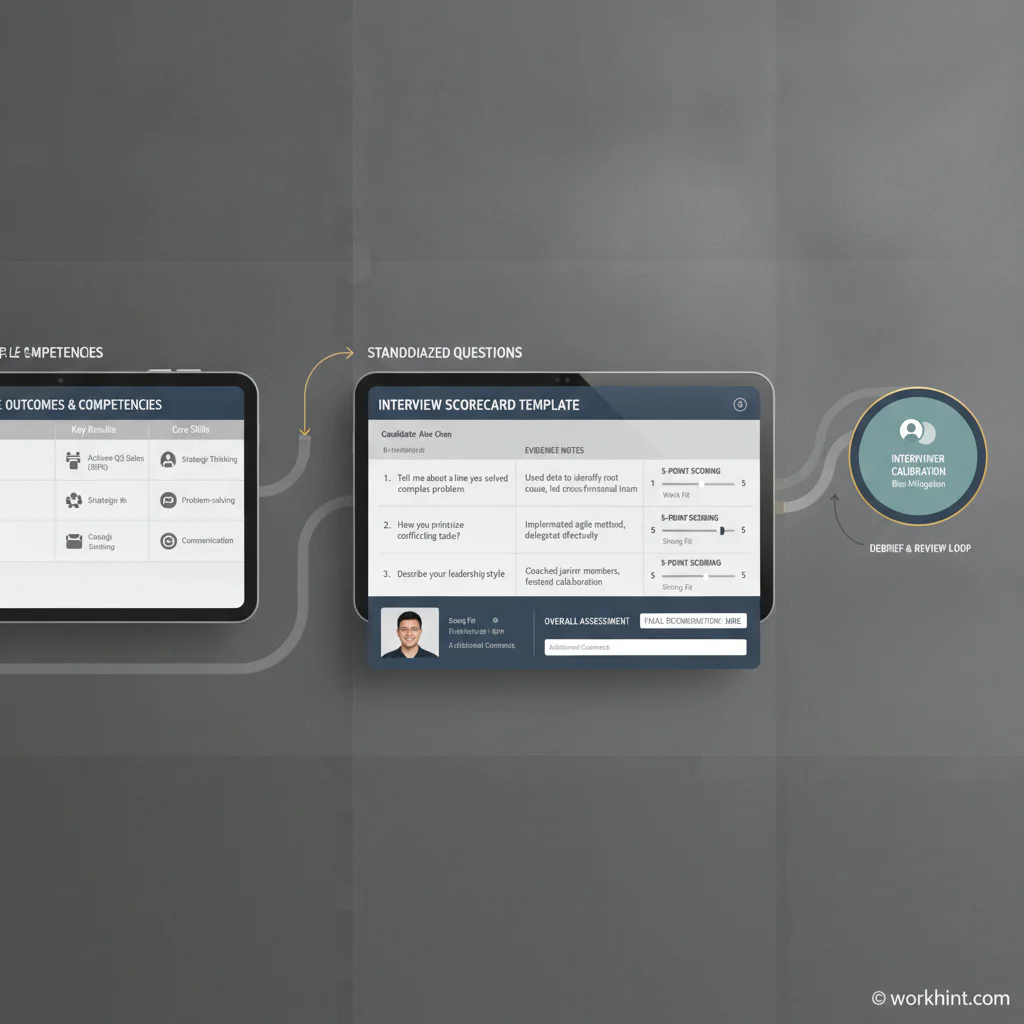
Interview scorecard template
Use one scorecard per candidate per interview stage. Keep the criteria tied to the role, not to a generic idea of a “great person.” Before interviews begin, decide which competencies are required, which are helpful, and which interviewer owns each area.
| Scorecard field | What to enter | Example |
|---|---|---|
| Role and stage | Job title, team, interview stage, and interviewer name. | Operations Manager, panel interview, interviewer: COO. |
| Competency | The job-related skill, behavior, or knowledge being assessed. | Prioritization, stakeholder communication, workflow design. |
| Question | The structured question or prompt asked of every candidate at this stage. | Tell me about a time you fixed a recurring operational bottleneck. |
| Evidence notes | Specific examples, facts, tradeoffs, metrics, and follow-up answers. | Mapped intake queue, reduced approval delay from six days to two. |
| Score | Numerical rating using the agreed scale. | 4 out of 5. |
| Concern or risk | Specific job-related uncertainty to validate, not personal opinion. | Limited experience managing contractors across time zones. |
| Recommendation | Advance, hold, decline, or needs calibration. | Advance if contractor operations can be validated in reference call. |
Scoring scale
Use a simple five-point scale and define the anchors before interviews begin. OPM’s structured interview scoring guidance recommends basing scores on proficiency levels and documenting any reason for weighting competencies differently. That is the right principle for business hiring too: make the scoring method clear before the candidate walks in.
| Score | Anchor | How to interpret it |
|---|---|---|
| 1 | Does not meet requirement | No relevant evidence, answer avoids the competency, or examples conflict with role needs. |
| 2 | Partially meets requirement | Some exposure, but examples are shallow, highly assisted, or missing key ownership. |
| 3 | Meets requirement | Clear evidence the candidate can perform the competency in normal conditions. |
| 4 | Strong evidence | Specific examples show independent judgment, measurable results, and transferable experience. |
| 5 | Exceptional evidence | Candidate has solved similar problems at higher complexity and can explain repeatable methods. |
How to use the scorecard
- Define the role outcomes first. List what the person must deliver in the first 90 to 180 days. Do not start with personality traits.
- Choose three to six competencies. More than six usually creates noisy scoring. For each competency, write one primary question and one follow-up prompt.
- Assign interview ownership. Avoid five interviewers all scoring the same vague areas. Give each interviewer a clear lane.
- Score independently before discussion. Each interviewer should submit scores and evidence notes before the debrief, so the loudest voice does not anchor the group.
- Calibrate with evidence. In the debrief, compare examples, not feelings. Ask, “What did the candidate say or demonstrate that supports this score?”
- Record the decision rule. Decide whether a candidate must meet a minimum score on must-have competencies, an average score overall, or both.
Example scorecard for an operations manager
| Competency | Question | Weight | Score |
|---|---|---|---|
| Workflow design | Describe a process you redesigned from intake to completion. | 30% | 1-5 |
| Cross-functional communication | Tell me about a time two teams disagreed on ownership. | 20% | 1-5 |
| Data-driven execution | What metric did you use to know the process improved? | 20% | 1-5 |
| Escalation judgment | Give an example of a problem you escalated early. | 15% | 1-5 |
| People coordination | How have you coordinated contractors, vendors, or distributed teams? | 15% | 1-5 |
Common mistakes
- Scoring likeability instead of job evidence. Warmth matters in many roles, but it should be evaluated through job-related behaviors such as communication clarity or customer judgment.
- Changing questions candidate by candidate. Follow-ups are fine, but the core questions should stay consistent enough for fair comparison.
- Using undefined numbers. If a 4 means something different to every interviewer, the scorecard becomes decoration.
- Skipping notes. Scores without evidence are hard to calibrate later and do not help the hiring team learn.
- Overweighting culture fit. Replace vague culture fit with specific working behaviors, such as feedback style, operating cadence, or customer judgment.
Where Workhint fits
A scorecard is useful as a document, but hiring teams usually need a live workflow around it. Workhint helps organizations turn the scorecard into an AI-assisted work system with role-specific interview stages, interviewer assignments, candidate intake, permissions, due dates, structured feedback collection, debrief routing, approvals, and reporting.
That matters when hiring involves multiple managers, external recruiters, contractors, regional teams, or repeatable operational roles. Instead of chasing scorecards in documents and messages, the team can run the interview process from a shared system where evidence, decisions, and next steps stay connected.
FAQ
What is an interview scorecard?
An interview scorecard is a structured evaluation form used to rate candidates against predefined job-related competencies. It usually includes questions, rating scales, evidence notes, risks, and a recommendation.
How many competencies should an interview scorecard include?
Most business roles work best with three to six competencies per interview stage. If the list is longer, split ownership across stages or interviewers instead of making every interviewer evaluate everything.
Should every candidate get the same questions?
The core questions should be consistent for candidates applying to the same role and stage. Interviewers can ask relevant follow-ups to clarify details, but the main evaluation criteria should remain stable.
Can interview scorecards reduce bias?
They can help when they are tied to job requirements, used consistently, and supported by interviewer training. A scorecard does not remove bias by itself, but it creates a better structure for evidence-based hiring decisions.
Should scores be weighted?
Only weight scores when the business reason is clear. If one competency is essential to success, document why it has more weight. If there is no clear reason, equal weighting is usually easier to explain and maintain.
Conclusion
An interview scorecard template is not about making hiring mechanical. It is about giving the hiring team a better memory, a fairer comparison method, and a clearer decision record. Start with the role outcomes, define the competencies, use consistent questions, score against evidence, and calibrate before making the final call.
Leave a Reply