


A training plan works best when it connects learning, practice, ownership, and proof of readiness.
A training plan template helps a business turn required learning into a clear operating plan: what people need to learn, who owns the training, when it happens, how progress is checked, and what evidence proves the person is ready to do the work.
Use this resource for new hire training, role-specific training, compliance learning, manager enablement, software rollouts, customer service standards, field operations, vendor onboarding, or any repeatable process where inconsistent training creates risk.
What’s included
- A practical training plan template you can copy into a document, spreadsheet, or workflow
- A simple method for choosing learning objectives and completion evidence
- An example training plan for a customer operations role
- Common mistakes that make training plans hard to use
- FAQ for managers, HR teams, and operations leaders
How to use this training plan template
Start with the business outcome, not the training content. A useful plan answers one question: what should the employee be able to do differently after the training? That may be resolving customer tickets, operating equipment safely, approving invoices correctly, following a compliance process, using a new system, or handling a service workflow without constant manager support.
For complex programs, use the plan as a living workflow rather than a one-time document. The Association for Talent Development’s overview of ADDIE describes analysis, design, development, implementation, and evaluation as a structured way to build training. You do not need to make every plan formal, but you should analyze the need before building sessions.
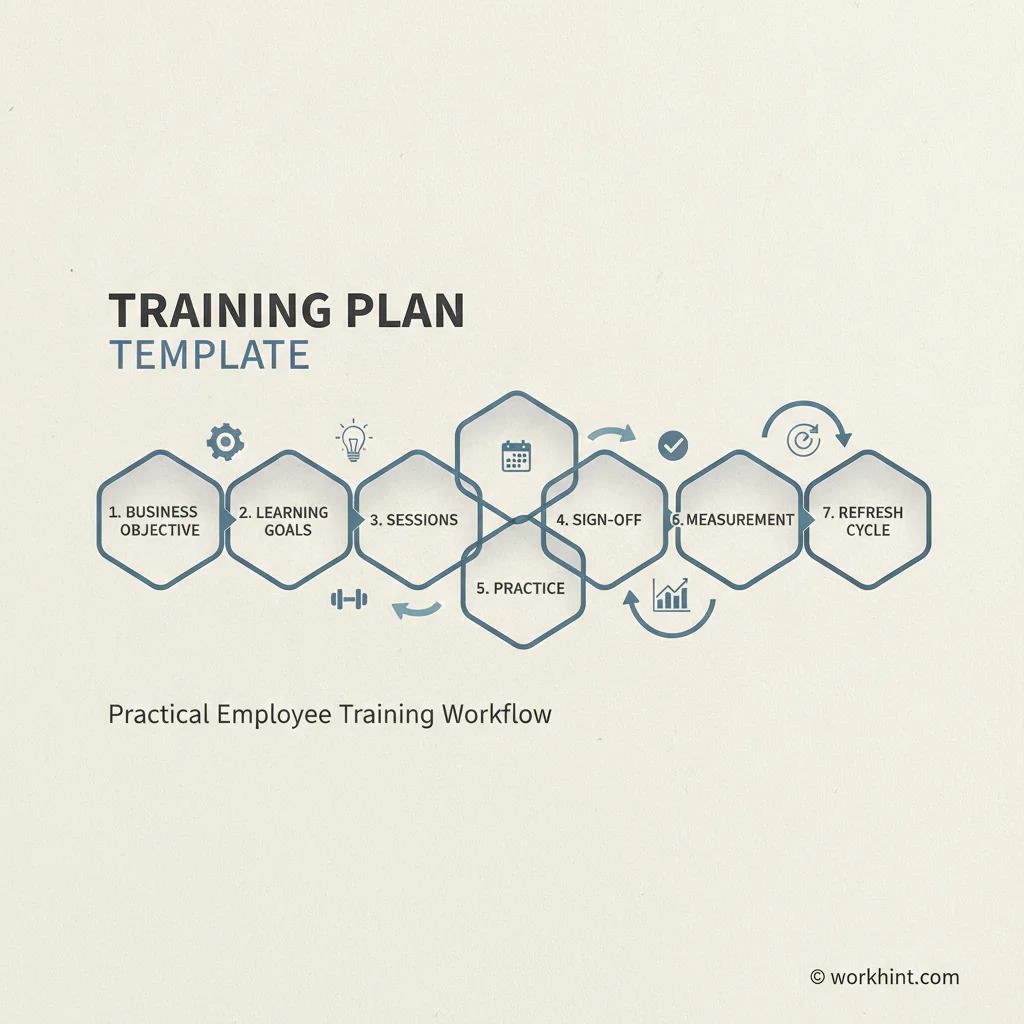
Training plan template
| Field | What to write | Example |
|---|---|---|
| Training name | Clear title for the program or module | Customer Operations Ticket Resolution |
| Audience | Role, team, location, seniority, or worker type | New customer operations associates |
| Business objective | The operating result the training supports | Resolve standard support tickets within service targets |
| Learning objectives | Three to five measurable capabilities | Classify issue type, use macros, escalate exceptions |
| Training owner | Person accountable for content and completion | Customer operations manager |
| Delivery method | Live session, self-study, shadowing, practice, job aid, or blended | Self-study, shadowing, simulated tickets, manager review |
| Schedule | Dates, duration, sequence, and deadlines | Days 1-5, with sign-off by end of week one |
| Resources | Documents, videos, SOPs, systems, examples, and access needed | Support SOP, help center, CRM sandbox, escalation policy |
| Practice activity | Task that proves the learner can apply the material | Resolve five sample tickets and explain escalation choices |
| Completion evidence | What gets reviewed, stored, or approved | Manager scorecard, completed simulation, system access log |
| Success metric | How the business checks whether training worked | First response quality, rework rate, ticket aging, escalation accuracy |
| Refresh cycle | When the training is reviewed or repeated | Quarterly, or when the workflow changes |
What makes a training plan practical
A practical training plan has a clear owner, a real work outcome, and a way to prove readiness. Avoid building a plan around content alone. A folder of videos is not a training plan if nobody knows what the learner must do after watching them.
For compliance-sensitive training, confirm the actual requirement before relying on a generic template. OSHA notes that many standards require employers to train workers in the safety and health aspects of their jobs, and its training compliance guidance points employers to standards-specific requirements. This article is not legal advice; use official rules, counsel, or qualified specialists where training affects safety, employment, privacy, finance, or regulated work.
Example employee training plan
Here is a simple example for a customer operations associate joining a team that handles inbound service requests.
| Day | Training focus | Practice | Evidence |
|---|---|---|---|
| Day 1 | Team context, customer promise, support tools | Log in, review sample tickets, map ticket categories | Access confirmed and category quiz complete |
| Day 2 | Standard operating procedures and response quality | Draft responses for common issues | Manager reviews five sample responses |
| Day 3 | Escalation rules, refunds, exceptions, and risk flags | Sort ten sample tickets into resolve, escalate, or hold | Escalation scorecard |
| Day 4 | Shadowing and guided production work | Handle live tickets with review before sending | Supervisor sign-off on first live set |
| Day 5 | Independent work with quality review | Resolve assigned queue segment | Quality score, rework notes, next coaching action |
How to measure whether training worked
Training measurement should go beyond attendance. The Kirkpatrick Model organizes evaluation around reaction, learning, behavior, and results. For a business training plan, that means checking whether participants understood the material, changed behavior on the job, and improved the operating metric the training was meant to affect.
Choose one or two metrics before training begins. Examples include time to productivity, error rate, rework, escalation accuracy, safety incident rate, policy completion, customer quality score, manager readiness rating, or first-week task completion. The goal is not to over-measure. The goal is to know whether the training changed work.
Common mistakes
- Starting with content instead of outcome. Decide what the employee must be able to do, then choose the training format.
- Assigning no owner. Every training plan needs someone accountable for accuracy, completion, and updates.
- Ignoring practice. People rarely become ready by reading alone. Include simulations, shadowing, role play, or supervised work.
- Using one plan for every role. Keep a shared structure, but customize objectives, examples, tools, and evidence by role.
- Forgetting refresh triggers. Update training when systems, policies, risks, regulations, or workflows change.
Where Workhint fits
Workhint fits when a training plan needs to become a live workflow instead of a static document. An operations team can turn this template into role-based onboarding paths, training assignments, resource checklists, access requests, practice tasks, manager approvals, reminders, completion evidence, and reporting.
That matters when training crosses HR, operations, managers, IT, compliance, and external contributors. Workhint can help connect the training plan to the actual work system: who needs the training, which steps are required for each role, who signs off, what evidence is stored, what tasks remain open, and when the plan should be refreshed.
FAQ
What is a training plan template?
A training plan template is a reusable structure for planning employee learning. It usually includes the audience, objectives, owner, schedule, resources, practice activities, completion evidence, and success metrics.
What should an employee training plan include?
It should include the business objective, learning objectives, training owner, delivery method, timeline, required resources, practice activities, evaluation method, sign-off process, and refresh cycle.
How long should a training plan be?
Most business training plans should be short enough to use. One page may work for a single module. A multi-week onboarding or compliance program may need a table with modules, deadlines, owners, and evidence.
Who owns a training plan?
The owner depends on the topic. HR may own general onboarding, operations may own process training, IT may own system access training, compliance may own regulated training, and managers may own role readiness.
How often should training plans be updated?
Review training plans whenever the role, system, policy, tool, regulation, customer promise, or workflow changes. For recurring programs, a quarterly or semiannual review is usually a practical baseline.
Conclusion
A good training plan template does more than organize sessions. It connects learning to the work people must perform, assigns ownership, creates practice, captures evidence, and measures whether the training improved execution. Start with the outcome, keep the structure simple, and make the plan part of the workflow people actually use.
Leave a Reply