


External teams move faster when communication is designed before the first missed update, unclear handoff, or delayed approval.
A contractor communication plan defines how your company shares information with freelancers, agencies, vendors, staffing partners, and independent contractors during the work. It is not a surveillance system, a Slack free-for-all, or a substitute for a clear scope of work. It is the operating agreement that keeps everyone aligned on updates, decisions, blockers, documents, approvals, and payment readiness.
The primary keyword is simple because the business problem is simple: without a contractor communication plan, external work slips into scattered messages, repeated questions, unclear ownership, and slow approvals. Internal employees may know who to ask or where to look. External contributors usually do not. They need a clear route through the work without being treated like employees or micromanaged on how they perform it.
What’s in this article?
- Why contractor communication breaks down as external teams grow
- The core elements of a contractor communication plan
- A practical template you can adapt for freelancers, agencies, vendors, and contractors
- Common mistakes that create delays or classification risk
- Where Workhint fits when the plan needs to become a real workflow
Why a contractor communication plan matters
Project communication guidance usually starts with stakeholders, message types, timing, and channels. A communication management plan gives teams a framework for sharing the right information with the right people throughout the work. For external workforce operations, that framework needs one more layer: boundaries.
Contractors need enough context to deliver the agreed outcome, but the company should avoid unnecessary control over the manner and means of work. The IRS describes behavioral control as facts showing whether a business has the right to direct or control how the worker does the work. That does not mean you cannot communicate. It means your communication plan should focus on deliverables, deadlines, standards, dependencies, approvals, and issues rather than employee-style supervision.
Good communication also protects the company operationally. When updates are documented, decisions are visible, and escalations have owners, finance can approve invoices faster, operations can see progress earlier, and legal or compliance teams can find the record if a dispute appears later.
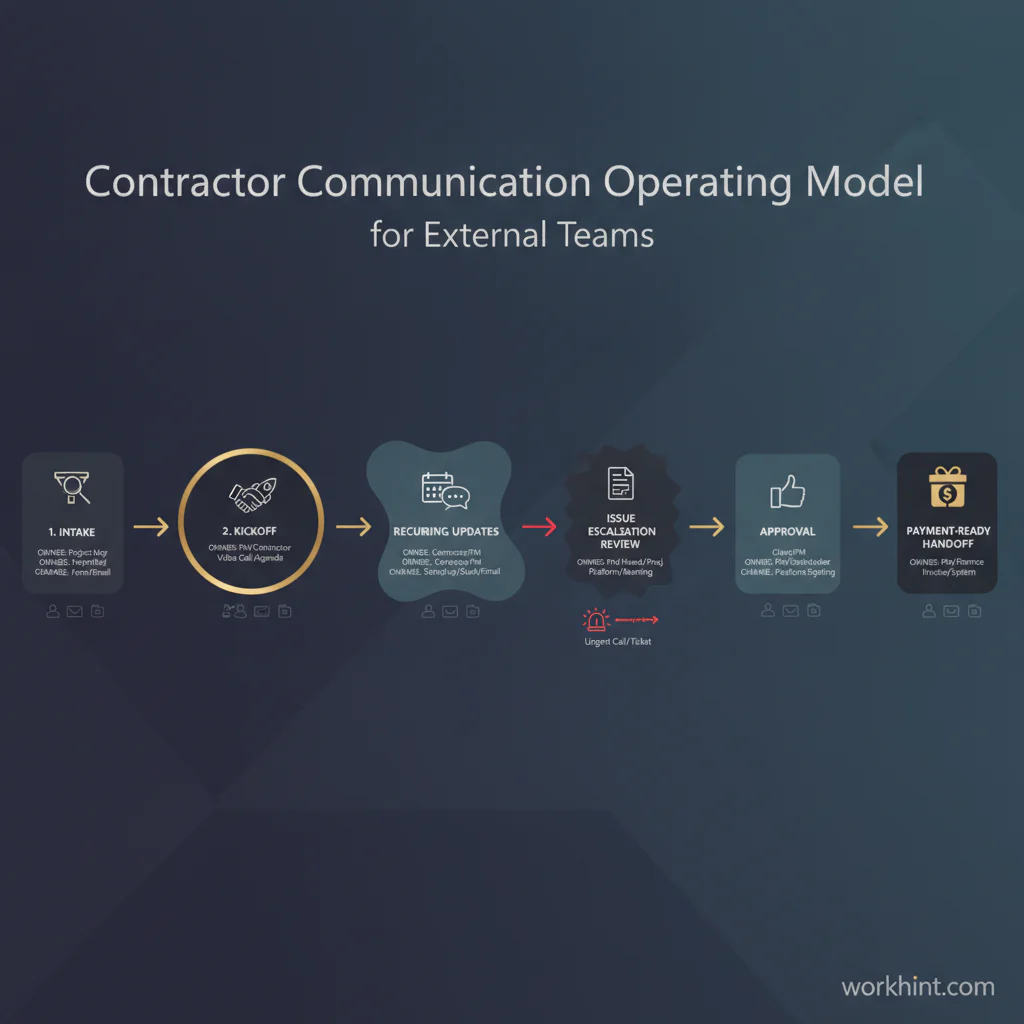
Contractor communication plan template
Use the plan below as a practical starting point. It is intentionally focused on operating clarity rather than generic communication advice.
| Communication moment | Owner | Channel | Purpose | Timing |
|---|---|---|---|---|
| Kickoff | Internal project owner | Shared workspace or kickoff call | Confirm scope, deliverables, milestones, access, and decision owners | Before work starts |
| Status update | Contractor or agency lead | Project workspace | Show progress, blockers, open questions, and upcoming work | Weekly or milestone-based |
| Issue escalation | Whoever discovers the blocker | Dedicated issue thread or form | Route blockers to the person who can decide or unblock | Same business day for urgent issues |
| Deliverable review | Internal approver | Approval workflow | Accept, request changes, or reject with specific feedback | Within the agreed review window |
| Payment handoff | Operations or finance | Payment-ready checklist | Confirm invoice, tax forms, approval, and completion evidence | After approved work |
How to build the plan
1. Define the external roles
Start by listing each external party: independent contractor, freelancer, agency account lead, staffing supplier, vendor manager, subcontractor, or partner operator. Then list internal owners: project sponsor, operations lead, finance approver, compliance reviewer, and day-to-day point of contact. The plan should make ownership obvious without requiring everyone to attend every conversation.
2. Separate updates from approvals
Status updates keep the work visible. Approvals make decisions official. Do not mix them. If a contractor posts a weekly update, that update should not automatically count as approval, acceptance, or payment readiness. Use explicit approval steps for scope changes, deliverable acceptance, timesheets, invoices, and milestone completion.
3. Choose channels by decision type
Email is useful for formal notices. Chat is useful for quick clarification. A project workspace is better for ongoing progress. An approval workflow is best for decisions that affect money, deadlines, compliance, or scope. The plan should tell people where each type of message belongs so important decisions do not disappear into private threads.
4. Set a cadence that matches the risk
High-risk work needs tighter reporting. Routine work can use milestone-based updates. A weekly status update is enough for many freelance projects, while field operations, staffing coverage, customer-facing services, or regulated work may need daily activity summaries. PMI’s guidance on project communication management emphasizes active listening and involving stakeholders in developing solutions; the cadence should support that without creating noise.
5. Add escalation rules
Every contractor communication plan needs a rule for blockers. Define what counts as urgent, who receives the escalation, how fast they should respond, and what happens if no one answers. Escalation rules prevent contractors from waiting quietly while a dependency blocks delivery.
Common mistakes
- Using too many channels: If the same update can appear in email, chat, text, and a spreadsheet, the system will break.
- Confusing activity with progress: Ask for deliverable progress, blockers, and decisions needed, not constant proof that someone is busy.
- Skipping decision owners: A shared inbox is not an approver. Name the person who can accept work or release payment.
- Ignoring classification boundaries: Communication should clarify the result and constraints, not dictate every working method. The IRS notes that worker classification can consider behavioral control, financial control, and the relationship between parties.
- Leaving finance out until the end: Payment delays often start because approval evidence, invoice rules, or tax documents were not collected during the work.
Where Workhint fits
Workhint fits when a contractor communication plan needs to become an operating system rather than a document. A team can use Workhint to define contractor intake, roles, access, onboarding steps, project assignments, update cadences, approval checkpoints, document collection, invoice readiness, payment status, and reporting in one connected workflow.
That matters because communication problems are usually workflow problems. If the contractor does not know where to submit a blocker, if the approver never sees the deliverable, or if finance cannot confirm completion, the plan has not been operationalized. Workhint helps turn the plan into structured steps, permissions, reminders, and records so external contributors can move through the work without relying on manual follow-up.
FAQ
What should a contractor communication plan include?
It should include external roles, internal owners, approved channels, update cadence, escalation rules, approval steps, document requirements, and payment handoff rules.
How often should contractors send status updates?
Use the lowest cadence that keeps the work visible. Weekly updates work for many projects. Daily updates may be appropriate for field work, customer-facing delivery, or time-sensitive operations.
Can a company require contractors to use its communication tools?
Often yes, especially for security, documentation, and coordination. The safer practice is to require tools for project communication and deliverable submission while avoiding unnecessary control over how the contractor performs the work. Ask counsel for classification-sensitive situations.
Who should own contractor communication?
One internal project owner should own the day-to-day communication path, but finance, compliance, and senior approvers should own the decisions that affect payment, risk, or scope.
Conclusion
A contractor communication plan is not paperwork. It is the practical system that keeps external work moving across people who do not share the same org chart, tools, assumptions, or availability. Define the roles, channels, cadence, approvals, and escalation paths before the work gets messy. Then turn the plan into a workflow your team can actually run.
Leave a Reply