


A clear PTO policy prevents time-off confusion before it becomes a scheduling, payroll, or fairness problem.
A PTO policy template gives a business a repeatable way to explain who is eligible for paid time off, how leave is earned, how requests are approved, what happens to unused balances, and how records are kept. The goal is not to write a perfect legal document in one sitting. The goal is to create a clear operating baseline that HR, managers, payroll, and employees can follow consistently.
This resource is written for founders, operations leaders, HR managers, and finance teams cleaning up paid time off. It is not legal advice. Paid leave, vacation payout, carryover, and final wage rules vary by jurisdiction, so have counsel or an HR compliance specialist review the final policy. SHRM’s sample PTO policy with accrual and carryover provisions is a useful reference point, and its coverage of state paid-leave requirements shows why location-specific review matters.
What’s included
- A copy-ready PTO policy template you can adapt.
- A clause-by-clause table explaining what each section controls.
- A workflow for requests, approvals, balances, and payroll handoff.
- Common mistakes and business-specific FAQ.
How to use this PTO policy template
Start by deciding what the policy covers. Some companies combine vacation, sick time, and personal days into one PTO bank. Others separate vacation, sick leave, holidays, bereavement, jury duty, parental leave, unpaid leave, and legally required leave. OnPay’s guide to time-off policies for small businesses highlights that the right structure depends on business needs, employee expectations, and local rules.
Before publishing the policy, confirm who is eligible, when accrual begins, whether part-time employees accrue PTO, whether unused PTO carries over, whether balances are paid out at separation, who approves exceptions, and how conflicts are resolved.
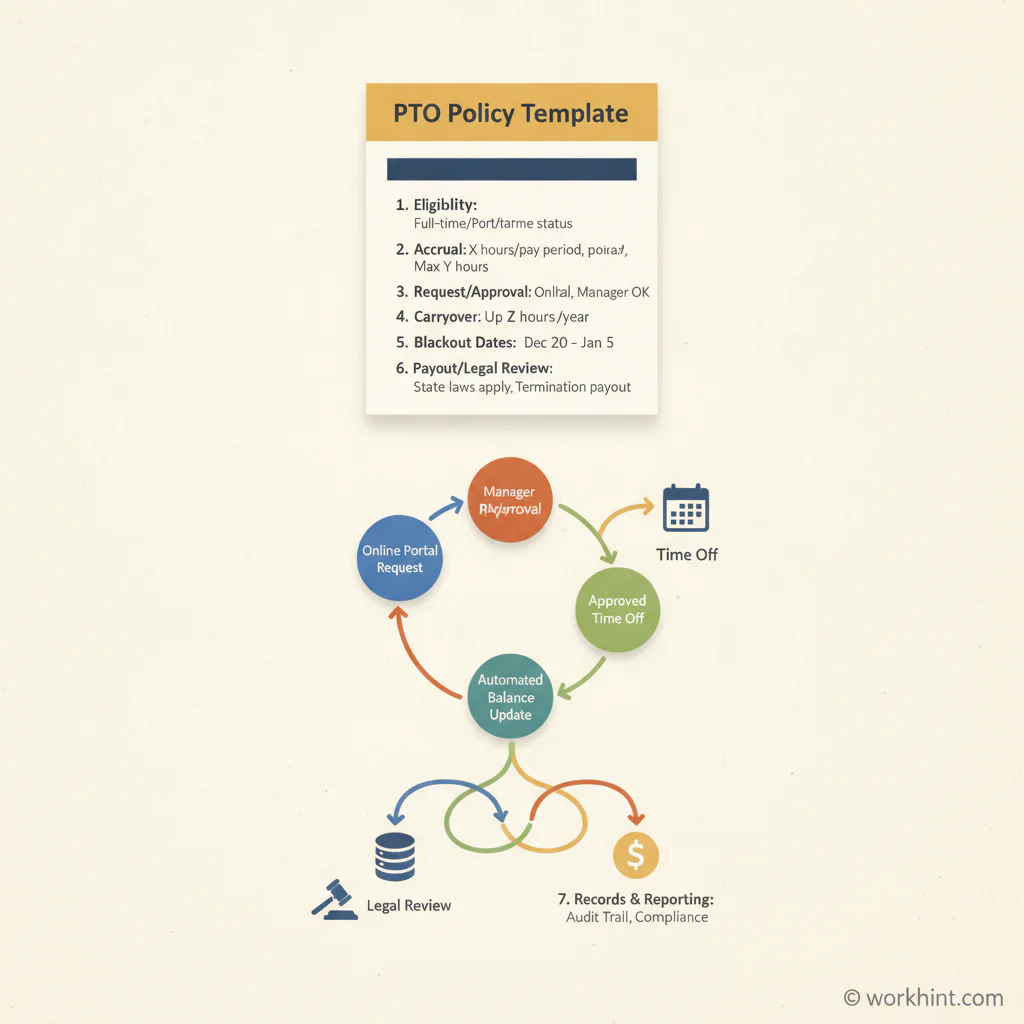
PTO Policy Template
Policy name: Paid Time Off Policy
Effective date: [Month Day, Year]
Policy owner: [HR, People Operations, Finance, or Operations]
1. Purpose
[Company Name] provides paid time off to help eligible employees rest, recover, handle personal needs, and maintain sustainable work performance. This policy explains how PTO is earned, requested, approved, tracked, and administered.
2. Eligibility
This policy applies to [full-time employees / regular part-time employees / eligible employee groups] after [start date, waiting period, or probationary period]. Temporary workers, contractors, interns, seasonal employees, or employees covered by a separate agreement are [not eligible / governed by separate terms] unless required by law.
3. Accrual and balances
Eligible employees accrue PTO at [rate] based on [hours worked, pay period, month, year, or tenure level]. PTO accrual begins on [date] and appears in [payroll system, HR system, or time-off tracker]. Employees may not use more PTO than they have accrued unless an exception is approved by [role].
4. How PTO may be used
PTO may be used for vacation, personal time, rest, illness when permitted by law and company policy, appointments, family needs, or other approved time away from work. Some leave types may be governed by separate policies, including protected sick leave, family leave, parental leave, disability leave, bereavement leave, jury duty, or unpaid leave.
5. Request and approval process
Employees should submit PTO requests through [system or channel] at least [number] business days in advance when the need is foreseeable. Requests should include dates, hours or days requested, coverage notes, and handoff information. Managers approve or decline requests based on coverage, workload, timing, fairness, and business needs. Emergency absences should be reported to [role or channel] as soon as practical.
6. Carryover, caps, and expiration
Unused PTO [may / may not] carry over into the next year. The maximum carryover amount is [number] hours or days. Employees may accrue up to [cap], after which additional accrual [pauses / is handled according to policy] until the balance drops below the cap. Any expiration, forfeiture, or cap rules must be reviewed for compliance with applicable law.
7. Separation from employment
When employment ends, unused PTO will be handled according to [company policy and applicable law]. Some jurisdictions regulate whether accrued vacation or PTO must be paid out. Review payout decisions with HR, payroll, and legal counsel where needed.
8. Records and payroll
Managers, employees, HR, and payroll are responsible for accurate PTO request, approval, balance, and usage records. For covered employees, the U.S. Department of Labor’s FLSA recordkeeping guidance explains that employers must keep certain wage and hour records, including hours worked for nonexempt employees. PTO records should connect to payroll, scheduling, and timekeeping records.
Policy clauses and operating decisions
| Policy section | Decision it controls | Owner |
|---|---|---|
| Eligibility | Who can earn and use PTO | HR |
| Accrual | How balances are calculated | Payroll |
| Request process | How employees ask for time off | Manager |
| Approval rules | How coverage conflicts are resolved | Manager and operations |
| Carryover and caps | What happens to unused time | HR and legal |
| Separation payout | How unused PTO is handled at exit | Payroll and legal |
| Records | What must be tracked for audit and payroll | HR, payroll, and operations |
Example PTO workflow
- Employee checks available balance before submitting a request.
- Employee submits dates, hours, coverage notes, and handoff tasks.
- Manager reviews coverage, deadlines, overlapping requests, and fairness.
- Approved PTO updates the calendar, schedule, and payroll record.
- Denied or modified requests include a clear reason and next available option.
- Payroll reconciles PTO used against the balance each pay period.
- HR reviews exceptions, negative balances, carryover, and policy updates.
Common mistakes
- Copying a generic policy without local review. Paid leave and payout rules vary, so a template should be adapted before use.
- Separating the policy from the workflow. A policy that lives in a handbook but not in the request and approval process will be ignored under pressure.
- Using unclear approval standards. Managers need guidance for overlapping requests, blackout periods, absences, and coverage gaps.
- Forgetting part-time and remote employees. Eligibility and accrual rules should explain how different worker groups are handled.
- Failing to reconcile balances. PTO balances should match payroll, scheduling, and HR records before year-end and separation.
Where Workhint fits
Workhint helps when a PTO policy needs to become a live operating workflow rather than a static handbook page. A business can use Workhint to collect time-off requests, route approvals, connect coverage tasks, track balances and exceptions, document policy acknowledgments, notify payroll, and report on scheduling bottlenecks.
That matters when the team includes multiple locations, shift workers, hourly employees, managers with different approval habits, or payroll handoffs that happen in spreadsheets and messages. The policy defines the rules. Workhint helps teams apply them consistently.
FAQ
What should a PTO policy include?
A PTO policy should include eligibility, accrual rules, permitted uses, request process, approval standards, carryover, caps, payout rules, holidays, records, and exceptions.
Is PTO required by law?
Rules vary by location and leave type. Some jurisdictions require paid sick leave or regulate vacation payout, while others do not require private employers to offer vacation. Review local law before finalizing the policy.
Should PTO include sick leave?
Some companies combine sick leave, vacation, and personal time into one PTO bank. Others separate them because local paid sick leave rules, reporting needs, or employee expectations require different treatment.
How far in advance should employees request PTO?
For planned time off, many businesses require advance notice such as two weeks. Emergency absences need a different standard because they are not foreseeable.
Who should approve PTO requests?
The direct manager usually approves routine requests, but HR, operations, or finance may need to review exceptions, extended leave, negative balances, protected leave, or separation payout questions.
Conclusion
A good PTO policy is practical, specific, and operational. It tells employees how paid time off works, gives managers a fair approval standard, gives payroll clean records, and gives the business a repeatable way to manage coverage. Use this template as a starting point, review it for local requirements, then connect it to the workflow people actually use.
Leave a Reply