


A property management business can start lean when the platform, vendor network, and owner pipeline come before office overhead.
If you are researching how to start a property management business, the real question is whether rental owners want help managing tenants, repairs, rent collection, inspections, and reporting.
That makes property management a strong fit for a platform-first launch: a narrow market, a branded owner and resident experience, trusted vendors, and a clear promise of fewer landlord headaches.
This guide shows how to launch with minimal upfront investment, validate demand first, and use Workhint as the operating foundation before you hire staff or build a custom system.
What’s In This Article?
- Why property management works as a lean service business
- What you need before taking on your first doors
- Startup costs, pricing, and revenue examples
- How to get your first owner clients
- How Workhint can power the business from owner intake to vendor payout
- A practical 7-day launch plan and final checklist
Why This Business Works
Property owners buy property management because rental income becomes less passive when tenant questions, late payments, maintenance issues, lease renewals, and vendor coordination pile up.
The business can also create recurring revenue through monthly management fees, leasing fees, renewal fees, inspection fees, and coordination fees.
A lean model starts with one clear niche: small landlords, local investors, short-term rental owners, or busy professionals with one rental property. Pick one segment and validate before expanding.
Independent vendors are central to the model. You do not need plumbers, cleaners, handymen, inspectors, landscapers, and photographers on payroll at launch. You need a vetted vendor network, clear service rules, fast approval workflows, and a system that keeps owners informed.
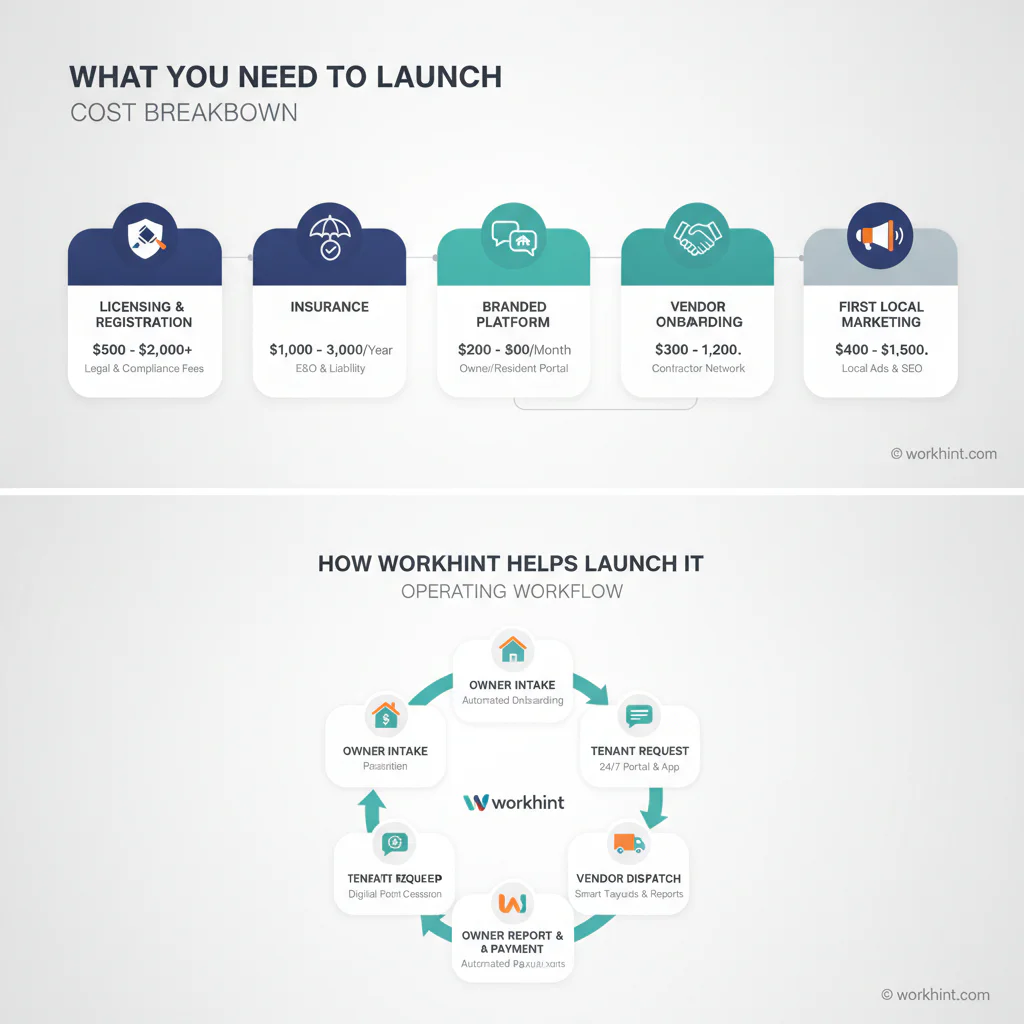
What You Need To Launch
Licensing requirements vary by state. In many places, managing rental property for others can require a real estate broker license, property management license, or working under a licensed broker. Verify your local rules before collecting rent, negotiating leases, or managing another owner’s property.
After legal basics, keep the first version simple: owner intake, resident requests, vendor dispatch, approval rules, insurance, and a launch market small enough to serve well.
| Launch item | Lean budget | Why it matters |
|---|---|---|
| Business registration and licensing review | $300 to $2,500 | Confirms whether you can legally manage properties in your market. |
| Insurance and professional coverage | $800 to $3,000 | Protects the business before handling owner, tenant, or vendor issues. |
| Branded owner and resident platform | $500 to $2,000 | Creates intake, requests, approvals, reporting, payments, and communication. |
| Vendor onboarding and checks | $250 to $1,000 | Builds your first network of cleaners, maintenance pros, inspectors, and contractors. |
| Local marketing and sales materials | $500 to $2,000 | Helps you reach rental owners, agents, investors, and landlord groups. |
A lean launch budget is often several thousand dollars if you avoid office space, full-time employees, broad advertising, and custom software until demand is proven.
How To Price It
Most property management companies combine recurring fees with event-based fees. Owners should understand the monthly fee, extra fees, and repair approval rules.
| Revenue stream | Example pricing | Best use |
|---|---|---|
| Monthly management fee | 8% to 12% of collected rent or a flat monthly fee | Core recurring revenue for ongoing management. |
| Tenant placement fee | 50% to 100% of one month’s rent | Covers listing, showing, screening, and lease coordination. |
| Lease renewal fee | $150 to $300 | Compensates renewal work without surprising the owner. |
| Setup or onboarding fee | $100 to $350 per property | Covers property intake, documentation, and account setup. |
Do not race to be cheapest. New property managers win by being clear, responsive, and operationally reliable.
How To Get First Customers
Start with owners who already feel the pain. Good first channels include local real estate agents, investor meetups, landlord associations, mortgage brokers, insurance agents, short-term rental hosts, and small owners posting in local groups.
Your first offer should be specific: management for small landlords in one city, short-term rental turnover coordination, maintenance-first management for owners with older homes, or leasing plus resident support for new investors.
Ask for conversations before selling a full contract. If several owners describe the same repair, tenant, or reporting problem, build the first package around that pain.
How Workhint Helps Launch It
Workhint can become the branded operating system before you invest in custom software or a large back office. The business can launch with an owner portal, resident request form, operations dashboard, vendor onboarding, approval rules, payment flows, and reporting in one connected platform.
An owner submits a property through your branded portal. Workhint captures property details, documents, repair thresholds, communication rules, and approvals. When a resident submits a maintenance request, the system routes it by urgency, matches it to an approved vendor, sends a quote for owner approval if needed, schedules the job, tracks completion, collects the invoice, and records the owner update.
That flow matters because property management is a chain of requests, approvals, vendors, messages, payments, and records. Workhint lets you sell a professional management experience while keeping the first version lean.
First 7-Day Launch Plan
- Day 1: Choose your niche, launch city, legal path, and first property type.
- Day 2: Build the branded Workhint platform basics for owner intake, resident requests, and internal tracking.
- Day 3: Define pricing, repair approval limits, vendor dispatch rules, invoice flow, and owner reporting.
- Day 4: Recruit the first vendors for cleaning, maintenance, inspections, landscaping, and emergency repairs.
- Day 5: Contact agents, investors, landlord groups, and local owners with a narrow offer.
- Day 6: Route first conversations, sample properties, and test requests through the platform.
- Day 7: Review demand, pricing resistance, vendor readiness, and legal requirements before expanding.
The first-week goal is proving that owners want the offer and that your process can support the first few doors.
Final Launch Checklist
- Choose one owner segment and one launch market.
- Verify state and local licensing requirements.
- Register the business and open a business bank account.
- Secure appropriate insurance and professional coverage.
- Create a branded Workhint owner and resident platform.
- Set up property intake, resident requests, approvals, scheduling, invoices, payments, and vendor payout flows.
- Recruit a small network of independent vendors.
- Create simple management, leasing, and renewal pricing.
- Contact first owner prospects and validate demand before hiring staff or leasing office space.
FAQ
How much does it cost to start a property management business?
A lean launch can often start with several thousand dollars for licensing review, registration, insurance, platform setup, vendor onboarding, and local marketing. Costs rise if your state requires licensing, broker affiliation, larger reserves, paid ads, or office space.
Do I need a license to start a property management company?
In many states, managing properties for others requires a real estate broker license, property management license, or licensed supervision. Check your state rules before signing owners or handling leases, rent, deposits, or repairs.
Can I start without employees?
Yes, if your legal structure allows it and your service model is narrow. Many early tasks can be handled by the founder, while repairs, cleaning, inspections, and specialty work are fulfilled through independent vendors.
How do property management companies make money?
Common revenue includes monthly management fees, leasing fees, renewal fees, setup fees, inspection fees, and sometimes coordination fees. Keep pricing transparent so owners understand what is included.
How do I get my first property management clients?
Start with rental owners, real estate agents, investor groups, landlord associations, and local referral partners. Lead with a specific problem you solve, such as maintenance coordination, tenant requests, or leasing support for small landlords.
Should I manage long-term rentals or short-term rentals first?
Choose the model that best matches your market and vendor network. Long-term rentals usually need tenant, maintenance, lease, and rent workflows. Short-term rentals need faster cleaning, guest support, turnover, and issue resolution.
Conclusion
A property management business is worth starting when you treat it as an operating system, not a pile of admin tasks. Validate owner demand, build a vendor network, launch a branded platform, and keep the first offer focused.
Workhint gives the business a branded foundation for owner intake, resident requests, vendor coordination, approvals, payments, and reporting from day one. Start with a few doors, prove the workflow, then scale.
Leave a Reply