


Strong contractor retention comes from reliable work systems, not employee-style perks or last-minute relationship management.
Contractor retention is the ability to keep reliable independent contractors, freelancers, consultants, agencies, and other external specialists willing to return for repeat work. For a business, it matters because the best external talent already has options. If the relationship is confusing, payment is slow, scope changes constantly, or approvals stall, good contractors move on.
The goal is not to treat contractors like employees. It is to build a clear, fair, low-friction operating model that makes the business easy to work with while preserving the contractor’s independence.
What’s in this article?
- Why contractor retention matters for external workforce operations
- The reasons strong contractors stop accepting work
- A practical contractor retention framework
- A workflow table for improving repeat engagement
- Common mistakes that create retention and compliance risk
- Where Workhint fits when contractor relationships need structure
Why contractor retention matters
Companies increasingly rely on flexible talent for specialist work, seasonal demand, project delivery, field operations, content production, customer support, and professional services. The U.S. Bureau of Labor Statistics reported that 11.9 million people were independent contractors on their sole or main job in July 2023. That figure does not include every agency partner, vendor team, platform worker, or occasional freelancer a company may use.
When reliable contractors leave, the cost is not only sourcing a replacement. Teams lose context, quality history, speed, customer familiarity, and trust. Managers also repeat onboarding, access setup, scope explanation, and payment setup.
Retention is especially important when external workers support recurring operations. A company that uses freelance designers, installation contractors, agency teams, or consultants needs a repeatable relationship model, not one-off coordination.
Why contractors stop coming back
Contractors rarely leave only because of the rate. Many leave because the client is hard to work with. Common friction points include vague scope, delayed approvals, unpaid changes, unclear points of contact, inconsistent communication, late payments, uncontrolled revisions, missing access, and surprise compliance requests after work has already started.
There is also a compliance boundary. The IRS guidance on independent contractor status says businesses should look at the whole relationship and the degree of behavioral and financial control. This is not legal advice, but retention programs should improve clarity without turning contractors into managed employees.
Contractor retention strategies that actually work
Use these strategies when you want strong contractors to accept repeat assignments without creating unnecessary control or administrative drag.
- Define the work before the relationship starts. Contractors stay with clients who know what they need. Use a scope, deliverables, success criteria, deadlines, and payment terms before kickoff.
- Make one owner accountable. Contractors should not chase five internal stakeholders for decisions. Assign a business owner who can answer questions, route approvals, and unblock work.
- Pay predictably. Late or unclear payment is one of the fastest ways to lose good contractors. Tie payment to accepted milestones, approved hours, or agreed deliverables.
- Respect independence. Give outcomes, context, and constraints. Avoid managing contractors like employees unless counsel has confirmed the model supports that level of direction.
- Reduce repeat onboarding work. For contractors who return, reuse verified records where appropriate, refresh only expired documents, and avoid asking for the same information every engagement.
- Close the loop after each project. Confirm final deliverables, payment status, access removal, reusable notes, and whether the contractor is approved for future work.
- Track quality and fit. Keep practical notes on responsiveness, quality, reliability, scope fit, and preferred work type so repeat assignments are based on evidence.
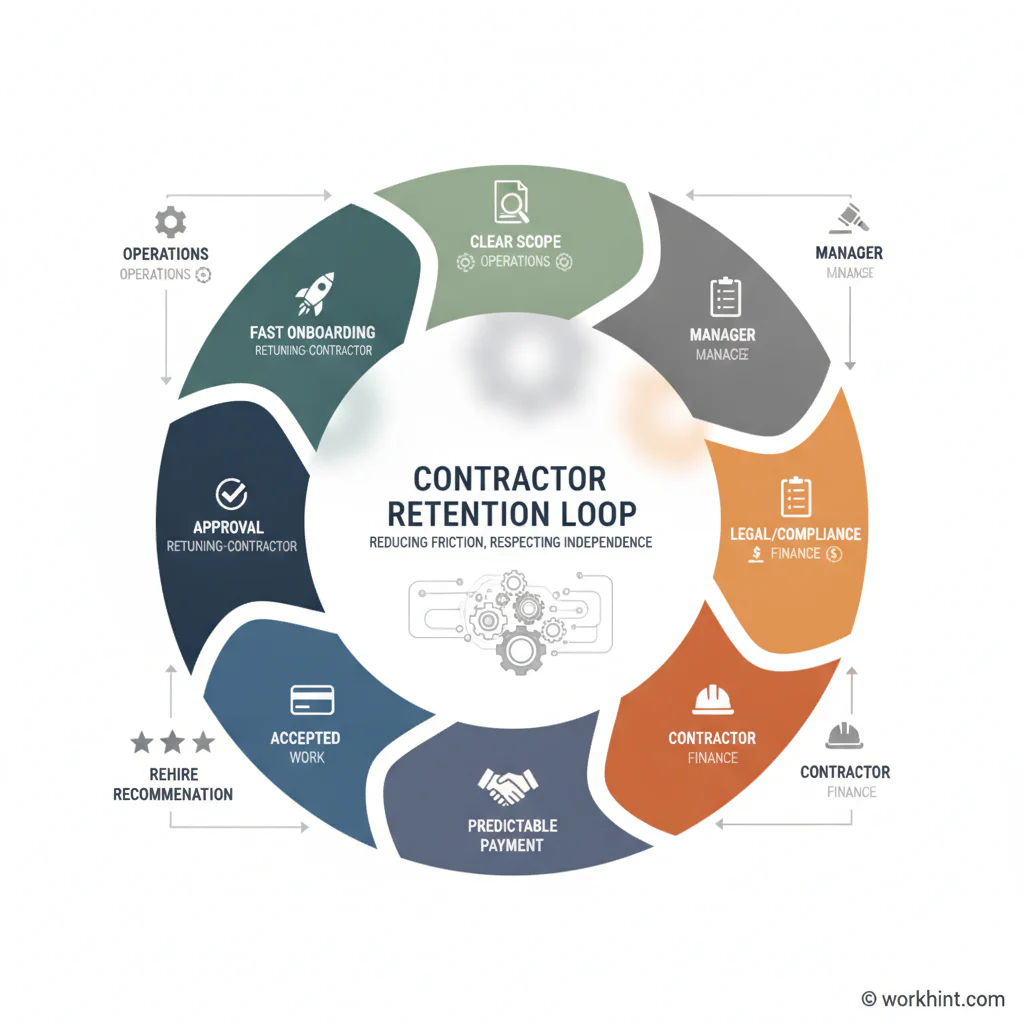
A practical contractor retention workflow
The best contractor retention programs are operational. They make repeat work easier to approve, start, deliver, and pay.
| Retention lever | Operational practice | Owner | Evidence to track |
|---|---|---|---|
| Clear scope | Define deliverables, review points, deadlines, and change rules before kickoff | Business owner | Scope, SOW, brief, approved budget |
| Fast starts | Reuse approved profile data and refresh only expired documents | Operations | Document status, onboarding checklist, access needs |
| Decision speed | Route approvals to named reviewers with due dates | Project owner | Approval timestamps, blockers, escalation notes |
| Payment trust | Connect work acceptance to invoice or milestone payment approval | Finance | Invoice status, payment terms, accepted deliverables |
| Repeat fit | Review performance after closeout and tag contractors for future work types | Manager or program lead | Quality notes, rating, rehire recommendation |
How to retain contractors without creating compliance risk
A good contractor experience should not depend on employee-style supervision. Businesses can improve retention by being clearer, faster, and more reliable while still respecting the nature of independent work.
The U.S. Department of Labor explains that employment status under the Fair Labor Standards Act depends on the economic realities of the relationship. That means the operational details matter. A contractor agreement helps, but actual work practices, control, opportunity for profit or loss, tools, investment, permanence, and integration may all matter depending on the applicable test.
Retention practices should therefore focus on business clarity: better scopes, faster approvals, timely payment, cleaner documentation, respectful communication, and repeatable offboarding. Avoid retention tactics that create exclusivity, employee-like schedules, direct supervision of methods, or benefits language without legal review.
Common contractor retention mistakes
- Confusing friendliness with process. Good relationships help, but contractors remember whether the client paid on time and respected scope.
- Making every engagement start from zero. Returning contractors should not have to repeat the same administrative work unless something changed or expired.
- Letting internal approvals stall the contractor. If reviewers miss deadlines, the contractor carries idle time and context switching.
- Changing scope without changing budget. Revisions and extra work should have a documented path for approval.
- Tracking only cost. Rate matters, but reliability, quality, responsiveness, fit, and reuse potential matter too.
Where Workhint fits
Workhint fits when contractor retention needs to become a managed operating system instead of a manager-by-manager habit. A team can use Workhint to structure contractor intake, reuse approved records, assign roles and permissions, route scopes and approvals, track milestones, connect accepted work to payment status, store performance notes, and trigger closeout steps. For ongoing contractor operations, contractor management software can connect onboarding, assignments, access, records, performance, and offboarding in one operating system.
That helps the business become easier for external talent to work with. Contractors get clearer expectations, fewer repeated requests, faster decisions, and more reliable payment visibility. Internal teams get cleaner records, better rehire decisions, and less dependence on scattered spreadsheets, messages, and personal memory.
FAQ
What is contractor retention?
Contractor retention is the ability to keep reliable contractors, freelancers, consultants, agencies, or external specialists willing to accept future work from the business. It depends on clear scope, predictable payment, respectful communication, good coordination, and low administrative friction.
How do you improve contractor retention?
Improve contractor retention by defining scope before kickoff, assigning one internal owner, paying on time, routing approvals quickly, reducing repeated onboarding, documenting changes, and reviewing performance after each engagement.
Is contractor retention the same as employee retention?
No. Employee retention often involves career paths, benefits, internal culture, and management practices. Contractor retention should focus on clear commercial terms, independent work boundaries, efficient coordination, timely payment, and repeat engagement quality.
Can contractor retention create misclassification risk?
It can if the company tries to retain contractors by controlling how they work like employees. Businesses should improve the operating experience while preserving contractor independence and should get legal advice when classification risk is material.
What metrics should we track for contractor retention?
Track repeat acceptance rate, time to onboard returning contractors, approval cycle time, payment cycle time, scope-change frequency, quality ratings, rehire recommendations, and reasons contractors decline future work.
Conclusion
Contractor retention is not about perks or persuasion. It is about making the business a reliable client. Strong contractors return when work is scoped clearly, decisions happen on time, payment is predictable, independence is respected, and repeat engagements are easier than the first one. The companies that keep the best external talent are the ones that treat contractor relationships as an operating system, not a series of one-off transactions.
Leave a Reply