


A 30-60-90 day plan turns a new role from good intentions into visible progress, clear ownership, and useful manager check-ins.
A 30-60-90 day plan template gives a new hire, newly promoted manager, or internal transfer a practical path for the first three months. Instead of vague onboarding goals, the plan breaks the ramp period into three phases: learn, contribute, and own measurable outcomes.
Most templates stop at goals and dates. For a business, that is not enough. A useful plan should define what the person needs to learn, which deliverables prove progress, who reviews the work, and what changes if priorities shift.
What is included in this 30-60-90 day plan template?
This resource includes the sections a manager should complete before the person starts, the milestones the employee should own during each phase, and the review questions that keep the plan alive after day one. It is designed for business use, not just interview preparation.
- Role outcome: the business result the person is expected to improve.
- Learning goals: systems, customers, policies, processes, metrics, and stakeholders to understand.
- Execution goals: projects, decisions, handoffs, or deliverables to complete.
- Relationship goals: people the new hire must meet and working agreements to establish.
- Evidence of progress: outputs that show the plan is working.
- Review cadence: manager check-ins at day 30, day 60, and day 90, plus weekly adjustments.
Several high-ranking guides define a 30-60-90 plan as a structure for early goals and milestones, including Coursera’s overview and Indeed’s template guide. For companies, the key is making those milestones operational enough that both the employee and manager know what success looks like.
How to use the 30-60-90 day plan template
- Start with the role outcome. Write one sentence that explains why this role exists. For example: “Improve vendor onboarding speed without increasing compliance risk.”
- Separate learning from execution. A new person should not be judged only on output before they understand the system. Define what must be learned before bigger ownership begins.
- Assign real owners. Every goal should have a manager, teammate, or stakeholder who can unblock the work.
- Use evidence, not vibes. Replace “build relationships” with “complete five stakeholder interviews and summarize recurring pain points.”
- Review weekly. A 90-day plan should not sit untouched until the end of the quarter. Adjust it when the business reality changes.
Asana’s template guidance frames the plan as part of onboarding, while Culture Amp’s manager guide emphasizes shared expectations between the employee and manager. That shared expectation is the point: the plan should make the first three months easier to manage, not add paperwork.
Copy-ready 30-60-90 day plan template
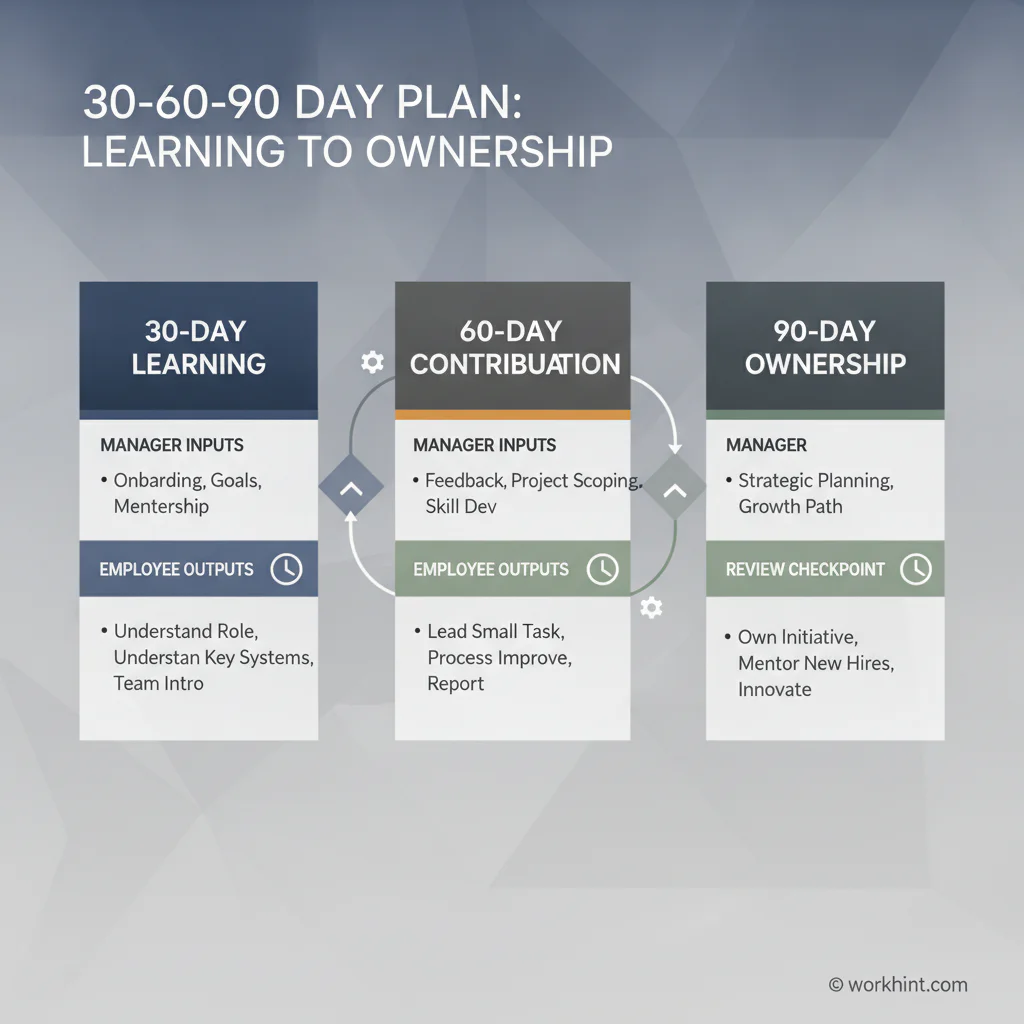
| Phase | Primary focus | Manager inputs | Employee outputs | Review questions |
|---|---|---|---|---|
| Days 1-30 | Learn the business, role, tools, stakeholders, expectations, and current problems. | Role context, success metrics, required training, stakeholder list, process documentation, first small assignment. | Learning notes, stakeholder map, tool access confirmation, first process observation, early questions, quick-win recommendation. | What is clear? What is still confusing? Which process blocks progress? What support is missing? |
| Days 31-60 | Contribute to active work, own defined tasks, and test assumptions from the first month. | Priority project, decision boundaries, quality standards, feedback rhythm, examples of strong work. | Completed deliverables, updated workflow notes, risk list, stakeholder feedback, one measurable improvement. | Is the person producing useful work? Are expectations realistic? Which goals should change? |
| Days 61-90 | Own a meaningful outcome, improve the workflow, and define the next quarter. | Outcome target, authority level, escalation path, performance expectations, next-quarter planning input. | Project result, operating recommendations, documented process, KPI baseline, 90-day review summary. | What can the person now own independently? What should be measured next? What system needs improvement? |
Example: 30-60-90 day plan for an operations manager
Role outcome: Improve contractor onboarding speed while keeping document collection, approval, and payment setup consistent.
Days 1-30: Review the current onboarding workflow, meet operations, finance, legal, and hiring managers, observe three contractor onboarding cases, document the systems used, and identify the top five causes of delay.
Days 31-60: Own onboarding for a small group of contractors, create a checklist for required documents, define handoff points between hiring managers and finance, and test a weekly status report that shows blocked contractors.
Days 61-90: Propose the improved contractor onboarding workflow, define owner responsibilities, set an approval SLA, create a dashboard for onboarding stage and missing documents, and recommend what should be automated next.
This example works because it connects learning to actual workflow ownership. The plan does not ask the manager to “get up to speed” in the abstract. It gives them a real operational problem, a defined group of stakeholders, and visible proof of progress.
Common mistakes to avoid
- Making the plan too broad. “Learn the company” is not a useful goal. Name the systems, customers, metrics, and decisions the person needs to understand.
- Using only activity metrics. Meetings completed and documents read matter, but they should lead to insight, delivery, or a better workflow.
- Skipping decision rights. A new manager or specialist needs to know what they can decide, what needs approval, and when to escalate.
- Ignoring manager responsibilities. If the employee owns every action and the manager owns nothing, the plan will fail when access, context, or feedback is missing.
- Waiting until day 90 to evaluate progress. The first three months should include weekly check-ins and formal checkpoints at each phase.
AIHR’s onboarding template notes that 30-60-90 plans are useful for new employees and internal promotions. That makes the template especially valuable for growing companies where people are often moving into new responsibilities before every process is fully mature.
Where Workhint fits
A 30-60-90 day plan is useful as a document, but it becomes much more valuable when it is connected to the work system around the person. Workhint can help teams turn the template into a live onboarding or role-transition workflow with assigned owners, permissions, documents, check-ins, approval steps, reminders, and reporting.
For example, a hiring manager can map the first 90 days, assign stakeholder meetings, collect required documents, route approvals, track weekly progress, and keep the employee’s plan connected to projects, schedules, and operating metrics. That keeps the plan from becoming a static file that everyone forgets after the first week.
FAQ
Who should write a 30-60-90 day plan?
The manager should define the business outcomes, expectations, and review cadence. The employee should contribute learning goals, questions, and milestone updates. For senior roles, the plan is often co-created before or shortly after the start date.
Is a 30-60-90 day plan only for new hires?
No. It is also useful for promotions, internal transfers, new managers, sales territory changes, major project launches, and role resets after a reorganization.
How detailed should the plan be?
Detailed enough that both the manager and employee can tell whether progress is happening. Avoid writing a task list for every day. Focus on outcomes, deliverables, relationships, and decisions for each 30-day phase.
Should the plan be tied to performance review?
It can inform early performance conversations, but it should not be treated as a rigid pass-fail contract. Use it to clarify expectations, spot blockers early, and agree on what the employee should own next.
What should happen after day 90?
Convert the final review into a normal operating plan for the next quarter. Keep the useful parts: ownership, metrics, check-ins, project milestones, and documented workflow improvements.
Conclusion
A strong 30-60-90 day plan template gives a new role structure without pretending the first three months will be perfectly predictable. The best plans combine learning, contribution, ownership, manager support, and visible evidence of progress.
Use the template above as a starting point, then adapt it to the role, team, and operating system around the work.
Leave a Reply