


A readiness checklist is only useful when it proves the work can run without heroic follow-up.
An operational readiness checklist helps a team decide whether a process, service, workflow, or system is ready to go live. It is not just a project-management form. Used well, it is a practical operating gate: the team confirms owners, inputs, workflows, support paths, training, metrics, risks, and evidence before work moves into real use.
The problem is that many teams treat readiness as a final meeting. They ask whether everyone feels ready, scan a few open items, and launch because the deadline has arrived. That is how new workflows enter the business with unclear ownership, missing handoffs, weak reporting, and no agreement on what happens when something breaks.
What’s in this article?
- What operational readiness means in business operations
- A practical checklist for go-live decisions
- A readiness scoring table you can adapt
- Common launch mistakes to avoid
- Where Workhint fits when readiness needs to become a live work system
Why operational readiness checklist matters
An operational readiness checklist matters because launch risk usually sits between teams. The system may work, but support is not trained. The workflow may be documented, but exceptions still go to a manager in chat. The dashboard may exist, but nobody owns the metric after go-live. Readiness is the discipline of finding those gaps before customers, employees, vendors, or operators depend on the work.
PMI’s discussion of operational readiness argues that readiness should consider the environment around the system, including processes, people, structure, roles, and responsibilities. That framing is useful for any business operation. A launch is not ready because the build is complete. It is ready when the operating environment can absorb and run the change.
Microsoft’s go-live checklist guidance makes a similar point for implementations: readiness checks should help teams assess completeness, quality, and confidence before going live. For operations leaders, that means the checklist should produce a decision, not a false sense of control.
Operational readiness checklist
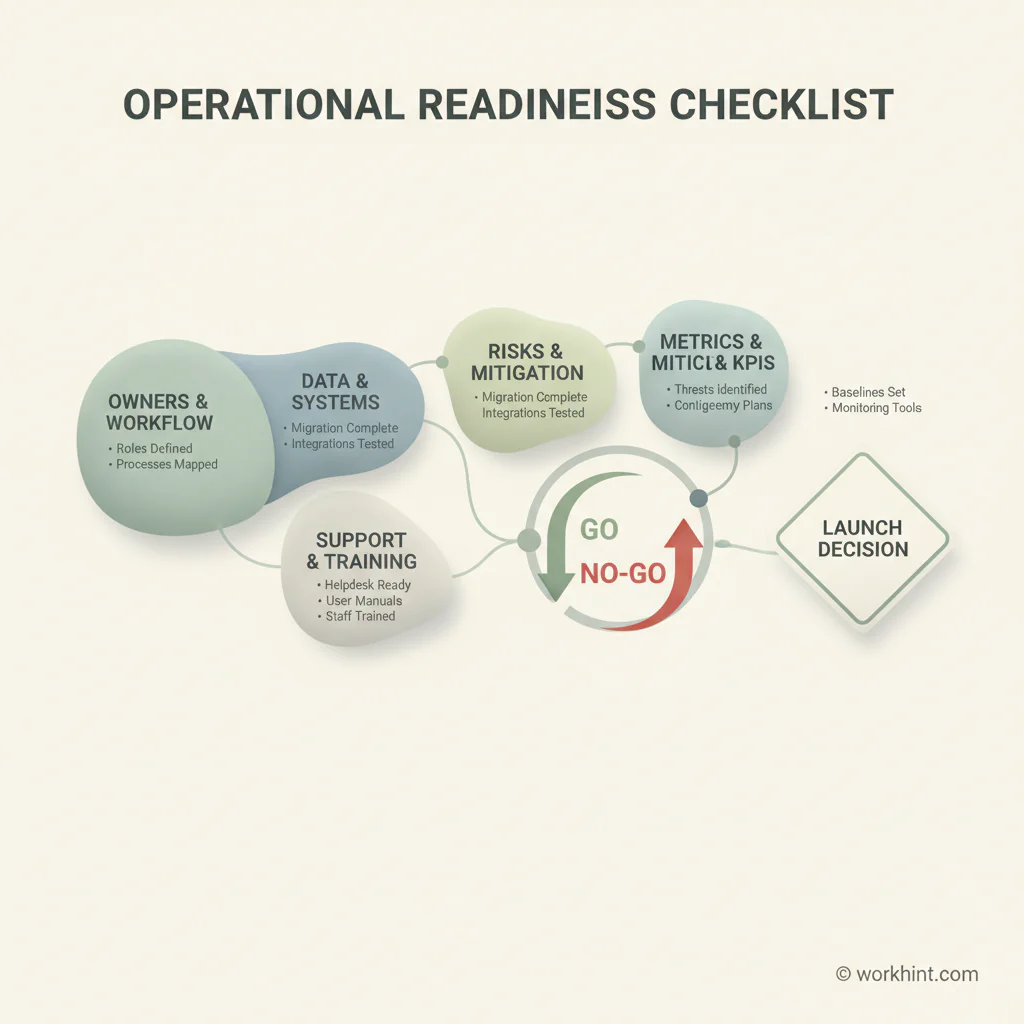
Use this checklist before launching a new process, workflow, internal service, customer operation, automation, or system. The specific items will vary, but the readiness domains should stay consistent.
| Readiness area | Question to answer | Evidence to collect |
|---|---|---|
| Purpose | What business outcome is this launch supposed to improve? | Goal, success metric, launch scope, out-of-scope list |
| Ownership | Who is accountable for the work after go-live? | Named owner, backup owner, approver, support lead |
| Workflow | Can the team describe the trigger, steps, decisions, and end state? | Workflow map, decision rules, handoff points, exception path |
| People | Are users, operators, and approvers trained for their roles? | Training record, role guide, quick reference, support channel |
| Systems | Do the required tools, permissions, integrations, and data flows work? | Test results, access review, integration check, sample records |
| Support | What happens when a user is blocked or the workflow fails? | Support owner, escalation rule, issue categories, response targets |
| Controls | What approvals, policy checks, audit records, or risk reviews are needed? | Approval matrix, risk log, compliance notes, audit trail |
| Measurement | How will the team know whether the launch is working? | Dashboard, baseline, KPI owner, review cadence |
How to run a readiness review
Start the review before the final week. Operational readiness should be built into the work, not bolted on at the end. Give every readiness area an owner and require evidence, not opinion. If someone says training is complete, the evidence might be attendance, a guide, or a test run. If someone says support is ready, the evidence might be a queue, a triage owner, and a documented escalation path.
Score each area as green, yellow, or red. Green means ready with evidence. Yellow means launch can proceed only with a named mitigation. Red means the launch should not proceed until the blocker is resolved. AWS describes operational readiness reviews as checklist-based reviews that record results, residual risk, and action items. That is the right pattern for business operations too: every yellow or red item needs an owner, due date, and decision.
Include the people who will live with the workflow after launch. The Agency for Healthcare Research and Quality notes that a readiness assessment should be a team activity because buy-in affects implementation success. Even outside healthcare, the principle holds. Operators, approvers, support teams, and managers will see risks the project team may miss.
A simple go-live decision model
The readiness meeting should end with one of three decisions. First, go: all critical areas are green, and any minor open items have owners. Second, go with conditions: the business accepts a small number of yellow risks with documented mitigations. Third, no-go: one or more critical areas are red, or the team cannot show evidence for essential readiness claims.
Do not let the checklist become a political exercise. A no-go decision is not failure. It is the system doing its job before the business absorbs avoidable risk. A conditional go-live is acceptable only when leadership understands the tradeoff and the mitigation is specific enough to manage.
Common mistakes
- Checking tasks instead of readiness: Completed project tasks do not prove the operation can run.
- Ignoring post-launch ownership: The launch team may leave, but the work still needs an accountable operator.
- Skipping exception paths: Real work will produce missing data, edge cases, late approvals, and confused users.
- Launching without measurement: If there is no baseline or dashboard, the team will not know whether the change helped.
- Using the same checklist for every launch: Keep core domains consistent, but adapt evidence to the workflow’s risk and complexity.
Where Workhint fits
Workhint fits when operational readiness needs to become more than a document. A team can describe the workflow it wants to launch, then use Workhint to structure the roles, intake, permissions, assignments, approval steps, dashboards, support paths, and automations around that work.
That matters because readiness evidence usually lives across tools: documents in one place, tasks in another, access checks in a spreadsheet, approvals in email, and risks in a meeting note. Workhint helps turn those pieces into a connected work system where owners are visible, blockers are routed, readiness evidence is captured, and post-launch metrics stay tied to the operating workflow.
FAQ
What is an operational readiness checklist?
An operational readiness checklist is a structured review used to confirm that a process, system, workflow, or service can run in the real operating environment after launch.
What should be included in an operational readiness checklist?
Include purpose, scope, ownership, workflow steps, user training, system access, integrations, support paths, escalation rules, controls, risks, metrics, and post-launch review cadence.
Who owns operational readiness?
The business owner should own readiness for the outcome. Project, operations, technology, support, and compliance teams may each own specific readiness areas.
When should an operational readiness review happen?
Run readiness reviews throughout implementation, with a final go-live review before launch. Waiting until the final meeting makes blockers harder to fix.
What is the difference between operational readiness and project completion?
Project completion means planned work was delivered. Operational readiness means the business can use, support, measure, and improve that work after go-live.
Conclusion
An operational readiness checklist should protect the business from launching work that is technically complete but operationally fragile. Confirm the outcome, owner, workflow, people, systems, support, controls, risks, and metrics before go-live. Require evidence for each claim. When readiness becomes a repeatable work system, launches become less dependent on memory, meetings, and last-minute heroics.
Leave a Reply