


An event staffing business can start with one niche, one trusted crew, and a platform that makes every shift feel organized.
How to start an event staffing business is a practical question because organizers always need reliable people for temporary, high-pressure work. Weddings, conferences, brand activations, festivals, corporate events, and private parties all depend on hosts, servers, bartenders, registration staff, brand ambassadors, runners, and setup crews who show up prepared.
The lean version does not begin with a large payroll, office, or giant worker database. It begins with a narrow event niche, a branded customer platform, a small network of independent event staff, clear shift workflows, and proof that local planners or venues will pay for dependable coverage.
What’s in this article?
- Why event staffing is worth starting
- What you need to launch without employees
- How to price event staffing jobs
- How to find first clients and providers
- How Workhint helps launch the operating platform
- A 7-day launch plan, checklist, and FAQ
Why this business works
Event staffing works because demand is project-based. Clients do not need a full-time employee to cover a three-day conference, a Saturday wedding, or a product activation. They need the right people for the exact shift, role, dress code, location, and service standard.
Recent search results show current interest in startup costs, staffing agency requirements, onboarding, scheduling, insurance, payroll timing, first clients, and pricing. Competitor guides cover legal setup and agency operations, but the gap is the launch model: how to validate demand first with a branded platform and a small independent provider network.
The first version should be specific. Instead of saying you staff all events, pick one starting lane: wedding service staff, conference registration teams, brand ambassadors, hospitality event staff, or private-party bartenders where legally allowed. A focused offer is easier to train for, price, insure, and sell.
How to start an event staffing business with the right launch setup
You need enough infrastructure to look credible, coordinate shifts, and protect the business. You do not need employees on day one. Many founders can start by recruiting qualified independent contractors or service providers, then using clear agreements, role requirements, shift confirmations, and payment processes. Worker classification rules vary by state and role, so review your model locally before assigning work.
The first goal is not to build the largest roster. The first goal is to prove that a small group of reliable people can fulfill a narrow event offer for paying clients.
| Launch item | Lean first version | Typical early budget |
|---|---|---|
| Business setup | LLC or local registration, EIN, bank account, basic client and provider agreements | $150 to $1,000 |
| Insurance and compliance | General liability, event-specific coverage review, liquor liability if staffing bars | $500 to $2,500+ |
| Branded platform | Customer request form, quote approvals, shift board, provider profiles, calendars, payments | $0 to $800 to configure |
| Provider network | 10 to 20 vetted independent event staff with role, location, availability, and dress-code notes | $100 to $600 |
| Training assets | Role checklists, event brief template, conduct standards, no-show policy, client feedback form | $0 to $500 |
| Customer acquisition | Local planner outreach, venue partnerships, landing page, referral offers, follow-up process | $100 to $1,000 |
The expensive trap is trying to look like a large agency before the market confirms demand. Start with a branded platform, a credible offer, and a small roster. Add payroll support, managers, uniforms, and specialized equipment only when booked work justifies them.
How to price it
Event staffing pricing usually combines worker pay, agency margin, shift minimums, role complexity, urgency, travel, overtime, and payment timing. The price must cover the provider, admin work, insurance, replacement risk, and cash-flow gap between provider payouts and client payment.
| Service package | Example use case | Simple pricing model |
|---|---|---|
| Event support crew | Setup, check-in, runners, guest direction | Hourly bill rate with 4-hour minimum |
| Hospitality staff | Servers, hosts, coat check, banquet support | Hourly bill rate plus role-based premium |
| Brand ambassadors | Sampling, activations, trade shows, street teams | Hourly or day rate with briefing fee |
| Bartending support | Private events or venues where legally permitted | Higher hourly rate plus liquor liability review |
| Recurring event partner | Venue, planner, or corporate client with repeated events | Monthly minimum plus shift-based billing |
A common starting approach is to bill roughly 1.7 to 2.2 times the provider’s take-home rate, then adjust based on role difficulty, insurance, local wages, and reliability standards. Do not underprice the first client just to win the job. Thin margins make it harder to pay providers quickly, and slow pay damages the roster.
How to get first customers
The fastest first customers usually come from people already close to events: planners, venue managers, caterers, production companies, wedding coordinators, nonprofit event teams, corporate marketing teams, and local hospitality groups.
Lead with a narrow promise. For example: “We provide trained registration and guest-flow staff for corporate events,” or “We provide vetted servers and hosts for private events in Austin.” Specific positioning beats a generic staffing pitch.
Contact 30 to 50 local prospects. Offer to cover one defined need, not every role. Ask what shifts are hardest to fill and what would make them trust a new staffing partner. The goal is to validate demand and book the first small event through your platform.
How Workhint helps launch an event staffing platform
Workhint helps founders launch the operating system for the event staffing business before they invest in offices, payroll staff, or custom software. The business can start with a branded customer portal where planners request staff, upload run-of-show details, approve quotes, and manage booking status.
On the provider side, Workhint can create onboarding flows, collect profiles and documents, store role preferences, track availability, and route shift invitations to qualified providers. A wedding server, conference host, and brand ambassador can each have different requirements, checklists, and approval steps.
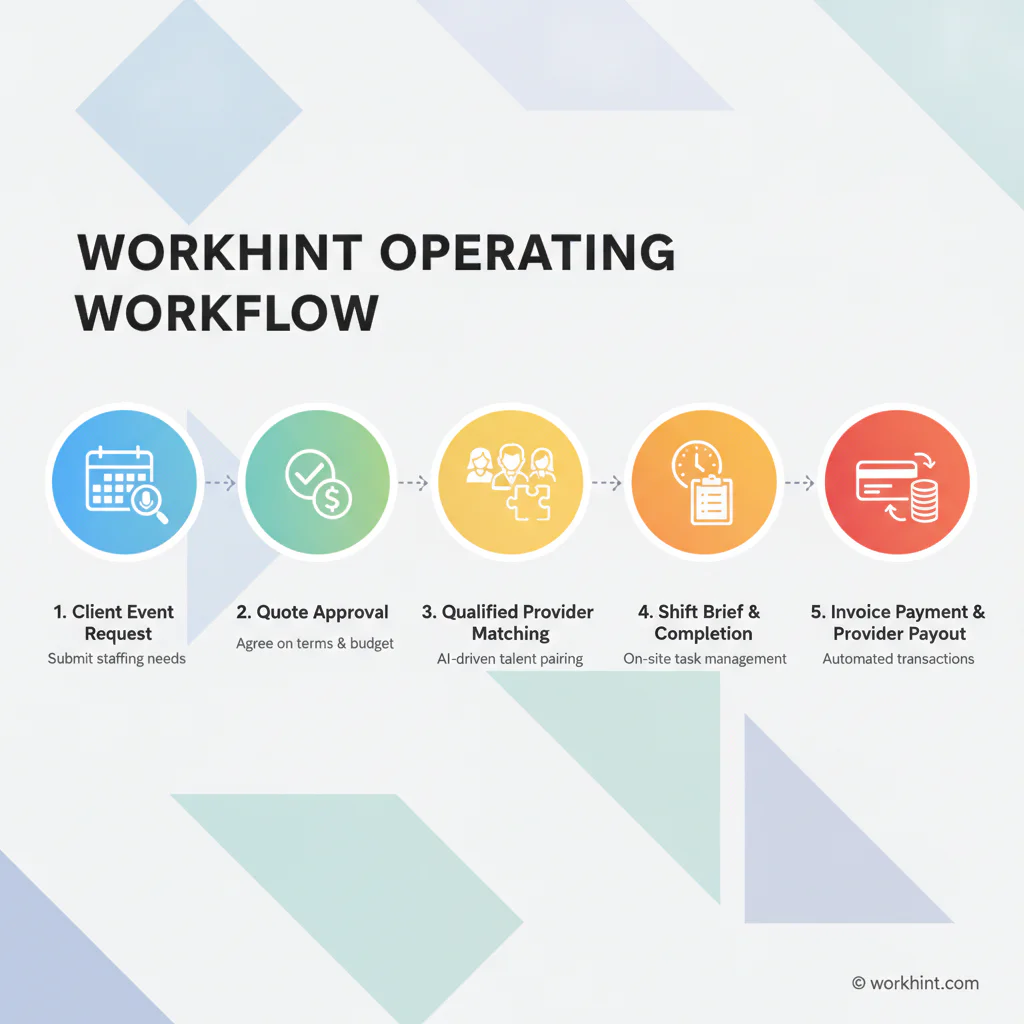
The operating flow becomes clear: a client submits an event request, the founder reviews the role mix, Workhint generates a quote approval process, qualified providers are invited, shifts appear on a calendar, event briefs are sent, attendance and completion are confirmed, the client receives an invoice, online payment is collected, and provider payouts are tracked from the same system.
That matters because event staffing fails when details scatter across forms, texts, spreadsheets, invoices, and payment apps. Workhint lets the founder validate a real staffing model before hiring a team or building custom software.
First 7-day launch plan
- Day 1: Choose one niche, one city, and one buyer type. Avoid trying to staff every event category.
- Day 2: Set up the branded Workhint platform basics: service request form, provider application, customer dashboard, and internal operations view.
- Day 3: Create pricing, quote approval, shift scheduling, event brief, payment, and provider payout workflows.
- Day 4: Recruit 10 to 20 independent providers with relevant event experience. Collect availability, role preferences, and reliability signals.
- Day 5: Contact planners, venues, caterers, and corporate event teams with one clear offer.
- Day 6: Route real inquiries through the platform, follow up, and test whether clients understand the offer.
- Day 7: Review demand, provider readiness, pricing, and fulfillment risk before spending more on marketing, uniforms, payroll support, or management hires.
Final launch checklist
- Choose a focused event staffing niche and launch market
- Register the business and open a business bank account
- Review insurance, liquor liability, worker classification, and local requirements
- Create client agreements, provider agreements, cancellation terms, and payment terms
- Configure the branded Workhint customer portal and provider onboarding flow
- Create pricing packages and a quote approval process
- Recruit the first independent providers and collect role-specific profiles
- Build event brief, shift confirmation, attendance, issue escalation, invoice, and payout workflows
- Contact first planners, venues, caterers, and corporate event buyers
- Validate demand before hiring employees or building a large roster
FAQ
How much does it cost to start an event staffing business?
A lean launch can often start with a few thousand dollars for registration, insurance, basic legal documents, a branded platform, and outreach. The bigger issue is cash flow, because providers may need to be paid before clients pay invoices.
Do I need employees to start an event staffing business?
Not necessarily. Some founders begin with independent contractors or service providers, but worker classification rules matter. Review local labor laws before assigning shifts.
What insurance does an event staffing agency need?
Most founders should review general liability, professional liability, workers’ compensation requirements, and event-specific coverage. If you staff bar service, liquor liability may be required.
How do event staffing agencies get first clients?
Start with local event planners, venues, caterers, corporate event teams, nonprofits, schools, and hospitality groups. A narrow offer and a small successful event usually beat broad cold outreach.
How should I price event staffing?
Use hourly or day rates with shift minimums, role premiums, overtime rules, and cancellation terms. Make sure the margin covers provider pay, admin time, insurance, replacements, and payment delays.
Can Workhint help me launch before I have a large roster?
Yes. Workhint can help create the branded customer portal, provider onboarding flow, scheduling process, quote approvals, payments, and payout tracking so you can validate demand with a small provider network.
Conclusion
An event staffing business is not just a list of available workers. It is a trust system for high-pressure, temporary work. Start with one event niche, validate customer demand, recruit a small reliable provider network, and use Workhint to turn requests, scheduling, briefs, payments, and payouts into a branded operating platform from day one.
Leave a Reply