


Contractor payment terms should protect cash flow, reduce disputes, and make payment approvals predictable before work starts.
Contractor payment terms define when an independent contractor, freelancer, agency, or service provider gets paid after work is agreed, delivered, approved, or invoiced. For businesses, the goal is not simply to choose net 15 or net 30. The goal is to create terms that match the work, risk, approval path, and contractor relationship.
Payment terms also sit next to compliance-sensitive decisions. U.S. businesses that pay independent contractors may need to report nonemployee compensation on Form 1099-NEC when IRS conditions apply, and the IRS guidance on reporting payments to independent contractors is a useful baseline. Classification should be reviewed separately from payment timing; the Department of Labor’s employment relationship guidance makes clear that the actual working relationship matters, not just the contract label.
What’s in this article?
- How common contractor payment terms work.
- When to use net 15, net 30, deposits, retainers, and milestone payments.
- A practical decision table for choosing terms.
- How to turn payment terms into an approval workflow.
- Common mistakes that create disputes, delays, or compliance risk.
Why contractor payment terms matter
Contractors run their own businesses and often work across several clients at once. Vague payment terms can make a good relationship feel unreliable.
For the business, unclear terms create a different problem: invoices arrive before acceptance, approvers disagree about milestones, finance lacks tax records, and nobody knows whether the clock starts on invoice date, receipt date, acceptance date, or month end.
Common contractor payment terms
Most contractor payment policies use one or more of these models:
- Due upon receipt: Payment is expected as soon as the invoice is received or processed. This works for small projects, trusted recurring contractors, and low-risk work.
- Deposit plus balance: A percentage is paid before work begins, with the rest due after delivery or approval. This is common when the contractor carries up-front effort or material costs.
- Net 15: Payment is due within 15 days, usually from invoice date unless the agreement says otherwise. It is useful when the business can approve work quickly and wants to maintain a strong contractor experience.
- Net 30: Payment is due within 30 days. This fits companies with structured accounts payable cycles, but it should be matched with clear invoice and approval rules.
- Milestone payments: Payment is tied to defined deliverables, phases, or acceptance events. This is often the cleanest model for project work.
- Monthly retainer: A fixed recurring amount covers an agreed scope, capacity, or support window. Retainers need clear scope boundaries and change rules.
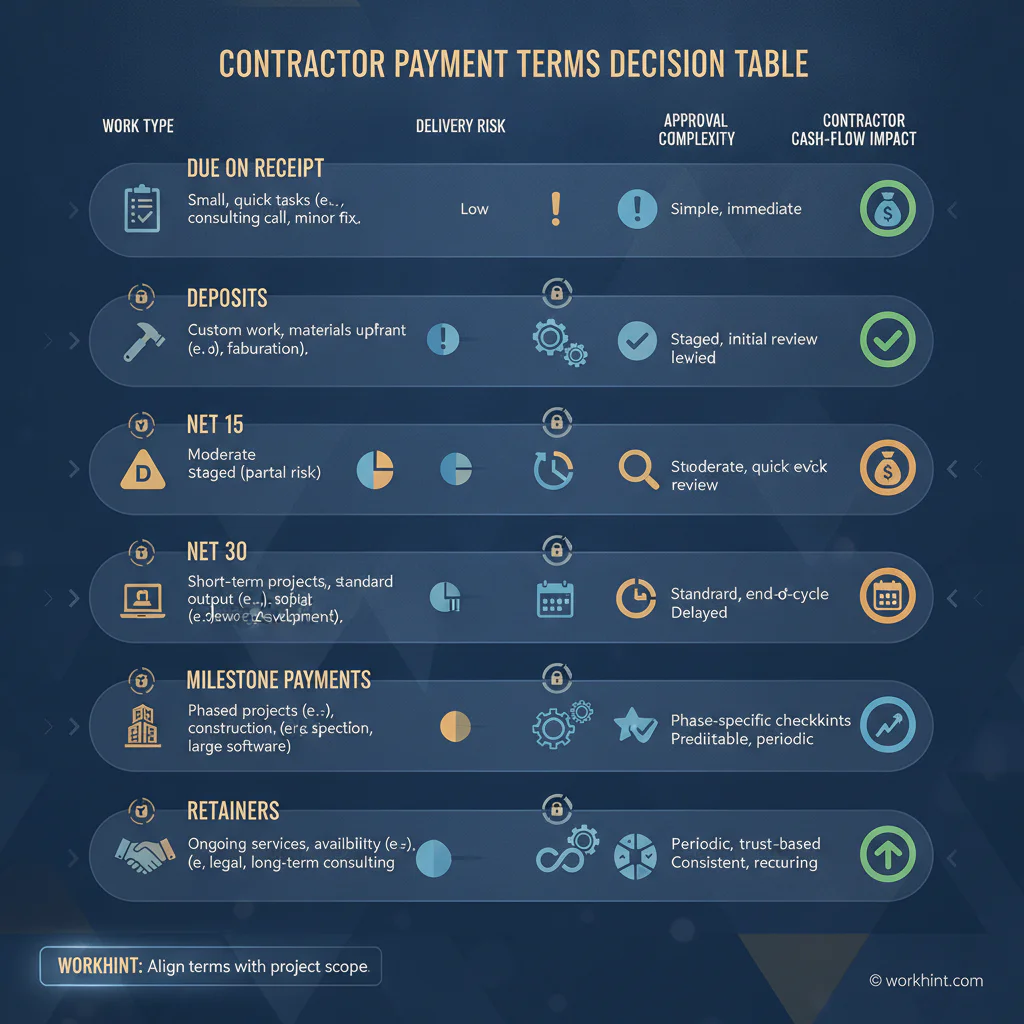
Contractor payment terms decision table
| Situation | Best-fit term | Why it works | Control to add |
|---|---|---|---|
| Small one-time task | Due upon receipt or net 15 | Low approval complexity and low financial risk. | Simple work acceptance note. |
| Creative or consulting project | Deposit plus milestones | Balances contractor cash flow with business approval. | Written milestone acceptance criteria. |
| Recurring freelance support | Net 15 or monthly retainer | Creates predictable payment and planning cadence. | Monthly scope and usage review. |
| Enterprise vendor or agency work | Net 30 with milestones | Matches AP cycles while preserving delivery checkpoints. | Named business approver and invoice deadline. |
| High-risk or cross-border work | Milestones with payment readiness checks | Prevents payment before documents, scope, and approvals are complete. | Tax, contract, and compliance review before first payment. |
How to set contractor payment terms
Start with the work model. A weekly designer, one-time videographer, software consultant, and staffing vendor should not all use the same terms. Decide whether the contractor is selling a deliverable, time, capacity, support, access to a team, or an outcome.
Then define the payment trigger. Finance, the contractor, and the business owner should reach the same conclusion. Good triggers include approved deliverable, accepted milestone, signed timesheet, approved invoice, month-end close, or scheduled retainer date. Weak triggers include “when finished” or “after the project.”
Next, define what must be true before the first payment. For U.S.-based contractors, businesses often collect Form W-9 before payment setup; the IRS page for Form W-9 explains that payers use it to request a taxpayer identification number and certification. Finance teams should also know when Form 1099-NEC may apply; the IRS Form 1099-NEC page covers nonemployee compensation reporting.
Finally, write the timing plainly. If net 15 starts from invoice date, say that. If it starts after business approval, say that. Contractors can plan around strict rules more easily than vague ones.
Build the approval workflow before invoices arrive
Payment terms fail when they live only in a contract. Each contractor engagement needs a business owner, finance owner, required documents, invoice instructions, approval criteria, and exception path.
- Capture the engagement: Record the contractor, scope, rate, term type, payment trigger, and approver.
- Confirm payment readiness: Check agreement status, tax records, payment details, and any required onboarding documents.
- Route work acceptance: Send deliverables, timesheets, or milestones to the right business approver.
- Approve the invoice: Match the invoice to the agreed scope, rate, milestone, and payment trigger.
- Track payment status: Give the contractor visibility into received, approved, scheduled, paid, or blocked status.
- Handle exceptions: Route missing information, disputed work, budget issues, or compliance holds to a named owner.
Common mistakes
The first mistake is using employee-style controls with contractor relationships. Payment terms should focus on outcomes, deliverables, acceptance, and agreed commercial terms, not employee-like supervision.
The second mistake is promising fast payment without a fast approval workflow. Net 15 is credible only if the business can review work, resolve exceptions, and submit payment on time.
The third mistake is treating every contractor the same. A long-term expert contractor may deserve faster, simpler terms than a new vendor doing an untested project. A strategic agency may need milestone controls because the work spans teams, budgets, and approvals.
Where Workhint fits
Workhint helps businesses turn contractor payment terms into a live work system instead of a policy buried in a contract. A company can structure intake, onboarding, document collection, role-based access, deliverable approvals, invoice routing, payment status, and reminders in one workflow.
That matters most when external work scales. The same system that captures scope can also assign the approver, collect required records, trigger milestone review, flag missing information, and give finance a clean handoff. Contractors get clarity, business owners get control, and payments stop depending on scattered emails.
FAQ
What are standard contractor payment terms?
Common contractor payment terms include due upon receipt, net 15, net 30, deposits, milestone payments, and monthly retainers. The right choice depends on project size, risk, approval speed, and contractor relationship.
Is net 15 or net 30 better for contractors?
Net 15 is usually better for contractor cash flow and relationship quality. Net 30 may fit companies with structured accounts payable cycles, but it should be paired with clear invoice deadlines and fast internal approvals.
Should businesses pay contractors upfront?
Upfront deposits make sense when the contractor has meaningful preparation costs, blocks capacity, buys materials, or starts a substantial project. The deposit should be tied to a clear scope and written agreement.
How do milestone payments work for contractors?
Milestone payments release payment after defined phases are completed and accepted. Each milestone should include a deliverable, acceptance criteria, approver, invoice rule, and payment timeline.
Can payment terms affect contractor compliance?
Payment timing alone does not decide classification, but the overall relationship matters. Businesses should keep contractor terms focused on scope, outcomes, independence, and commercial deliverables, while reviewing classification separately with qualified advisors when needed.
Conclusion
Contractor payment terms work best when they are specific, operational, and matched to the work. Net 15, net 30, deposits, retainers, and milestones can all work when the payment trigger, approver, documentation, and exception path are clear.
Treat payment terms as part of contractor operations. Decide the term, document the trigger, build the approval workflow, and give contractors predictable visibility from invoice to payment.
Leave a Reply