


You do not need to become a large inspection company before you can sell your first home inspection.
Introduction
If you are researching how to start a home inspection business, the old playbook can make the opportunity look heavier than it needs to be. Many guides assume you will become the inspector, buy every tool, build a solo book of business, and slowly add employees later.
A faster path is to launch as a platform-first inspection company. You create the brand, customer intake, scheduling, quote approval, payment flow, and reporting process first. Then you build a private network of licensed or qualified independent inspectors who can fulfill jobs under your operating standards.
This model still requires care. Home inspection rules vary by state, and insurance matters. But it lets you validate demand before hiring employees, leasing an office, or buying more equipment than the first jobs require.
What’s in this article?
- Why a home inspection business can work
- What you need to launch with a small budget
- How to price inspections and related services
- How to get first customers
- How Workhint helps you launch the operating platform
- A 7-day launch plan, checklist, and FAQ
Why This Business Works
Home inspections sit close to major financial decisions. Buyers, sellers, real estate agents, property investors, and landlords need clear inspection reports before they move forward. That creates steady demand in active real estate markets.
The business also has natural add-on revenue. A basic home inspection can lead to pre-listing inspections, rental property inspections, annual maintenance checks, reinspection visits, radon testing, mold testing referrals, sewer scope coordination, or commercial property walkthroughs.
The platform-first version works because customers care about trust, speed, availability, and report quality. If your brand can make it easy to request an inspection, match the job to a qualified provider, collect payment, and deliver a clean report, you can start building demand before you carry the cost of a full internal team.
Independent inspectors may join because you can send them booked work, handle customer intake, standardize communication, and reduce their admin burden. Your job is not to pretend licensing does not matter. Your job is to build a reliable network of providers who meet the rules in your launch market.
What You Need To Launch
Start with the requirements that prove the business can operate: legal setup, local licensing research, insurance, provider onboarding, customer intake, scheduling, payments, and inspection report standards.
If you will personally perform inspections, you may need training, licensing, exam fees, and basic tools. If you launch through independent licensed inspectors, your early spend shifts toward platform setup, provider recruitment, insurance guidance, customer acquisition, and quality control.
| Launch item | Lean startup approach | Estimated early budget |
|---|---|---|
| Business registration | Form the entity and set up basic banking | $100-$800 |
| Licensing research | Confirm state and local inspection rules before selling | $0-$500 |
| Insurance | General liability and errors and omissions guidance | $500-$2,000+ |
| Branded platform | Customer requests, scheduling, payments, and provider workflows | Start lean |
| Provider onboarding | Recruit licensed inspectors and collect credentials | $0-$500 |
| Marketing | Local website, real estate outreach, referral materials | $300-$1,500 |
| Tools and training | Only if you personally inspect homes at launch | $1,000-$5,000+ |
The important decision is sequencing. Do not buy a large equipment stack before you know which services customers request and which provider partners can fulfill them. Validate demand, book real jobs, learn the market, then invest.
How To Price It
Most home inspection businesses price by property size, property type, age, travel distance, report complexity, and add-on services. A simple first offer is a standard residential inspection with clear add-ons.
| Offer | Example price range | Best use |
|---|---|---|
| Standard home inspection | $300-$600 | Buyer or seller inspection for typical homes |
| Large home inspection | $600-$900+ | Larger, older, or more complex properties |
| Pre-listing inspection | $300-$700 | Sellers preparing before listing |
| Reinspection | $150-$300 | Verify repair completion after negotiation |
| Ancillary coordination | Referral fee or service margin | Radon, mold, sewer scope, pest, or specialty checks |
Keep the first pricing page easy to understand. Customers should know what is included, what costs extra, how quickly the report is delivered, and how they book. Providers should know the payout rules before accepting jobs.
How To Get First Customers
The first customers usually come from local trust channels, not broad advertising. Start with real estate agents, mortgage brokers, property managers, investor groups, relocation consultants, estate attorneys, and neighborhood homeowner communities.
Make the offer specific: fast booking, qualified inspectors, clear reports, transparent pricing, and easy payment. Then route every request through your platform so you learn which zip codes, home sizes, add-ons, and referral partners create real demand.
- Build a simple local landing page for your launch area.
- Create one inspection request form with the details providers need.
- Ask real estate agents what slows inspections down in your market.
- Offer fast scheduling windows if your provider network can support them.
- Follow up after every completed inspection for reviews and referrals.
How Workhint Helps Launch It
Workhint can become the branded operating platform behind the inspection company before you build custom software or hire coordinators. Instead of stitching together forms, calendars, spreadsheets, payment links, and provider emails, you can create a customer-facing inspection platform around your brand.
A buyer requests an inspection through your branded portal. The intake captures property details, timing, location, add-ons, agent information, and urgency. Workhint routes the request into an internal operations dashboard, helps match it to an available qualified inspector, sends the quote for approval, schedules the visit, collects payment, and tracks the job through completion.
For providers, Workhint can support invitations, onboarding documents, credential collection, assignment notifications, inspection checklists, mobile job execution, payout rules, and status updates. For customers, it can support a self-service dashboard, appointment updates, invoices, payment confirmation, report delivery checkpoints, and review requests.
That matters because the business is not just inspections. It is request intake, trust, matching, scheduling, documentation, payment, provider payout, and customer communication. Workhint helps you launch that operating foundation while you focus on demand, provider quality, and referral relationships.
First 7-Day Launch Plan
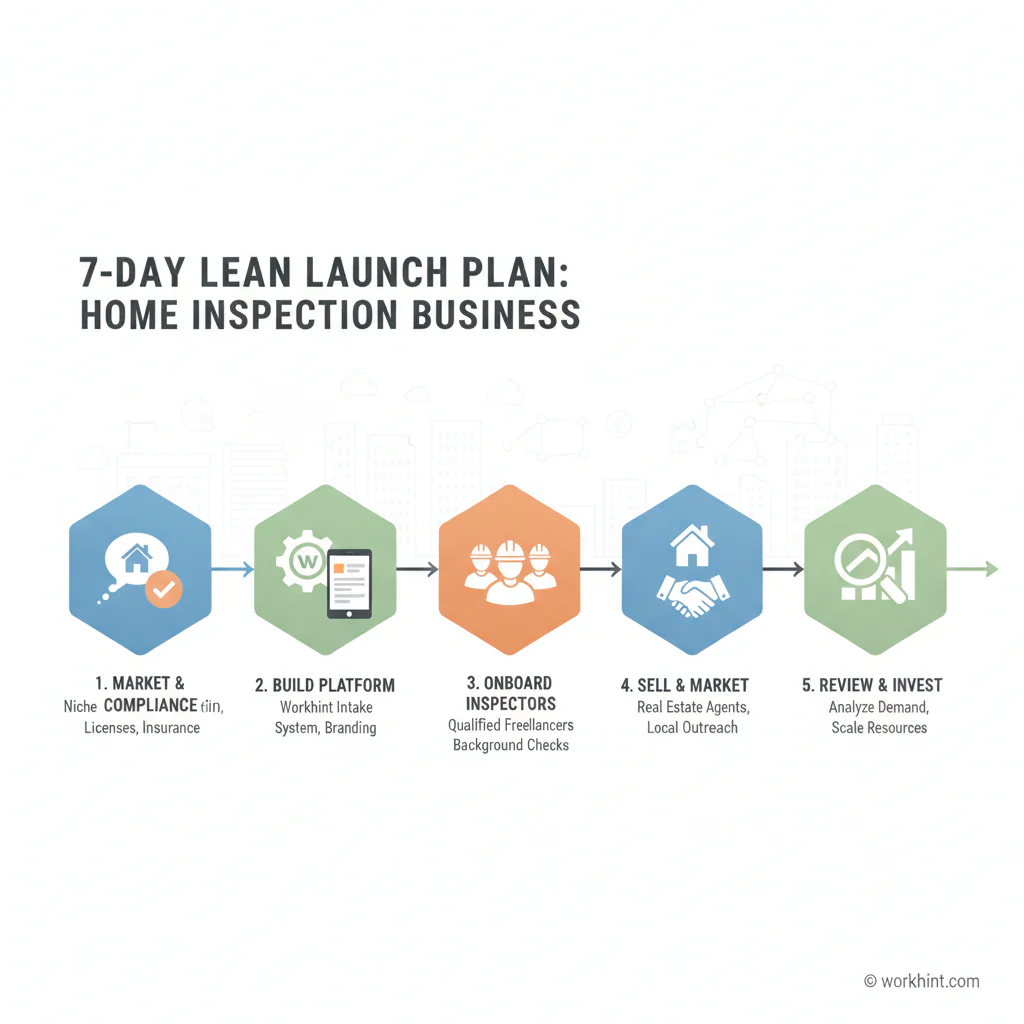
Use the first week to validate whether customers and providers will move through the model. The goal is not perfection. The goal is a working path from request to completed inspection.
- Day 1: Choose the launch market, inspection offer, customer type, and licensing requirements to verify.
- Day 2: Set up the branded Workhint platform basics: request form, customer dashboard, and internal pipeline.
- Day 3: Build quote approval, scheduling, payment, provider payout, and report delivery steps.
- Day 4: Recruit the first licensed independent inspectors or inspection partners.
- Day 5: Contact real estate agents, investor groups, and property managers with the first offer.
- Day 6: Route early requests through the platform and test provider availability.
- Day 7: Review demand, pricing, fulfillment quality, and what must be improved before spending more.
Final Launch Checklist
- Choose the inspection niche and launch geography.
- Verify state licensing, insurance, and disclosure requirements.
- Register the business and set up banking.
- Create the branded Workhint customer platform.
- Build the inspection request, quote, scheduling, payment, and payout workflows.
- Recruit qualified independent inspectors or provider partners.
- Define report standards, service levels, and customer communication rules.
- Launch a local landing page and referral outreach list.
- Book first requests before buying unnecessary equipment or hiring employees.
- Review results and invest only where demand is proven.
FAQ
How much does it cost to start a home inspection business?
A lean launch can often begin with a few thousand dollars, depending on licensing, insurance, training, tools, and marketing. A provider-network model can reduce early equipment spend because you work with qualified inspectors who already have the required tools.
Do home inspectors need a license?
Licensing rules vary by state and sometimes by locality. Check your state requirements before selling inspections, onboarding providers, or advertising specific services.
Can I start a home inspection business with no employees?
Yes, if you structure the business carefully. You can start with independent licensed inspectors or provider partners, but you need clear contracts, compliance guidance, insurance, quality standards, and scheduling rules.
What insurance does a home inspection business need?
Most operators should review general liability and errors and omissions coverage. Requirements vary, so speak with an insurance professional who understands inspection businesses in your state.
How do home inspection businesses get customers?
Early customers often come from real estate agents, property managers, investor groups, local SEO, referrals, and direct outreach. Speed, trust, and clear reports matter more than looking like a large company.
What should I avoid buying at the beginning?
Avoid expensive tools, office leases, vehicles, broad advertising campaigns, and employee hiring until customer demand and inspection volume justify them.
Conclusion
A home inspection business can be launched lean if you treat it as an operating platform, not just a solo trade. Start with demand validation, local compliance, a qualified provider network, and a branded system that makes booking and fulfillment easy.
Workhint gives you the foundation to launch that system quickly: customer intake, provider onboarding, scheduling, approvals, payments, payouts, reporting, and communication in one branded platform. Prove the market first. Then invest with confidence.
Leave a Reply