


Staffing vendors work best when every request, approval, submission, and invoice follows one visible operating path.
Learning how to manage staffing vendors is less about choosing another tool and more about designing the operating rhythm around external labor. A company may use staffing agencies to fill temporary roles, seasonal demand, specialized work, field shifts, or hard-to-hire positions. The problem starts when each manager works with suppliers differently, finance sees invoices late, and HR cannot tell which suppliers are performing.
A staffing vendor program needs a clear workflow. It should define how demand becomes a requisition, how suppliers receive work, which approvals are required, how assignments start, how time or milestones are approved, and how vendor performance is measured.
What’s in this article?
- A practical staffing vendor management workflow.
- The roles HR, procurement, finance, operations, and hiring managers should own.
- A KPI table for comparing staffing vendors fairly.
- Common mistakes that create cost, compliance, and delivery problems.
- Where Workhint fits when staffing vendor management needs to become a live system.
Why staffing vendor management matters
Staffing vendors can help a business move faster, but only when the company controls the process. Without a shared workflow, the business may lose visibility into open requests, supplier response times, worker start dates, rate differences, compliance documents, assignment changes, and invoices. That can affect service levels, budget control, worker experience, and workforce planning.
The Washington Office of Financial Management describes workforce planning as aligning workforce needs with the business plan. That logic applies to external labor too. Staffing vendors should be part of the workforce plan, with clear rules for when to use suppliers, which suppliers receive requests, what evidence is required, and how performance is reviewed.
How to manage staffing vendors with a clear operating model
The core model has four layers: demand, supplier workflow, assignment control, and performance review. Each layer needs an owner. HR or talent may own role requirements. Procurement may own supplier contracts and rate cards. Finance may own invoice controls. Operations or department leaders may own demand, schedules, and quality.
Start by defining approved staffing use cases: temporary coverage, surge capacity, location-based staffing, specialized roles, seasonal labor, or trial assignments before permanent hiring. Then define which suppliers are approved for each use case. This prevents managers from sending urgent requests to whichever agency they know personally.
A practical staffing vendor management workflow
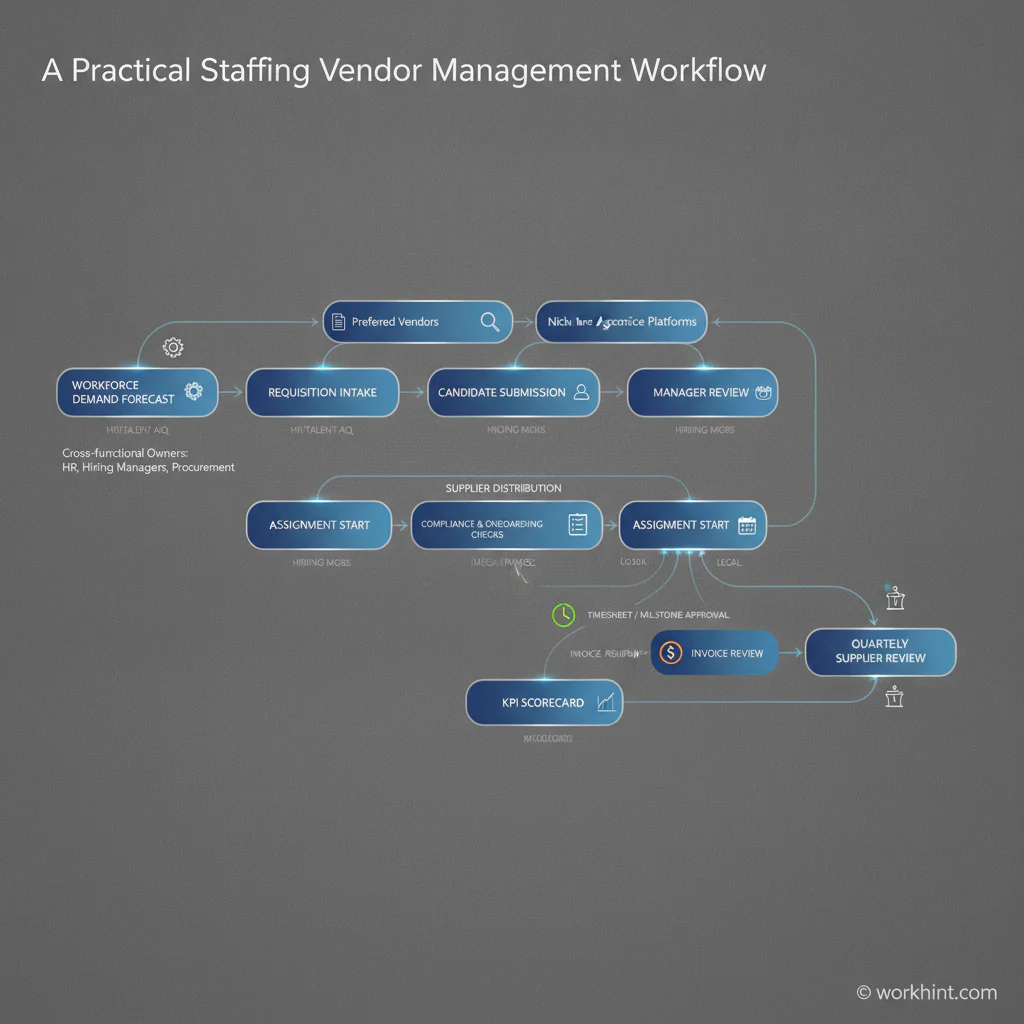
- Forecast demand. Review upcoming workload, coverage gaps, location needs, client commitments, and seasonal demand before requests become emergencies.
- Create a requisition intake. Capture role, location, shift or project dates, skills, pay or bill rate range, approval owner, budget, start date, and compliance requirements.
- Route approvals. Send the request to the right business, HR, procurement, and finance approvers based on cost, risk, location, or worker type.
- Distribute to approved suppliers. Share the requisition with selected staffing vendors using clear submission rules, deadline expectations, rate limits, and candidate requirements.
- Review submissions consistently. Compare candidates or workers against the same criteria instead of letting each manager invent a process.
- Confirm compliance and onboarding. Track required documents, background checks, safety training, system access, site rules, and assignment details before work starts.
- Manage active assignments. Keep schedules, manager feedback, time approvals, exceptions, replacement requests, and worker changes visible.
- Approve invoices against evidence. Match invoices to approved time, shifts, milestones, rates, purchase orders, and assignment records before payment.
- Review supplier performance. Use a scorecard to compare response speed, fill quality, retention, compliance completion, issue resolution, and cost.
The American Staffing Association lists vendor management platforms as tools that help standardize rates, terms, compliance protocols, and supplier entry points. Even without an enterprise VMS, the same principle matters: standardize the process before automating it.
Staffing vendor KPI table
| KPI | What it tells you | How to use it |
|---|---|---|
| Time to submit | How quickly a supplier responds to an open request | Compare vendors by role type, urgency, and location |
| Fill rate | How often the vendor fills accepted requisitions | Identify which suppliers deserve priority distribution |
| Start reliability | Whether assigned workers actually start as confirmed | Track no-shows, late starts, and replacement speed |
| Quality of match | How well workers fit skills, schedule, and manager expectations | Use manager feedback and early assignment outcomes |
| Compliance completion | Whether documents, checks, and training are complete before start | Block starts or escalate exceptions before risk appears |
| Invoice accuracy | Whether invoices match approved time, rates, and assignments | Reduce payment disputes and finance rework |
External guidance often warns that managing multiple staffing vendors increases coordination across HR, procurement, finance, and hiring managers. Suppliers may bring different contracts, invoicing processes, reporting requirements, and communication methods. That is why the KPI table should be tied to the workflow, not kept in a separate quarterly spreadsheet.
Common staffing vendor management mistakes
The first mistake is treating staffing vendor management as procurement only. Contract terms matter, but the daily workflow lives across hiring managers, worker onboarding, assignment changes, time approval, and issue resolution.
The second mistake is distributing every requisition to every supplier. That can create noise, duplicate submissions, and weak accountability. Better programs define supplier lanes by role, location, availability, cost, and performance. Vendors should know when they are a preferred supplier, backup supplier, specialist supplier, or inactive supplier.
The third mistake is reviewing vendors only when something goes wrong. A useful review rhythm looks at open requisitions weekly, invoice exceptions before payment cycles, and supplier scorecards monthly or quarterly. The fix is a consistent review cadence with evidence attached.
Where Workhint fits
Workhint fits when staffing vendor management needs to become a live workflow instead of a mix of emails, spreadsheets, shared folders, and finance follow-ups. A business can use Workhint to structure requisition intake, assign approval owners, route requests to the right staffing vendors, collect required documents, track candidate or worker submissions, manage assignment updates, connect approved time or milestones to invoice readiness, and report on vendor performance.
The value is not that Workhint replaces every staffing supplier or payroll system. The value is one operating path for external workforce coordination. HR can see worker readiness, procurement can see supplier activity, finance can see payment evidence, and managers can see what to approve next.
FAQ
What is staffing vendor management?
Staffing vendor management is the process a company uses to select, coordinate, review, and pay staffing agencies or suppliers that provide temporary, contingent, contract, or shift-based workers.
Who should own staffing vendor management?
Ownership depends on the company, but the process should be cross-functional. HR or talent usually owns role requirements and worker readiness, procurement owns supplier terms, finance owns invoice controls, and operations owns active workforce demand.
What KPIs should companies track for staffing vendors?
Useful KPIs include time to submit, fill rate, start reliability, quality of match, compliance completion, assignment issue rate, replacement speed, invoice accuracy, and cost against approved rates.
Do companies need a VMS to manage staffing vendors?
Not always. A large contingent workforce may need a VMS, MSP, or specialized platform. Smaller programs still need a defined workflow for intake, approvals, submissions, onboarding, time approval, invoices, and supplier reviews.
Conclusion
The practical answer to how to manage staffing vendors is to make the workflow visible before the vendor network grows beyond control. Define when staffing suppliers should be used, route every request through a consistent intake, assign approval owners, standardize submissions, track assignment evidence, approve invoices against records, and review vendors using clear KPIs. The stronger the operating model, the easier it becomes to scale external workforce support without losing cost control, quality, or accountability.
Leave a Reply