


You can validate employer demand before opening a clinic, buying a van, or hiring a full testing team.
A mobile drug testing business can start as a lean onsite service for employers that need faster screening. Companies lose time when workers travel to clinics, managers need compliant processes, and small employers do not want to manage testing logistics themselves.
The low-risk version is not a traditional clinic. It is a branded platform with trained independent collectors, lab and Medical Review Officer partners, scheduling, and tight documentation. Prove demand with employer customers before investing in fixed facilities or owned vehicles.
What’s in this article?
- Why mobile drug testing works as a service business
- What you need before accepting customers
- How to price onsite testing and employer accounts
- How to get the first customers
- How Workhint helps launch the operating platform
- A 7-day launch plan, checklist, and FAQ
Why this business works
Employers buy drug testing because they need safety, compliance, hiring speed, and clear records. Construction firms, transportation companies, staffing agencies, warehouses, home service companies, schools, municipalities, and healthcare-adjacent employers may need pre-employment, random, post-incident, reasonable suspicion, or return-to-duty testing.
Mobile service reduces downtime. Instead of sending workers across town, the employer can schedule testing at a job site, office, yard, or hiring event. That convenience supports visit fees, per-test pricing, and recurring employer accounts.
The founder does not need to start by employing collectors. A better early model is to become the brand, customer platform, scheduling layer, and quality-control owner while recruiting qualified independent collectors and lab partners. That keeps fixed cost lower and lets you test which industries, locations, and packages actually sell.
What you need to launch
Start by deciding whether you will serve DOT-regulated employers, non-DOT employers, or both. DOT testing has strict requirements under 49 CFR Part 40, including trained collectors, required procedures, custody and control documentation, and specific rules for alcohol testing. Non-DOT testing still needs careful policies, privacy handling, and reliable partners, but the requirements depend on the employer, state law, and test type.
You need qualified collectors or a plan to become qualified yourself, lab and MRO relationships, collection supplies, insurance, service agreements, secure records, scheduling, invoicing, and a customer intake process. If alcohol testing is part of the offer, confirm the equipment and training needed before selling it.
| Launch item | Lean startup approach | Early budget range |
|---|---|---|
| Business setup | LLC, basic legal templates, local licensing check | $300-$1,200 |
| Training and qualification | Collector training first; add BAT if demand supports it | $500-$2,500 |
| Insurance | General liability plus professional coverage guidance | $800-$3,000 |
| Supplies and lab setup | Partner-supplied kits where possible, basic mobile kit | $500-$3,000 |
| Platform and brand | Branded intake, scheduling, employer portal, payments | $500-$2,500 |
| Customer acquisition | Local outreach, search page, employer lists, partnerships | $300-$2,000 |
These ranges are planning estimates, not legal or compliance advice. Validate demand first, then invest in broader equipment, fixed locations, or wider coverage after job volume justifies it.
How to price it
Pricing should combine convenience, compliance handling, and testing volume. Many employers understand per-test pricing, but onsite work also needs a visit fee or minimum because travel and scheduling consume real capacity.
| Offer | Best use | Example pricing logic |
|---|---|---|
| Single onsite visit | Small employer or urgent request | Visit fee plus per-test fee |
| Hiring event package | Warehouses, staffing, seasonal teams | Minimum test count with volume discount |
| Monthly employer account | Recurring random or pre-employment testing | Monthly platform fee plus test fees |
| After-hours response | Post-incident or reasonable suspicion needs | Premium visit fee and clear response window |
Do not win customers by being the cheapest collector. Win by being easier to schedule, clearer to document, faster to communicate with, and more reliable for employers that cannot afford operational confusion.
How to get first customers
Start where downtime is expensive and testing is already familiar. Build a list of 50 local employers in transportation, construction, logistics, manufacturing, staffing, security, and field services. Ask who handles drug testing coordination today, and what makes it slow.
Your first offer should be narrow: onsite pre-employment testing for small logistics companies in one metro area, or scheduled testing days for staffing agencies. A focused offer is easier to sell than a broad testing menu.
Use direct outreach, Google Business Profile, local SEO pages, HR and safety associations, staffing partnerships, occupational health referrals, and owner-to-owner introductions. The first milestone is not a huge marketing campaign. It is five employer conversations, one pilot, and proof that customers will route requests through your process.
How Workhint helps launch it
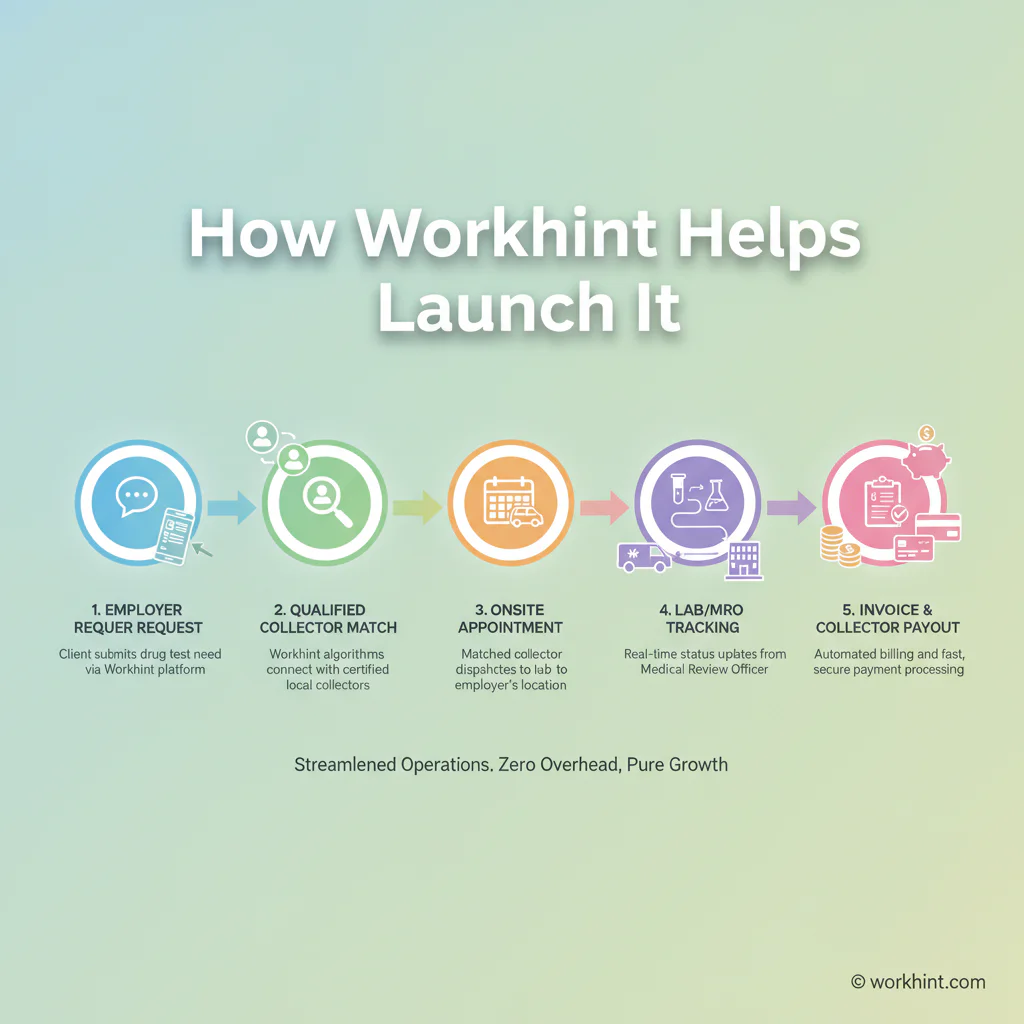
Workhint can become the branded operating foundation before you build custom software or hire coordinators. Instead of juggling forms, spreadsheets, texts, calendars, invoices, and collector availability, you can launch one platform for the service flow.
An employer submits a request through your portal, selects the testing need, uploads policy or candidate details, and chooses an onsite window. Workhint routes the request to your internal dashboard, checks the service area, matches the job with a qualified collector or partner, sends the assignment, tracks confirmations, and keeps the customer updated.
After the appointment, the platform can manage completion forms, document collection, lab or MRO tracking, invoices, online payments, and contractor payouts. The owner sees requests, appointments, provider readiness, accounts, revenue, and exceptions in one place.
Customers are not just buying a test. They are buying reliable coordination, documentation, and response. Workhint lets you launch that operating system while you sell employer accounts and recruit dependable collectors.
First 7-day launch plan
- Day 1: Choose one market, one customer type, and one testing offer. Avoid selling every test type immediately.
- Day 2: Set up the branded Workhint platform basics: employer intake, request types, service areas, and customer dashboard.
- Day 3: Build the quote, scheduling, assignment, completion, payment, and payout flow.
- Day 4: Identify qualified collectors, lab/MRO partners, and compliance advisors. Confirm what you can legally sell.
- Day 5: Contact the first 50 employer prospects and ask about current testing friction.
- Day 6: Route interested prospects through the platform, price pilots, and confirm collector coverage.
- Day 7: Review demand, compliance readiness, pricing, response times, and customer objections before investing more.
Final launch checklist
- Pick a narrow employer niche and launch city.
- Confirm DOT, non-DOT, state, privacy, and insurance requirements with qualified advisors.
- Set up lab, MRO, supply, and collector relationships.
- Create service packages, visit minimums, and recurring account pricing.
- Configure a branded Workhint customer portal, intake flow, scheduling process, assignment workflow, payment flow, and payout process.
- Recruit the first qualified independent collectors or partner providers.
- Build a list of local employer prospects and start direct outreach.
- Run one pilot before buying expensive equipment, opening a clinic, or hiring staff.
FAQ
How much does it cost to start a mobile drug testing business?
A lean launch may start with a few thousand dollars for setup, training, insurance, supplies, platform, and outreach. Costs rise quickly with alcohol testing equipment, a fixed site, a vehicle buildout, or paid staff. Validate demand first.
Do I need certification to collect DOT drug tests?
DOT collections must be handled by collectors who meet Part 40 training requirements. Confirm the exact qualification path, mock collection requirements, and refresher rules before selling DOT services.
Can I start with independent collectors instead of employees?
Yes, many founders can start with qualified independent providers or partner collectors, but the model needs clear contracts, compliance controls, availability tracking, service standards, and payout rules.
Who are the best first customers?
Start with employers that already need testing and lose money when workers leave the site: logistics, construction, staffing, manufacturing, transportation, security, and field service companies.
Should I buy a mobile testing van right away?
Usually no. Begin with a lean mobile kit, qualified providers, and scheduled onsite visits. Buy a dedicated vehicle only when recurring volume proves the investment will pay back.
How do I make the business recurring?
Sell employer accounts instead of one-off tests. Offer pre-employment, random, scheduled onsite days, after-hours response, and recurring reporting workflows.
Can Workhint replace a custom software build?
For launch, yes. Workhint can generate the branded intake, scheduling, provider coordination, forms, payment, payout, and dashboard foundation so you can operate before investing in custom software.
Conclusion
A mobile drug testing business is worth exploring when you treat it as an operations business, not just a testing errand. Start narrow, verify compliance, recruit qualified providers, sell employer convenience, and use Workhint to create the branded platform that coordinates requests, schedules, documentation, payments, and payouts from day one.
Leave a Reply