


Use this procurement checklist to move purchase requests from idea to approved, documented, paid, and audit-ready work.
A procurement checklist template helps a business buy goods or services without losing control of approvals, vendor evidence, contracts, receipts, invoices, or records. The value is not the checklist itself. The value is the discipline it creates before money leaves the company.
This resource is written for operations, finance, procurement, IT, and department leaders who need a practical way to manage purchases across teams. It is not legal, tax, or public procurement advice. If your organization spends grant funds, government funds, regulated funds, or public money, confirm your rules with counsel or the applicable procurement authority. For example, federal award recipients may need to follow the procurement standards in 2 CFR 200.317 through 200.327.
What’s included
- A procurement checklist template you can adapt for business purchases.
- A step-by-step workflow from purchase request to invoice handoff.
- A documentation table for approvals, quotes, contracts, receiving, and payment records.
- Common mistakes that cause delays, rejected requests, duplicate purchases, or weak audit trails.
How to use this procurement checklist
Use the checklist before the purchase starts, not after the invoice arrives. The requester should complete the business need, budget, timing, preferred vendor, and required outcome. Finance or procurement should then decide the correct path: simple purchase, quote comparison, RFP, renewal, sole-source justification, software/security review, or contract review.
Public-sector and university procurement checklists often separate purchases by type because different purchases require different evidence. The North Carolina Department of Information Technology, for instance, publishes different forms and templates for IT procurement activities, while the UCSF procurement checklist highlights different supporting documents for categories such as capital equipment, software, and services. Most private companies can use the same principle without copying public rules: match the checklist to the risk and value of the purchase.
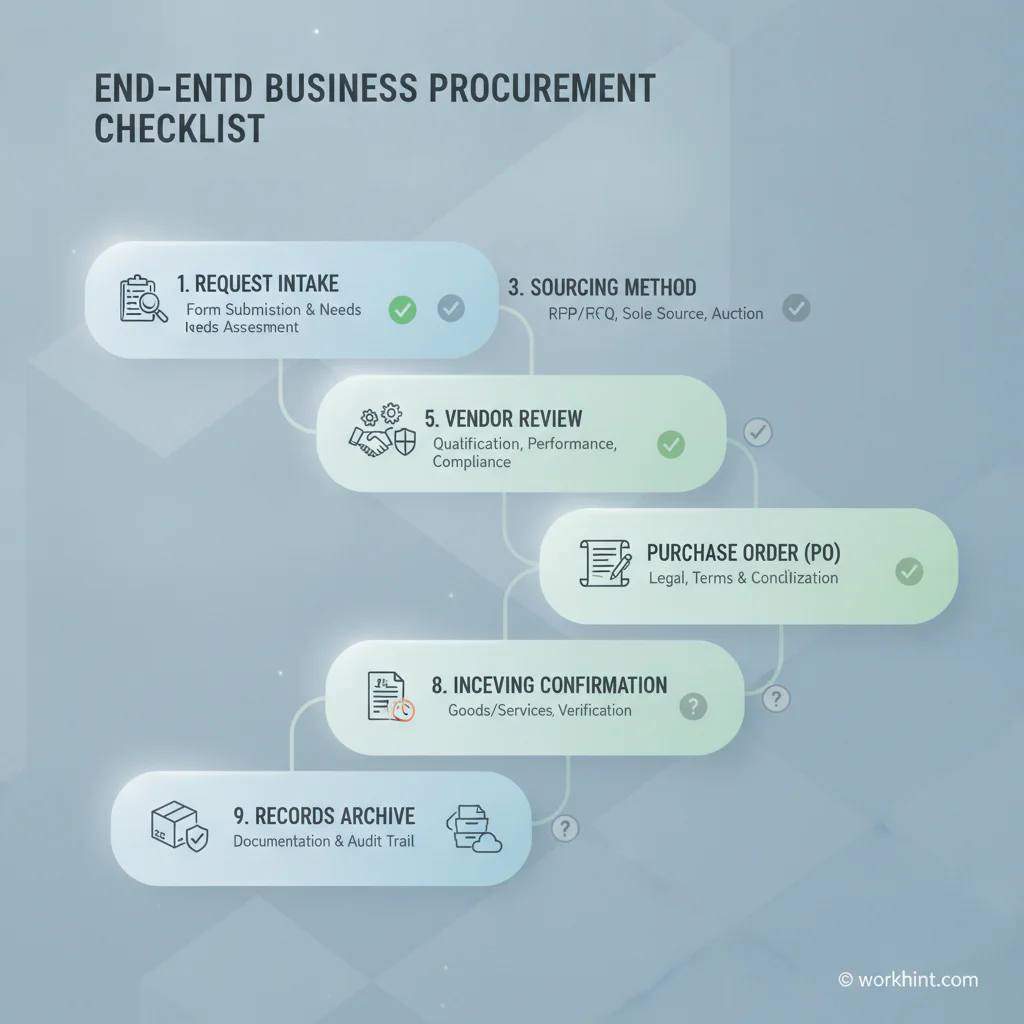
Procurement checklist template
| Stage | Checklist item | Owner | Evidence to keep |
|---|---|---|---|
| Intake | Describe the business need, expected outcome, urgency, department, and requester. | Requester | Purchase request, business case, required date |
| Budget | Confirm budget owner, cost center, spending limit, and whether the purchase is planned. | Finance | Budget approval, account code, spend threshold |
| Requirements | Define specifications, service scope, users, delivery needs, security needs, and success criteria. | Requester | Requirements brief, scope notes, stakeholder comments |
| Sourcing | Choose the sourcing path: preferred vendor, quotes, RFI, RFP, RFQ, renewal, or exception. | Procurement | Quote comparison, RFP file, exception rationale |
| Vendor review | Check vendor fit, insurance, tax information, security, references, conflicts, and risk level. | Procurement or Risk | Vendor profile, risk notes, compliance documents |
| Approval | Route the purchase to the correct approvers based on value, department, risk, and contract terms. | Finance | Approval log, approver names, timestamps |
| Contract | Review pricing, term, renewal, cancellation, data, liability, service levels, and signature authority. | Legal or Operations | Signed contract, redlines, order form, amendments |
| Purchase order | Create the purchase order or internal approval record before work starts. | Procurement | PO number, approved amount, vendor details |
| Receiving | Confirm goods were received or services were completed against the agreed scope. | Requester | Receipt, delivery note, completion confirmation |
| Invoice | Match invoice to PO, contract, received goods or services, tax details, and payment terms. | Accounts Payable | Invoice, match record, payment approval |
| Records | Archive the full procurement file so future audits, renewals, and vendor reviews have context. | Procurement | Complete procurement folder, renewal date, owner |
Procurement workflow by purchase type
Not every purchase needs the same process. A $200 office supply order should not move like a six-figure software contract. Use thresholds so the checklist stays useful instead of bureaucratic.
- Low-risk routine purchase: requester, budget approval, preferred vendor check, receipt, invoice match.
- Competitive purchase: requirements, quote comparison or RFP, evaluation notes, approval, contract or PO, receiving, invoice match.
- Software or data purchase: requirements, security review, data handling review, integration review, legal review, approval, implementation owner.
- Sole-source or exception purchase: business rationale, market check, approval by finance or leadership, contract evidence, record of exception.
- Renewal: usage review, vendor performance, price changes, owner confirmation, cancellation window, approval, updated contract.
If you use RFIs before formal procurement, resources such as the Results for America RFI checklist are useful because they show how early market discovery can be structured before an organization commits to a vendor or solicitation path.
Example procurement checklist in practice
Imagine a customer success team wants to buy a new training platform. The requester submits the need, user count, current problem, budget estimate, and target launch date. Finance confirms budget. IT checks security and integrations. Procurement compares two vendors and one renewal option. Legal reviews data terms and cancellation language. The department head approves the final vendor. After signature, procurement records the renewal date, the implementation owner confirms delivery, and accounts payable matches the first invoice to the signed order form.
The checklist prevents the common failure pattern: someone signs a tool before security review, the invoice arrives without a purchase order, nobody owns implementation, and the renewal surprises finance twelve months later.
Common procurement checklist mistakes
- Starting with the vendor instead of the need. The checklist should define the business outcome before comparing suppliers.
- Using one approval path for every purchase. Low-risk purchases need speed; high-risk purchases need evidence.
- Skipping receiving confirmation. Accounts payable should know whether the business actually received what it bought.
- Losing exception rationale. Sole-source decisions, emergency purchases, and expedited approvals need a written explanation.
- Forgetting renewal ownership. A procurement process is incomplete if nobody owns the renewal, cancellation window, or performance review.
Where Workhint fits
Workhint helps turn a procurement checklist template into a live work system. Instead of managing requests through email, spreadsheets, and scattered documents, a team can structure intake, route approvals by threshold, assign vendor review tasks, collect required files, track contract status, confirm receiving, and hand approved invoices to the right owner.
The checklist remains the operating standard. Workhint helps digitize the workflow around it so procurement, finance, legal, IT, department owners, and accounts payable can see what is waiting, who owns the next step, and what evidence is already attached.
FAQ
What is a procurement checklist template?
A procurement checklist template is a reusable list of steps, approvals, documents, and records used to manage purchases from request intake through vendor selection, contract review, receiving, invoice approval, and archive.
Who should own the procurement checklist?
Procurement or finance usually owns the checklist. Requesters own the business need, department leaders own approval, legal owns contract review when needed, and accounts payable owns invoice processing.
Does every purchase need three quotes?
No. Quote requirements depend on company policy, purchase value, risk, funding source, and applicable rules. Many companies use spending thresholds so routine purchases move quickly while larger purchases require more evidence.
What documents should be kept in a procurement file?
A strong procurement file usually includes the request, budget approval, requirements, vendor comparison or exception rationale, contracts or purchase orders, receiving confirmation, invoices, payment records, and relevant correspondence.
How is procurement different from vendor management?
Procurement focuses on buying the product or service correctly. Vendor management continues after the purchase and tracks performance, risk, renewals, relationship ownership, service levels, and value.
Conclusion
A good procurement checklist template gives teams a clear path from purchase request to payment without burying every purchase in unnecessary process. Start with the business need, match the workflow to the risk, keep the right evidence, and make ownership visible at every step. The result is faster purchasing, cleaner approvals, fewer invoice surprises, and a procurement record the business can trust later.
Leave a Reply