


Complex work slips when hidden dependencies control the schedule. The critical path shows which work cannot drift.
The critical path method helps operations teams see the sequence of dependent work that determines when a project, service launch, implementation, or cross-functional workflow can actually finish. Instead of treating every task as equally urgent, the method separates schedule-critical work from flexible work so managers know where delay will hurt most.
That matters beyond classic project management. In operations, the slowest dependency often hides inside approval, access setup, vendor response, customer information, quality review, or a single unavailable specialist. A plan may look healthy in a task list while the true completion date is already at risk. Critical path thinking gives teams a way to make that risk visible before it turns into missed commitments.
What’s in this article?
- What the critical path method means for operations teams
- How to identify the path that controls delivery time
- A practical table for mapping dependencies and owners
- How to turn the plan into a live workflow
- Common mistakes that make critical path analysis unreliable
Why critical path method design matters
The classic definition is straightforward: the critical path is the longest sequence of dependent activities that determines the minimum project duration. As Atlassian explains, any delay on that sequence delays the project. Asana’s CPM guide similarly frames it as a way to identify dependent tasks, task duration, float, and the work that must stay on schedule.
For business operations, the value is not the diagram itself. The value is knowing which work deserves management attention. A customer onboarding team might have 60 tasks, but only a handful determine the go-live date. A field service rollout might depend on permits, provider availability, equipment delivery, training, and final quality review. A new internal workflow might depend on data cleanup, access permissions, approval rules, and user training. If those dependencies are not visible, leaders manage noise instead of risk.
Harvard Business Review described the critical path method as a planning and scheduling technique for complex projects decades ago. The same principle still applies: when work depends on other work, the team needs to understand which sequence controls time, cost, and delivery reliability.
How to use the critical path method
Start with one operational outcome, not the whole business. Good candidates include a customer implementation, a location launch, a vendor onboarding program, a service delivery workflow, a system migration, or a high-stakes internal process change.
- Define the completion point. Name the exact state that counts as done. “Launch complete” is vague. “Customer has signed off, users have access, first transaction has processed, and support handoff is complete” is usable.
- List the required activities. Capture the work needed to reach that state, including approvals, documents, reviews, training, external responses, and system setup.
- Identify dependencies. For each activity, ask what must be true before it can start. Dependencies are where operational plans usually break.
- Estimate duration. Use actual history where possible. Separate active work time from waiting time. A two-hour approval that waits four days is a four-day schedule risk.
- Find the longest dependent sequence. The path with the longest total duration is the critical path. Tasks outside it may still matter, but they have some float.
- Assign owners and review points. Every task on the path needs one accountable owner, a due date, status evidence, and an escalation rule.
PMI’s explanation of critical path calculations goes deeper into scheduling terms such as early start, late start, early finish, late finish, and float. Operations teams do not always need heavy math, but they do need the discipline behind it: understand sequence, calculate slack, and protect the work that controls the finish date.
Critical path planning table
| Element | Question to answer | Operational decision |
|---|---|---|
| Activity | What work must happen? | Write the task as a visible work item, not a vague milestone. |
| Dependency | What must be complete first? | Link the predecessor and make waiting work visible. |
| Duration | How long does it really take? | Use history, expected waiting time, and known constraints. |
| Owner | Who is accountable? | Assign one owner who can update status and resolve blockers. |
| Escalation rule | When does delay need attention? | Trigger review before the task burns all available float. |
| Evidence | How do we know it is done? | Require a document, approval, system status, or completion record. |
Turn the critical path into a live workflow
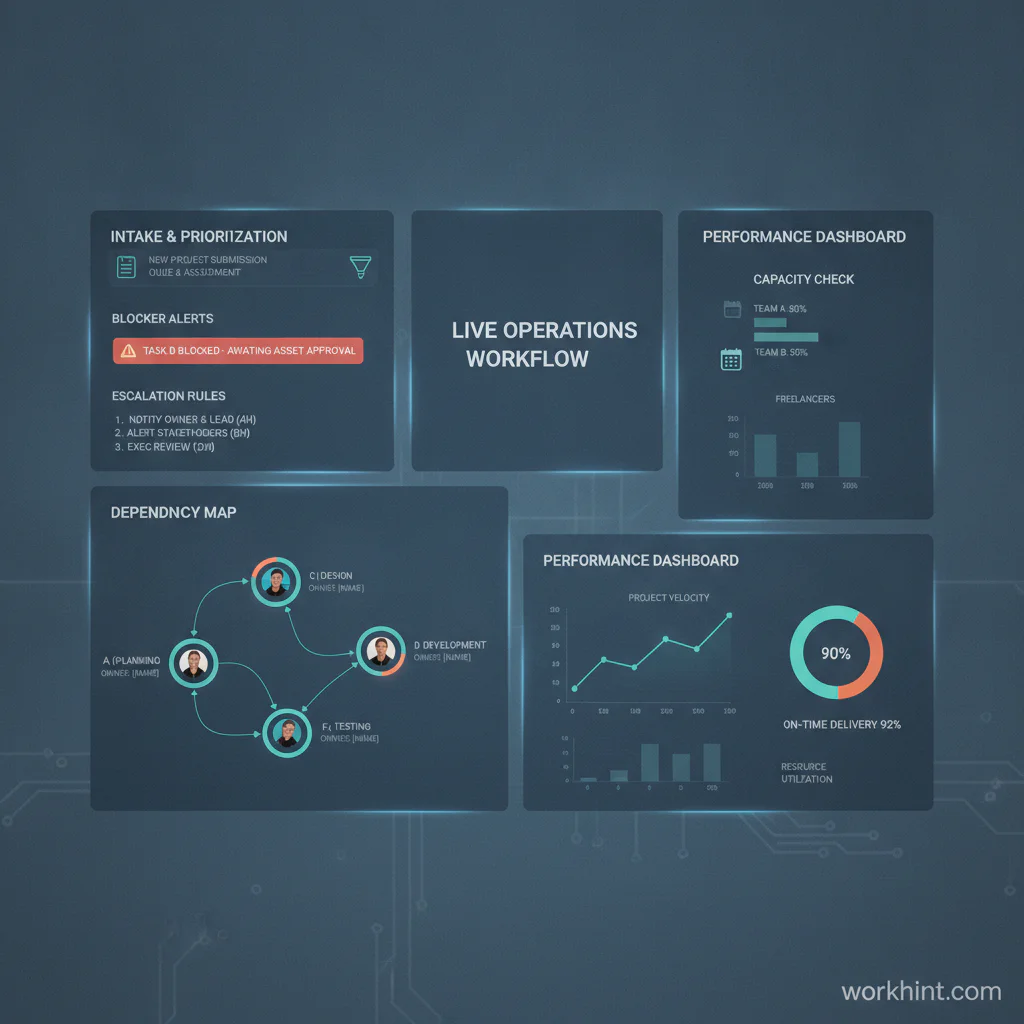
A critical path diagram is useful during planning, but operations teams need it to stay alive during execution. The path should change when scope changes, duration estimates prove wrong, an approver is unavailable, or a task finishes early. Treat the critical path as a management system with four routines.
First, review the path at the same cadence as the work. Fast-moving service operations may need a daily check. Longer implementation programs may need two reviews per week. Second, make blockers visible in the workflow itself instead of waiting for a meeting. Third, protect capacity for the owners on the path. If they are overloaded with non-critical tasks, the plan is pretending. Fourth, review the path after completion and update future estimates.
This is where Workhint fits naturally. A team can use Workhint to turn the critical path into a live work system with intake forms, dependency mapping, owner assignments, permissions, approval steps, blocker alerts, escalation rules, documents, dashboards, and reporting. The method explains which work controls delivery. Workhint helps the team run that work with the right roles, signals, and follow-through.
Common critical path mistakes
- Listing tasks without dependencies. A task list is not a critical path. The power comes from understanding sequence.
- Ignoring waiting time. Approvals, customer responses, vendor handoffs, and access requests often create more delay than active work.
- Assigning shared accountability. If three teams own a critical task, nobody owns the schedule risk.
- Failing to update the path. The first version is a forecast. Execution data should change the forecast.
- Optimizing non-critical work first. Finishing flexible tasks early feels productive, but it does not protect the delivery date.
FAQ
What is the critical path method?
The critical path method is a planning technique that identifies the longest sequence of dependent tasks needed to complete a project or workflow. That sequence determines the earliest realistic finish date.
How is critical path different from a Gantt chart?
A Gantt chart shows tasks over time. Critical path analysis shows which dependent sequence controls the finish date. A good schedule can include both.
Can operations teams use CPM without project management software?
Yes. A spreadsheet, table, or whiteboard can work for a small process. Software becomes more useful when dependencies, approvals, owners, exceptions, and reporting need to stay updated in real time.
What does float mean in critical path analysis?
Float is the amount of time a task can slip without delaying the overall finish date. Tasks on the critical path usually have zero float.
Conclusion
The critical path method is useful because it forces an operations team to answer the questions that vague plans avoid: what depends on what, who owns each step, where delay will hurt, and when leaders need to intervene. Start with one complex workflow, map the dependencies honestly, protect the owners on the path, and keep the path updated as work changes. The result is a work system that manages delivery risk before the deadline is already gone.
Leave a Reply