


Use this template to make project updates predictable, useful, and impossible to lose across teams, clients, and stakeholders.
A project communication plan template helps a team decide what information needs to be shared, who needs it, how often it should go out, and who owns each update. It is especially useful when a project crosses departments, vendors, clients, executives, or remote teams.
Without a plan, communication becomes reactive. Stakeholders ask for status in separate channels. Teams repeat the same update in meetings, chat, email, and documents. Decisions disappear into side conversations. A good communication plan does not add more noise. It gives every important update a clear audience, channel, cadence, owner, and escalation path.
What’s included
This resource gives you a copy-ready project communication plan template, a communication matrix, an example for a cross-functional project, common mistakes to avoid, and a workflow for turning the plan into a live operating habit.
- Stakeholder groups and information needs
- Update types, channels, cadence, and owners
- Decision, risk, escalation, and approval communication rules
- A reusable communication matrix
- A practical example for implementation teams
The Project Management Institute describes communication strategy as a way to define audiences, objectives, messages, and delivery methods before tactical communication starts. That is the right mindset: plan the flow of information before the project is already noisy.
How to use this project communication plan template
Start by listing the people who need project information. Do not treat everyone as one audience. Executives need risks, decisions, and business impact. Project team members need tasks, blockers, dependencies, and deadlines. Customers or external partners may need milestones, open questions, and changes that affect them.
Then decide what each audience actually needs to know. The goal is not to broadcast every update to every person. The goal is to deliver the right level of detail at the right time so people can make decisions, complete work, and trust the process.
Project communication plan template
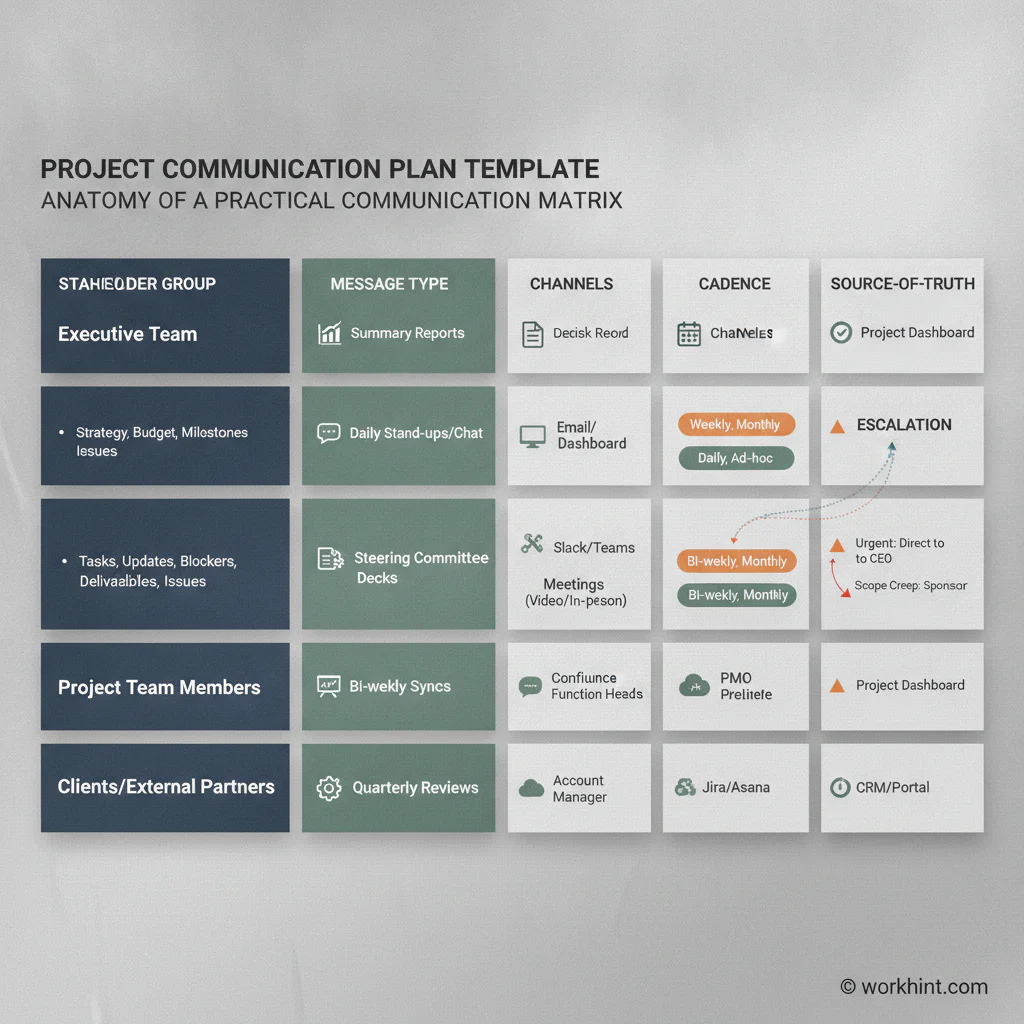
Copy the structure below into your project plan, operating document, spreadsheet, or workflow system.
| Field | What to capture | Example |
|---|---|---|
| Stakeholder group | The audience that needs information | Executive sponsor, client team, delivery team, finance, vendor |
| Information need | What this group must know to act | Budget risk, milestone status, blocked decisions, launch readiness |
| Message type | The recurring communication format | Weekly status report, daily standup note, risk alert, decision request |
| Channel | Where the update should happen | Email, project workspace, dashboard, meeting, chat, customer portal |
| Cadence | How often the update goes out | Daily, weekly, biweekly, monthly, milestone-based, exception-based |
| Owner | The person accountable for sending or maintaining it | Project manager, workstream lead, account owner, operations lead |
| Escalation rule | When normal communication is not enough | Escalate within 24 hours if budget, launch date, security, or customer impact changes |
| Record location | Where the source of truth lives | Project hub, decision log, risk register, approval record, shared dashboard |
Communication matrix example
For a customer implementation project, the communication matrix might look like this:
| Audience | Update | Cadence | Owner |
|---|---|---|---|
| Customer sponsor | Milestones, risks, decisions needed, launch readiness | Weekly | Account lead |
| Internal delivery team | Tasks, blockers, dependencies, handoffs | Daily or twice weekly | Project manager |
| Finance | Budget changes, billing milestones, purchase approvals | Milestone-based | Project owner |
| Executive sponsor | Health status, major risks, decisions above project authority | Biweekly or exception-based | Program lead |
| Vendor or contractor | Scope, deadlines, acceptance criteria, open questions | Weekly and as needed | Workstream lead |
The PM2 Alliance communications management plan template is a useful reference for formal projects because it treats communications planning as part of project governance, not just meeting scheduling.
What a strong plan should cover
A practical communication plan should cover routine updates, decisions, risks, changes, escalations, and records. Routine updates keep people informed. Decision communication makes sure the right person approves the right thing. Risk communication makes early warnings visible. Change communication explains what moved, why it moved, and what happens next.
For projects with external stakeholders, include a confidentiality rule. Some updates belong in internal channels only, especially pricing, staffing concerns, contract negotiations, security findings, or performance issues. The plan should make that boundary explicit before someone shares the wrong detail with the wrong audience.
Common mistakes
- Using one update for every audience. A single all-purpose status report usually becomes too shallow for the team and too detailed for executives.
- Confusing meetings with communication. A meeting is one channel. Decisions, risks, approvals, and action items still need written records.
- Skipping escalation rules. If nobody knows what counts as urgent, blockers wait until the next scheduled meeting.
- Leaving ownership vague. Every update needs one owner. Shared ownership often means nobody sends it consistently.
- Letting tools multiply. If the same project update lives in email, chat, a slide deck, and a spreadsheet, people will not know which version to trust.
Where Workhint fits
A project communication plan is easiest to follow when it becomes part of how work moves. Workhint helps teams turn the template into a live work system: intake captures the project type, roles define who needs each update, assignments route ownership, approvals create decision records, and dashboards show project status without rebuilding updates by hand.
For projects involving clients, contractors, vendors, or cross-functional teams, that matters because communication is tied to the work itself. Updates, decisions, documents, tasks, schedules, exceptions, and approvals stay connected instead of spreading across disconnected channels.
FAQ
What should a project communication plan include?
It should include stakeholder groups, information needs, message types, channels, cadence, owners, escalation rules, confidentiality boundaries, and the source of truth for records.
Who owns the project communication plan?
The project manager or project owner usually owns the plan, but workstream leads may own specific updates. The important rule is that every communication type has one accountable owner.
How often should project communication happen?
It depends on project risk and pace. Active delivery teams may need daily coordination, while sponsors may only need weekly or milestone-based updates. Escalations should happen immediately when timing, budget, scope, quality, or customer impact changes.
Is a communication plan only for large projects?
No. Small projects benefit from a lightweight version. If more than one team, client, vendor, or approver is involved, a simple communication matrix can prevent missed updates and repeated questions.
Conclusion
A project communication plan template gives teams a simple way to reduce confusion before it becomes rework. Define the audience, match each update to a real information need, choose the channel, assign the owner, and document where the record lives. The best communication plan is not the longest one. It is the one people can follow when the project gets busy.
Leave a Reply