


Workflow debt hides inside daily work until every handoff, approval, and exception takes longer than it should.
Workflow debt is the operational drag created when workflows accumulate temporary fixes, unclear ownership, redundant steps, unused approvals, manual workarounds, and disconnected tools. It usually starts harmlessly: a spreadsheet gets added because the system is missing one field, a manager creates an extra review because one mistake happened, or a team keeps an old approval path because no one is sure who can remove it.
The problem is not one workaround. The problem is that work keeps changing while the workflow stays patched together. Eventually the process becomes slower to run, harder to automate, harder to measure, and harder for new people to learn.
What’s in this article?
- What workflow debt looks like in operations.
- How to find it without turning the audit into a large consulting project.
- A practical workflow debt scorecard.
- How to reduce workflow debt without breaking useful controls.
- Where Workhint fits when cleanup needs to become a live operating system.
Workflow debt in operations: what it looks like
Workflow debt shows up when the official process and the real process no longer match. The documented process says requests enter through a form, but everyone still sends urgent work through chat. The approval workflow says finance reviews purchases above a threshold, but managers copy finance on every purchase because the rule is not trusted. The dashboard reports cycle time, but half the work happens outside the tracked system.
That gap matters because good operations depend on reliable process knowledge. APQC’s Process Classification Framework is built around a common process language for improving process management. Microsoft makes a similar point in its business process catalog, where end-to-end scenarios are organized into process layers. When workflow debt grows, that structure gets blurry.
Common signs include duplicate intake forms, approval chains no one can explain, work waiting on one person by habit, exception paths that are used more often than the standard path, status updates copied manually between tools, and metrics that people debate because the underlying workflow data is incomplete.
Why workflow debt is expensive
Workflow debt creates cost in four ways. It increases cycle time because work waits in queues, inboxes, and informal approval loops. It increases rework because people act on missing context or outdated instructions. It weakens accountability because no one knows whether the problem is a person issue, a process issue, or a system issue. It blocks automation because automating a messy workflow usually makes the mess faster, not better.
The analogy to technical debt is useful. A 2026 research preprint on technical debt management describes debt as short-term useful decisions that make later change harder. Workflow debt needs the same discipline: log it, measure it, assign it, and reduce it where it constrains execution.
How to find workflow debt
Start with one important workflow, not the whole company. Choose a workflow that affects revenue, customer experience, compliance, employee experience, payments, or delivery speed.
Then compare three versions of the workflow:
- Documented workflow: What the SOP, process map, or policy says should happen.
- System workflow: What the tools actually require people to do.
- Observed workflow: What people do in practice to get the work done.
IBM describes process analysis as examining process steps to understand how work happens and identify improvements. For workflow debt, the most valuable evidence is usually simple: timestamps, handoff counts, approval wait time, rework frequency, exception volume, duplicate data entry, and tools touched before completion.
Workflow debt scorecard
Use a scorecard to separate annoying friction from debt that deserves immediate attention.
| Debt signal | What to measure | Why it matters | Fix priority |
|---|---|---|---|
| Unclear owner | Steps without one accountable role | Work waits because no one can decide | High |
| Approval drag | Average wait time per approval | Control becomes delay instead of risk management | High |
| Duplicate entry | Fields copied between systems | Manual transfer creates errors and stale data | Medium |
| Exception overload | Percent of work using nonstandard paths | The standard workflow no longer fits reality | High |
| Metric distrust | Metrics disputed in reviews | Leaders cannot manage what the workflow does not capture | Medium |
| Automation blocked | Steps too ambiguous to automate | AI or automation cannot scale inconsistent rules | High |
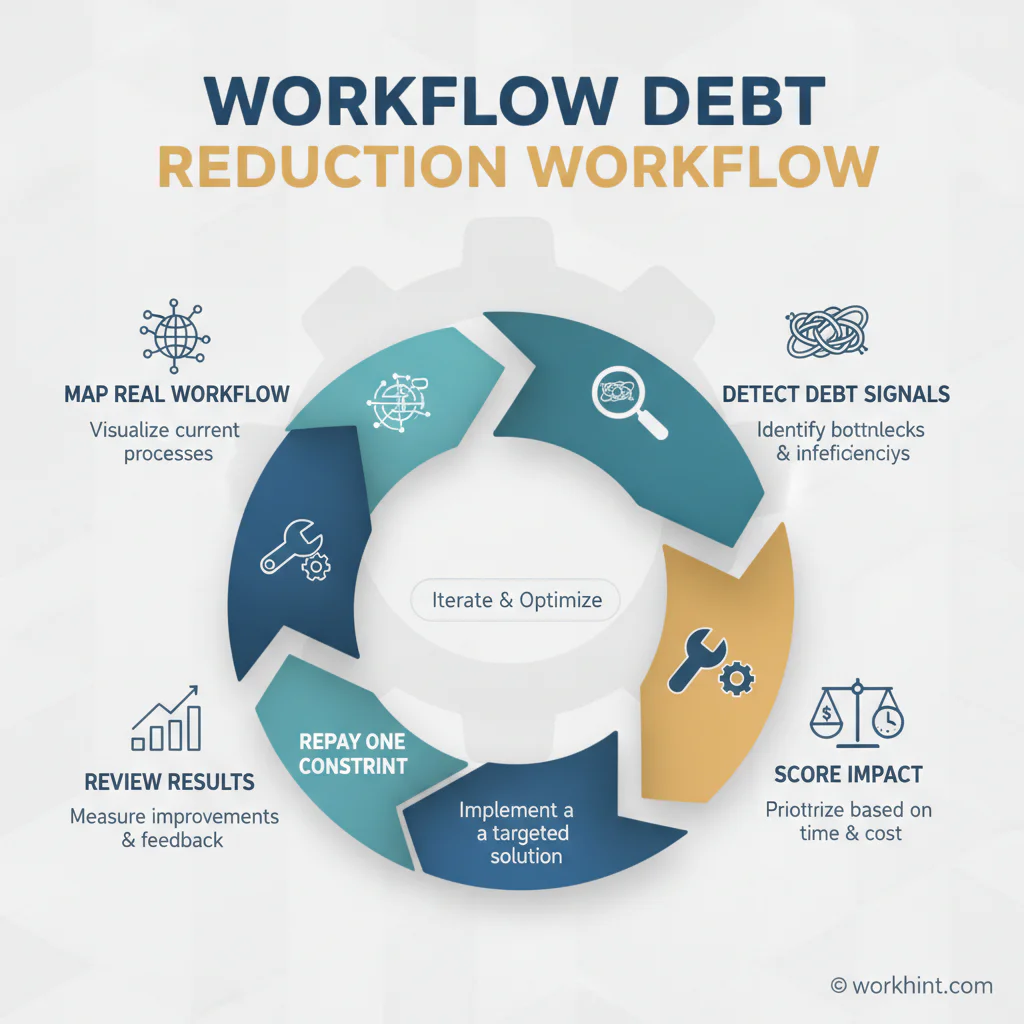
Workflow debt reduction workflow
Reducing workflow debt does not mean deleting every control. Keep the controls that protect the business and remove the friction that no longer earns its place.
- Name the workflow boundary. Define the trigger, first step, final output, customer, and process owner.
- Map the real path. Observe recent work items and capture how they actually moved through people, tools, decisions, and handoffs.
- Classify the debt. Label each issue as ownership debt, approval debt, data debt, documentation debt, exception debt, or integration debt.
- Quantify the impact. Estimate delay, rework, error risk, customer impact, cost, or automation blockage.
- Choose one repayment move. Remove a redundant step, merge duplicate forms, clarify one owner, create an exception rule, or connect two systems.
- Update the live workflow. Change the form, routing, permission, automation, dashboard, SOP, and review rhythm together.
- Review after two cycles. Confirm whether cycle time, wait time, error rate, or exception volume improved.
Common mistakes when reducing workflow debt
The first mistake is treating workflow debt as a documentation problem only. Updating an SOP helps, but it will not fix a broken intake route, missing permission, or overloaded approver.
The second mistake is removing controls without understanding why they were added. A slow legal review may be debt if every low-risk request goes through it. It may be essential if the workflow handles customer data, regulated work, financial commitments, or contractor classification.
The third mistake is trying to clean every workflow at once. Workflow debt repayment works better as a portfolio. Pick the workflows with the highest operational drag, fix one constraint, verify the result, then move to the next constraint.
Where Workhint fits
Workhint fits when workflow debt needs to become visible and repayable inside the way work actually runs. A team can describe the workflow it wants, then structure intake forms, roles, permissions, assignments, approvals, exception paths, dashboards, documents, and automations around that operating model.
That matters because workflow debt often lives between tools. A request starts in a form, moves to a spreadsheet, waits in chat, gets approved in email, and is reported later. Workhint helps bring those pieces into one live work system so the team can see where work is stuck, who owns the next step, which rules apply, and what evidence has been captured.
FAQ
What is workflow debt?
Workflow debt is the accumulated operational drag caused by outdated, patched, unclear, or overly complex workflows. It makes work slower, harder to measure, and harder to improve.
How is workflow debt different from technical debt?
Technical debt usually lives in software architecture or code decisions. Workflow debt lives in how work moves across people, tools, approvals, handoffs, data, and operating rules.
What is the fastest way to find workflow debt?
Compare the documented workflow, the system workflow, and the observed workflow for one high-value process. The gaps usually reveal the debt.
Should workflow debt always be automated away?
No. Automation should come after the workflow is clarified. Automating unclear ownership, bad data, or unnecessary approvals can make the debt more durable.
Conclusion
Workflow debt is a hidden execution cost that compounds when teams keep adding workarounds without reviewing the system they are creating.
The practical fix is to make workflow debt visible, measure the impact, assign an owner, and repay it in focused moves. Start with one workflow that matters, compare what should happen with what actually happens, and remove the friction that no longer protects the business. Scalable work systems are not built by adding more process. They are built by keeping the right process current, measurable, and easy to run.
Leave a Reply