


Peak season does not have to mean rushed hiring, unclear schedules, and payment cleanup after the rush is over.
Seasonal workforce planning is the process of matching short-term labor demand to the right mix of employees, temporary staff, contractors, agencies, and operating controls before the busy period starts. It is not just a hiring calendar. A useful plan connects demand forecasting, budget approval, sourcing, onboarding, schedules, safety, supervision, payroll, and closeout.
What is in this article?
- How to forecast seasonal labor demand before peak season.
- How to choose the right seasonal labor model.
- A workflow for approvals, sourcing, onboarding, scheduling, and closeout.
- A planning table business teams can adapt.
- Common failure points and where Workhint fits.
Why seasonal workforce planning matters
Seasonal demand compresses normal workforce problems into a shorter window. Retail, hospitality, logistics, field services, events, and local services may all need more capacity for a few weeks or months. The demand is temporary, but the operational risk is real.
For U.S. employers, seasonal employment is still employment in many cases. The U.S. Department of Labor notes that overtime requirements can apply for hours worked over 40 in a workweek, and the IRS says seasonal employees follow the same tax withholding rules as other employees. If temporary workers come through a staffing agency, OSHA says staffing agencies and host employers share responsibility for temporary worker safety and health.
That means seasonal workforce planning should not be reduced to hiring more people. It should answer: how many people, doing what work, under which relationship, with what approvals, trained by whom, scheduled where, and paid how?
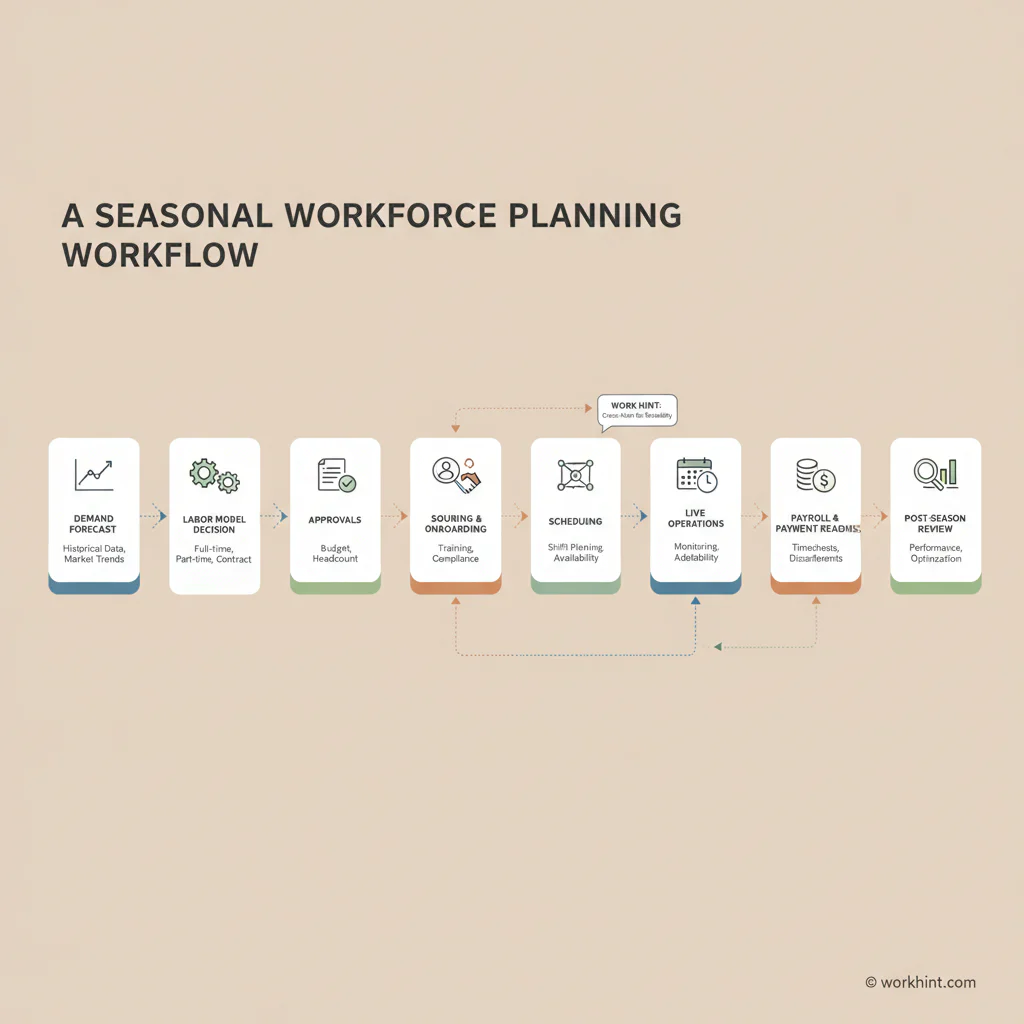
A seasonal workforce planning workflow
Start seasonal workforce planning with demand, not headcount. Look at historical volume, bookings, customer commitments, delivery windows, service-level targets, location coverage, and manager capacity. The U.S. Office of Personnel Management workforce planning guide frames workforce planning around analyzing current state, identifying gaps, developing strategies, implementing them, and monitoring progress. That structure works well for seasonal teams.
- Forecast the work: Estimate units of demand by week, location, role, shift, skill, and customer promise.
- Translate demand into capacity: Convert expected work into hours, assignments, coverage rules, and supervisor load.
- Choose the labor model: Decide whether each gap should be filled by seasonal employees, agency workers, contractors, freelancers, vendors, or internal overtime.
- Approve budget and risk: Confirm pay rates, agency margins, contractor terms, overtime assumptions, safety needs, and compliance review.
- Source early: Open roles, brief staffing partners, activate known worker pools, and confirm backup capacity before demand arrives.
- Onboard by role: Collect required documents, provide task-specific training, grant only needed system access, and confirm schedule readiness.
- Run daily operations: Track attendance, assignments, incidents, manager approvals, schedule changes, and accepted work.
- Close the season: Remove access, approve final pay or invoices, review performance, update vendor notes, and save lessons for next cycle.
Choose the right seasonal labor model
The best seasonal labor model depends on the work, not just the calendar. A warehouse may need agency workers for shifts. A local service business may need contractors for appointment-based delivery. A retailer may need seasonal employees because the company controls schedules, tools, training, and supervision.
| Labor model | Use when | Planning control to define |
|---|---|---|
| Seasonal employees | The company controls hours, supervision, tools, and work methods. | Payroll setup, wage rules, training, schedules, manager ownership. |
| Temporary staffing agency | You need volume hiring, fast replacement, or shift coverage through a supplier. | Job order, rates, safety responsibilities, attendance rules, invoice approval. |
| Independent contractors | The work is outcome-based, specialized, and not managed like employment. | Scope, deliverables, payment trigger, access limits, classification review. |
| Vendor or agency team | You need a managed service, project package, or external team outcome. | SOW, milestones, change process, point of contact, acceptance criteria. |
This decision matters because each model changes the approval path. The request should capture the operating need first, then route to HR, procurement, finance, legal, IT, or safety based on risk.
Build the plan backward from the peak date
A seasonal staffing plan should include dates, owners, and decision gates. Work backward from the first high-volume week. If workers must be live by November 1, sourcing may need to begin in August, supplier agreements may need review in September, and training may need to finish in October.
Use three planning windows. The 90-day window is for demand forecast, labor model, budget, and supplier readiness. The 60-day window is for sourcing, screening, document collection, and schedule design. The 30-day window is for training, access, manager briefings, and escalation paths.
Track the operating data during the season
Seasonal operations need live visibility, not a final spreadsheet. Track planned headcount versus active workers, fill rate, no-shows, overtime, agency response time, schedule changes, safety incidents, accepted work, invoice status, and customer impact. Public labor data also shows why this matters: the BLS temporary help services series published through FRED tracks temporary help employment as a distinct labor market category, which is a reminder that flexible labor supply changes over time.
The most useful seasonal workforce dashboard shows whether the business has enough people, whether those people are ready, whether managers are approving exceptions quickly, whether cost is on plan, and what must be fixed before next week.
Common seasonal workforce planning mistakes
- Planning only for hiring: Hiring is one step. The plan also needs onboarding, schedules, supervision, access, safety, pay, and closeout.
- Using one labor model for every gap: Seasonal employees, agency workers, contractors, and vendors create different obligations and workflows.
- Skipping manager capacity: Extra workers do not help if supervisors cannot train, assign, review, and approve work.
- Leaving payment rules vague: Define pay rates, overtime assumptions, invoice timing, acceptance criteria, and cost centers before work starts.
- Forgetting offboarding: Seasonal access, equipment, documents, and final payments should close cleanly when the peak period ends.
Where Workhint fits
Workhint fits when seasonal workforce planning needs to become a live operating system instead of a set of spreadsheets, emails, and manager reminders. A business can use Workhint to turn a seasonal labor request into a workflow with role-based approvals, document collection, staffing partner coordination, worker onboarding, schedule readiness, assignment tracking, exception approvals, payment status, and closeout.
That is especially useful when seasonal work involves more than one worker type. HR may own seasonal employees, procurement may own vendors, finance may own budget and payment rules, IT may own access, and operations may own daily execution. Workhint helps connect those steps so the business can see what is ready, what is blocked, and what needs action before peak demand hits.
FAQ
What should a seasonal workforce plan include?
A seasonal workforce plan should include demand forecast, required roles, labor model, budget, sourcing channel, onboarding steps, schedule rules, training, compliance review, safety responsibilities, payment or payroll process, reporting, and offboarding.
When should seasonal workforce planning start?
Start at least 90 days before the first peak period when possible. Longer lead times are better when the work requires training, background checks, supplier contracts, licenses, security access, or location-specific staffing.
How is seasonal workforce planning different from normal hiring?
Normal hiring often optimizes for long-term fit. Seasonal workforce planning optimizes for short-term capacity, readiness, compliance, schedule coverage, manager bandwidth, and clean closeout after demand drops.
Can contractors be part of a seasonal workforce plan?
Yes, but only when the work is structured appropriately. Contractors should have clear scope, deliverables, independence, payment terms, and access limits. Classification-sensitive decisions should be reviewed with qualified legal, HR, or tax advisors.
Conclusion
Seasonal workforce planning works best when the business treats peak demand as an operating workflow. Forecast the work, choose the right labor model, approve the budget and risk, onboard by role, track readiness, run live operations, and close the season with clean records. The goal is not simply to add people. The goal is to make temporary capacity reliable, compliant, visible, and easier to repeat next season.
Leave a Reply