


A clean MSP onboarding checklist turns a signed contract into accountable service delivery without access gaps, missed owners, or loose security.
A managed service provider onboarding checklist helps a business move from vendor selection to live service in a controlled way. For many teams, the risky part is the handoff after the agreement is signed: credentials are shared informally, systems are undocumented, service levels are vague, and internal teams are not sure who owns which decision.
Good onboarding gives the MSP enough context to support the business while keeping the company in control of access, approvals, data, and performance expectations. That matters when the provider touches IT systems, customer data, devices, security, finance, or critical operations. The checklist below is written for business operators, not just IT teams.
What’s in this article?
- An MSP onboarding checklist by phase
- The roles that should own discovery, access, security, service levels, and reviews
- Common mistakes that create vendor risk
- Where Workhint fits when several internal teams and an external provider must coordinate
Why MSP onboarding matters
An MSP often becomes part of the operating fabric of a company. It may manage devices, cloud systems, help desk tickets, backups, endpoint security, network access, or application support. The FTC’s business security guidance says companies should choose service providers carefully, set security expectations before work starts, and monitor whether providers meet them.
That makes onboarding more than an implementation task. It is a control point. The same principle appears in cybersecurity frameworks: NIST’s Cybersecurity Framework emphasizes governance, asset and risk identification, protection, detection, response, and recovery. MSP onboarding should translate those ideas into everyday steps: what systems exist, who can access them, what incidents require escalation, and what evidence proves the provider is doing the work.
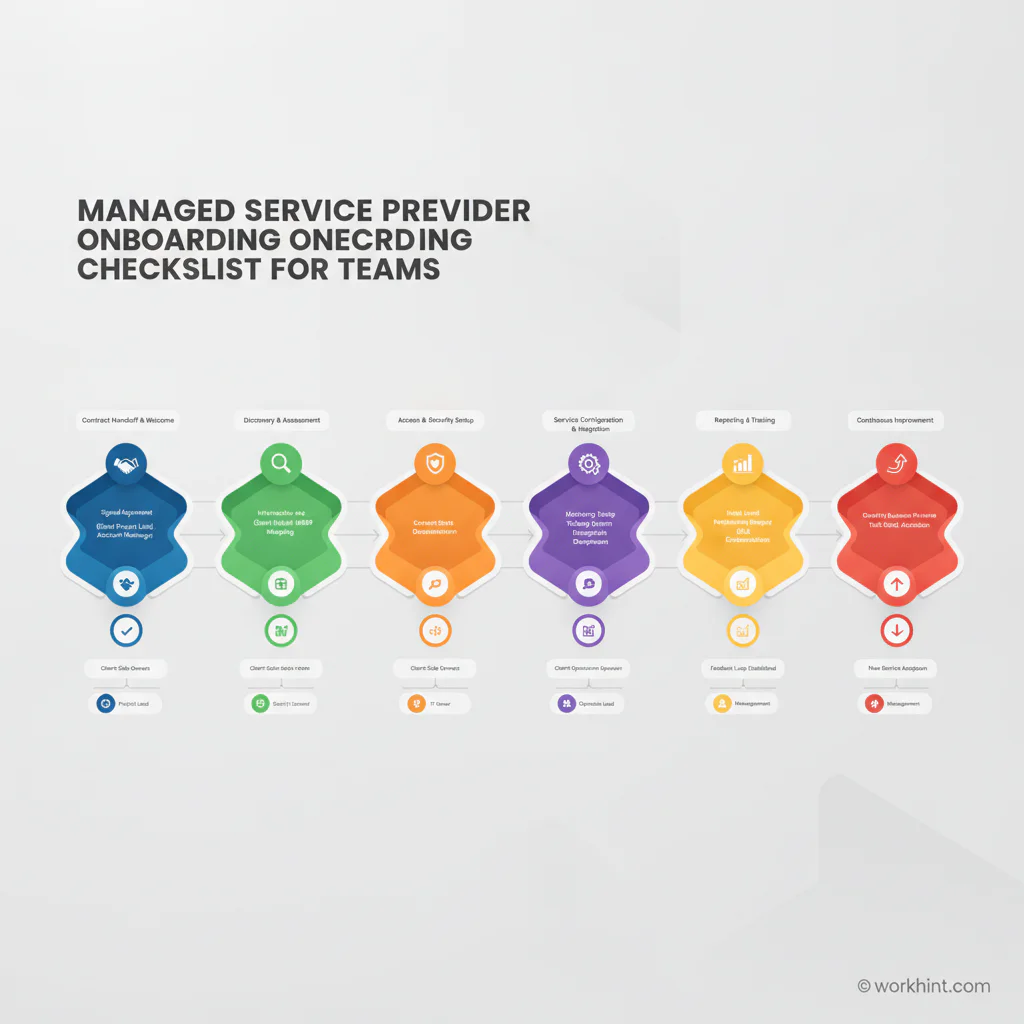
Managed Service Provider Onboarding Checklist for Teams
The best checklist is phased. If everything lives in one long spreadsheet, teams miss dependencies. Use these phases to make the handoff orderly.
1. Pre-onboarding and contract handoff
- Confirm the statement of work, scope boundaries, excluded services, service hours, response targets, and renewal dates.
- Name the business owner, technical owner, security reviewer, finance approver, and MSP account lead.
- Collect the provider’s onboarding plan, key contacts, escalation path, insurance evidence, data handling commitments, and subcontractor disclosure where relevant.
- Agree on the first 30, 60, and 90 day outcomes before access is granted.
2. Discovery and environment mapping
- Create an inventory of locations, users, devices, systems, cloud platforms, software licenses, network assets, and critical vendors.
- Document current support queues, recurring issues, open risks, backup status, security tools, and known technical debt.
- Identify business-critical workflows the MSP must not disrupt, such as payroll, customer support, field operations, payment processing, or executive reporting.
- Separate facts from assumptions. If a system owner, recovery process, or admin credential is unknown, record it as a gap.
3. Access, security, and data controls
- Grant access through named accounts, not shared credentials.
- Apply least privilege access and require approval for privileged roles.
- Confirm multi-factor authentication, password vaulting, logging, device requirements, and offboarding steps for MSP staff.
- Define how customer data, employee data, backups, exports, and support logs may be handled.
- Set incident notification rules, including what counts as urgent and who must be notified first.
For security-sensitive relationships, use official guidance as a floor, not a substitute for legal or security review. The NIST quick-start guide for cyber supply chain risk management is useful for thinking through digital service provider risk.
4. Service setup and workflow launch
- Set up ticket intake, categories, priorities, routing rules, response targets, and approval rules.
- Move recurring requests into standard workflows, such as new laptop setup, account creation, permission changes, software requests, device replacement, and access removal.
- Define which requests the MSP can complete independently and which require manager, finance, legal, security, or executive approval.
- Run a pilot with a small group before rolling the process across every team or location.
5. Reporting, review, and continuous improvement
- Agree on weekly launch check-ins for the first month and monthly or quarterly reviews after stabilization.
- Track ticket volume, response time, resolution time, reopened tickets, unresolved risks, security exceptions, user satisfaction, and cost variance.
- Review service level performance against the contract, not informal expectations.
- Keep an improvement backlog so recurring issues turn into process fixes instead of permanent noise.
The Chartered Institute of Procurement and Supply notes that supplier scorecards, metrics, and KPIs help teams monitor supplier performance. For an MSP, those metrics should connect operational service quality with risk management and business impact.
MSP onboarding ownership table
| Area | Primary owner | What good looks like |
|---|---|---|
| Scope and service levels | Business owner | Signed scope, clear exclusions, named escalation contacts, and review cadence |
| Systems and access | Technical owner | Asset inventory, approved credentials, MFA, logging, and least privilege access |
| Security and data handling | Security or risk reviewer | Documented requirements for data, incidents, backups, subcontractors, and evidence |
| Tickets and approvals | Operations lead | Request types, routing, approvals, priority definitions, and status reporting |
| Billing and renewal | Finance or procurement | Invoice rules, change order process, renewal date, and performance review inputs |
Common MSP onboarding mistakes
The first mistake is treating onboarding as a technical handoff only. A provider can have the right tools and still fail if priorities, approvals, and escalation paths are unclear.
The second mistake is granting broad access early because it is faster. That creates long-term cleanup work and makes it harder to prove who did what. Access should follow the work, and privileged access should have approval and review.
The third mistake is accepting vague service levels. Response time, resolution targets, business hours, urgent incident rules, and exclusions need plain definitions. Otherwise every missed expectation becomes a debate.
The fourth mistake is waiting until renewal to review performance. MSP relationships improve when scorecards, open risks, recurring issues, and improvement actions are reviewed while there is still time to fix them.
Where Workhint fits
Workhint helps teams turn MSP onboarding from a scattered handoff into a live operating workflow. A business can define roles, collect intake details, route access approvals, assign owners, track documents, manage launch tasks, coordinate reviews, and keep payment or renewal steps connected to performance evidence.
That is useful when the MSP relationship touches multiple teams. IT may own systems, finance may own invoices, security may own risk review, and operations may own the service experience. Workhint gives those teams one workflow around the external provider instead of spreading onboarding across email, spreadsheets, ticket comments, and disconnected documents.
FAQ
How long should MSP onboarding take?
Simple environments may stabilize in two to four weeks. More complex environments with many locations, cloud systems, security controls, or unresolved documentation gaps may need 60 to 90 days. The timeline should be based on scope and risk, not a generic launch date.
Who should own MSP onboarding inside the business?
One business owner should be accountable for the relationship, but onboarding usually needs a technical owner, security reviewer, operations lead, and finance or procurement owner. Without named owners, decisions stall and the MSP receives mixed direction.
What should be finished before giving the MSP admin access?
At minimum, confirm scope, identity requirements, MFA, least privilege rules, logging, data handling expectations, incident notification rules, and who approves privileged access. Temporary access should have an expiration date and a named approver.
What metrics should be reviewed after onboarding?
Track response time, resolution time, ticket backlog, reopened tickets, security exceptions, recurring request types, user satisfaction, unresolved risks, and invoice variance. The best metrics show whether the provider is improving operations, not just closing tickets.
Conclusion
A managed service provider onboarding checklist protects the business by making the provider relationship operational from day one. The goal is controlled access, clear ownership, reliable service, documented risk, and a review rhythm that keeps improving. When those pieces are connected, the MSP can move faster without the business losing visibility or control.
Leave a Reply