


A furniture assembly business can start lean when you sell convenience first and build a trusted local assembler network around demand.
Learning how to start a furniture assembly business is attractive because the first version can be simple. Customers buy furniture, storage systems, nursery items, desks, and office setups, then realize the real cost is time, tools, patience, and the risk of damaging something expensive.
The lean path is not to hire a crew on day one. It is to create a branded customer platform, recruit independent assemblers, validate demand in one service area, and coordinate work through a repeatable operating system before adding employees.
What’s in this article?
- Why a furniture assembly business works
- What you need to launch without staff
- How to price furniture assembly services
- How to get first customers
- How Workhint helps launch the operating platform
- A 7-day launch plan, checklist, and FAQ
Why this business works
Furniture assembly works because the problem is frequent, visible, and frustrating. Customers want the finished room, not a weekend spent reading instructions and sorting hardware.
The business can start with low overhead because you do not need inventory, a storefront, or full-time employees. You need a clear offer, local availability, basic insurance, reliable assemblers, and a way to manage bookings, estimates, job notes, payments, and customer communication.
Recurring demand can come from property managers, furnished rental operators, student housing, furniture stores, moving companies, interior designers, real estate agents, offices, and apartment communities. Residential jobs prove the offer. Partnerships make the calendar more predictable.
What you need to launch
Start with the smallest version that can safely deliver paid jobs: a branded booking page, a defined service area, a quote process, customer terms, provider onboarding, proof of insurance, payment collection, and provider payouts.
You do not need a warehouse, owned trucks, or a permanent team before demand is proven. If delivery is part of the offer, begin with partner movers or providers who already have vehicles. If wall mounting is included, verify local rules and insurance coverage first.
| Launch item | Lean approach | Typical early cost |
|---|---|---|
| Business registration | Register the business and get basic tax setup | $50 to $500 |
| Insurance | General liability, with extra coverage if mounting or moving | $300 to $1,500 |
| Branded platform | Customer intake, quotes, scheduling, payments, provider onboarding, and payouts | Start lean before custom software |
| Provider network | Recruit independent assemblers with tools and local availability | No payroll required |
| Starter tools | Keep backup bits, hardware organizer, blankets, level, and measuring tape | $100 to $600 |
| Marketing tests | Local pages, retailer outreach, apartment partnerships, and referrals | $100 to $800 |
How to price it
Furniture assembly pricing should protect travel time, setup time, job complexity, and customer expectations. A practical model is a minimum visit fee plus item-based pricing. Use hourly or custom quotes for large wardrobes, office buildouts, wall-mounted systems, stairs, missing parts, or multi-room installations.
| Offer | Example price | Best use |
|---|---|---|
| Minimum visit | $75 to $125 | Small items and travel protection |
| Basic item assembly | $50 to $100 per item | Chairs, shelves, small desks, side tables |
| Standard item assembly | $100 to $175 per item | Dressers, beds, TV stands, dining sets |
| Complex assembly | $175 to $350+ | Wardrobes, wall units, sectionals, multi-piece systems |
| Commercial or bulk work | Custom quote | Offices, rentals, student housing, property managers |
How to get first customers
The fastest early customers usually come from people who already have assembly pain. Start with a narrow service area and a specific first offer, such as same-week flat-pack assembly for apartments, home offices, nursery furniture, or short-term rental setup.
Build demand through Google Business Profile, neighborhood groups where promotion is allowed, apartment leasing offices, moving companies, furniture retailers, interior designers, and real estate agents. Do not spend heavily on ads before the fulfillment process works. Sell a few paid jobs, collect reviews, measure time per item, and learn which jobs are profitable.
How Workhint helps launch it
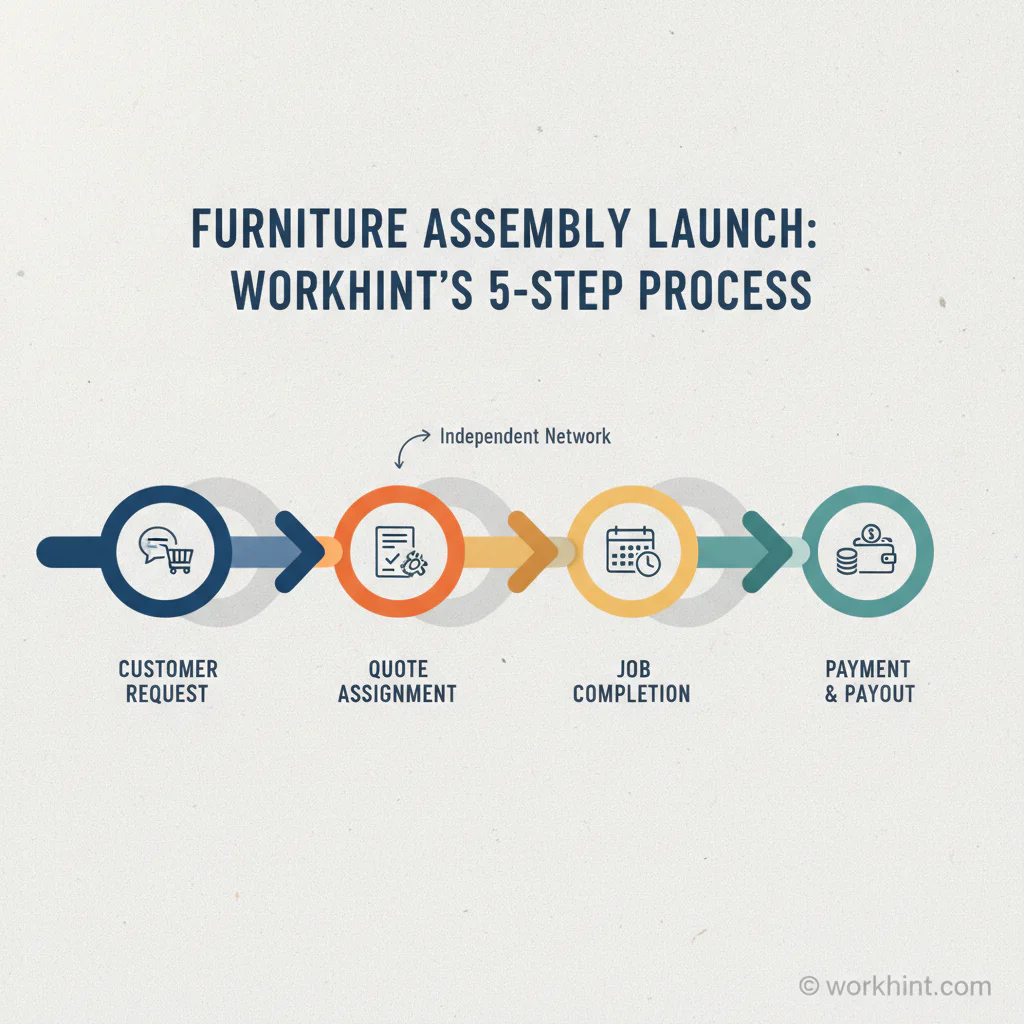
Workhint can become the branded operating platform for the furniture assembly business before the founder hires employees or builds custom software. A customer visits the branded portal, selects the furniture type, uploads product links or instruction photos, adds address details, chooses timing, and submits a request.
Inside Workhint, the request can become a quote, approval, payment, schedule, provider assignment, and job checklist. An independent assembler sees only the work they need: address, time window, parking notes, item details, required tools, customer instructions, completion checklist, photos, and payout terms.
That is the operating foundation of the business. Instead of stitching together forms, spreadsheets, texts, payment links, and reminders, the owner can run intake, estimates, availability, scheduling, customer updates, quality checks, invoices, reviews, and contractor payouts from one branded system.
First 7-day launch plan
- Day 1: Choose one launch area, one customer type, and one first offer. Avoid promising every handyman service.
- Day 2: Set up the branded Workhint platform basics: customer portal, intake form, quote stages, and internal dashboard.
- Day 3: Create the pricing menu, approval flow, payment setup, completion checklist, photo proof, and provider payout rules.
- Day 4: Recruit three to five independent assemblers or handypeople who already own basic tools.
- Day 5: Contact furniture stores, movers, apartments, rental operators, designers, and local homeowners.
- Day 6: Route every interested request through the platform so quotes, schedules, notes, and follow-ups stay organized.
- Day 7: Review demand, job timing, provider reliability, pricing, and feedback before buying more tools or expanding.
Final launch checklist
- Choose a business name, service area, and first furniture assembly offer.
- Register the business and check local licensing requirements.
- Secure insurance before entering customer homes or handling commercial jobs.
- Create pricing rules for minimum visits, item types, travel, stairs, and missing parts.
- Set up a branded Workhint portal for requests, quotes, approvals, scheduling, payments, and reviews.
- Recruit independent assemblers and document provider standards.
- Create job checklists, photo proof steps, damage notes, and customer signoff.
- Contact local stores, movers, apartments, real estate agents, and property managers.
- Validate demand before hiring employees, buying vehicles, or expanding into broad handyman work.
FAQ
How much does it cost to start a furniture assembly business?
A lean launch can often start with a few hundred dollars if you already own basic tools and transportation. A more realistic early budget is usually $1,000 to $5,000 for registration, insurance, backup tools, branding, local marketing, and platform setup.
Do I need employees to start a furniture assembly business?
No. You can start as the operator and build a private network of independent assemblers for overflow, specialty jobs, or different neighborhoods. Hire employees only after recurring demand supports fixed payroll.
Do furniture assembly businesses need a license?
Many basic assembly services do not require a specialized trade license, but rules vary by city and state. Wall mounting, electrical work, moving, or contractor-style services may trigger additional requirements.
What insurance should I consider?
General liability is the baseline because providers work inside customer homes and offices. If the business offers delivery, moving, or wall mounting, review commercial auto, cargo, and installation-related coverage.
How should I price furniture assembly jobs?
Use a minimum visit fee plus item-based pricing for common jobs. Use custom quotes for complex furniture, bulk office projects, mounting, stairs, long travel, or incomplete information.
How do I get the first customers?
Start with local channels where assembly demand already exists: furniture stores, moving companies, apartment communities, short-term rental operators, neighborhood groups, Google Business Profile, and referrals.
Conclusion
A furniture assembly business is worth starting when you treat it as a coordinated local service platform, not just odd jobs. Start with one clear offer, one service area, a small provider network, and a branded operating system that makes requests, quotes, scheduling, payments, and quality control easy to manage.
Workhint helps make that launch path practical by giving the business its customer portal and operating foundation from day one. Validate demand first, then invest into more providers, partnerships, vehicles, tools, or service lines only when the work proves it can support them.
Leave a Reply