


You can test commercial striping demand before buying a full equipment setup or hiring a crew.
How to start a parking lot striping business is usually taught as an equipment-first trade: buy a striper, learn layout, chase property managers, and hope jobs arrive. A leaner path is to build the customer platform first, recruit independent striping providers, and validate demand before heavy equipment costs.
Parking lot striping solves a visible business problem. Faded lines make properties look neglected, confuse traffic flow, and can create accessibility issues. Property managers, retail centers, schools, warehouses, apartments, and HOAs need clean markings.
What’s in this article?
- Why parking lot striping works
- What you need before taking your first paid job
- How to price restriping, markings, stencils, and maintenance
- How to find first customers through visible demand
- How Workhint helps you launch the operating platform
Why this business works
The buyer is practical. Property managers want a contractor who responds quickly, works after hours, follows requirements, and makes the lot look professional. They need dependable execution.
The work can become repeatable. Many lots need refreshing every one to three years. If you record lot size, completion date, contact, photos, and maintenance recommendations, every project becomes a future follow-up opportunity.
A no-staff launch works best when you begin as the operator and coordinator. You sell the job, route it through your branded platform, assign fulfillment to an independent striping provider, inspect the work, collect payment, and pay the provider. Once volume is proven, you can decide whether owning equipment makes sense.
What you need to launch
You do not need an office, payroll team, or fleet to validate this business. You need a legal setup, insurance guidance, a first offer, provider recruitment, and a system for quoting, scheduling, photos, approvals, invoices, and payouts.
Requirements vary by city and state. Some areas may require a business license, contractor registration, traffic-control rules, or specific insurance. ADA rules also matter when striping accessible spaces, access aisles, signs, and van-accessible spaces.
| Launch item | Lean approach | Typical early budget |
|---|---|---|
| Business registration and license checks | Register the business and confirm local rules | $50 to $500 |
| Insurance | Get general liability advice from a broker | $500 to $2,500 annually |
| Branded platform | Requests, quotes, schedules, invoices, payments, payouts | Platform subscription |
| Provider network | Recruit independent striping contractors with equipment | Time plus onboarding |
| Sales assets | Website, Google Business Profile, quote template, photos | $100 to $600 |
| Owned equipment | Delay owned equipment until demand is validated | $0 at launch, then $1,500+ |
If you personally perform the work, you need a striping machine, stencils, paint, measuring tools, cones, safety gear, and transport. If you launch through independent providers first, focus on vetting providers and making the customer experience professional.
How to price it
Parking lot striping pricing depends on linear feet, stalls, layout complexity, specialty markings, travel, surface condition, and after-hours work. For complex lots, ask for photos, use a site visit, or require a clear lot map before quoting.
| Service | Common pricing model | Use this for |
|---|---|---|
| Standard restriping | $0.15 to $0.50 per linear foot or $3 to $8 per stall | Existing lines that need repainting |
| New layout | $0.30 to $0.75 per linear foot or $10 to $20 per stall | Lots without usable existing markings |
| Accessible spaces and access aisles | Quoted separately because requirements matter | ADA-related markings and signs |
| Arrows, fire lanes, curb paint, and stencils | Per stencil, per linear foot, or bundled | Add-ons that increase ticket size |
| Recurring maintenance | Annual or 18-month follow-up proposal | Property managers with multiple lots |
A good first offer is a small commercial restripe package: site review, quote, off-hours scheduling, standard stall lines, simple stencils, completion photos, invoice, and recommended maintenance date. Keep the scope narrow until quoting and fulfillment are reliable.
How to get first customers
Start where the pain is visible. Drive commercial corridors, office parks, medical plazas, auto shops, small warehouses, and apartment communities. Identify faded lines, find the property manager, and send a short inspection or quote offer.
Property management companies should be a priority because one relationship can lead to many lots. Paving companies, sealcoating contractors, asphalt repair firms, facility managers, and commercial brokers can also become referral sources.
Build local search proof early. Create a Google Business Profile, publish job photos when allowed, collect reviews after completion, and build service-area pages. Customers often search when the need is already active.
How Workhint helps launch it
Workhint helps you launch the parking lot striping business as a branded operating platform before you invest heavily in equipment or payroll. The customer sees your brand, submits a lot request, uploads photos, chooses a service type, and receives a quote approval flow. Behind the scenes, you manage provider availability, scheduling windows, job details, completion checklists, invoices, payments, and provider payouts.
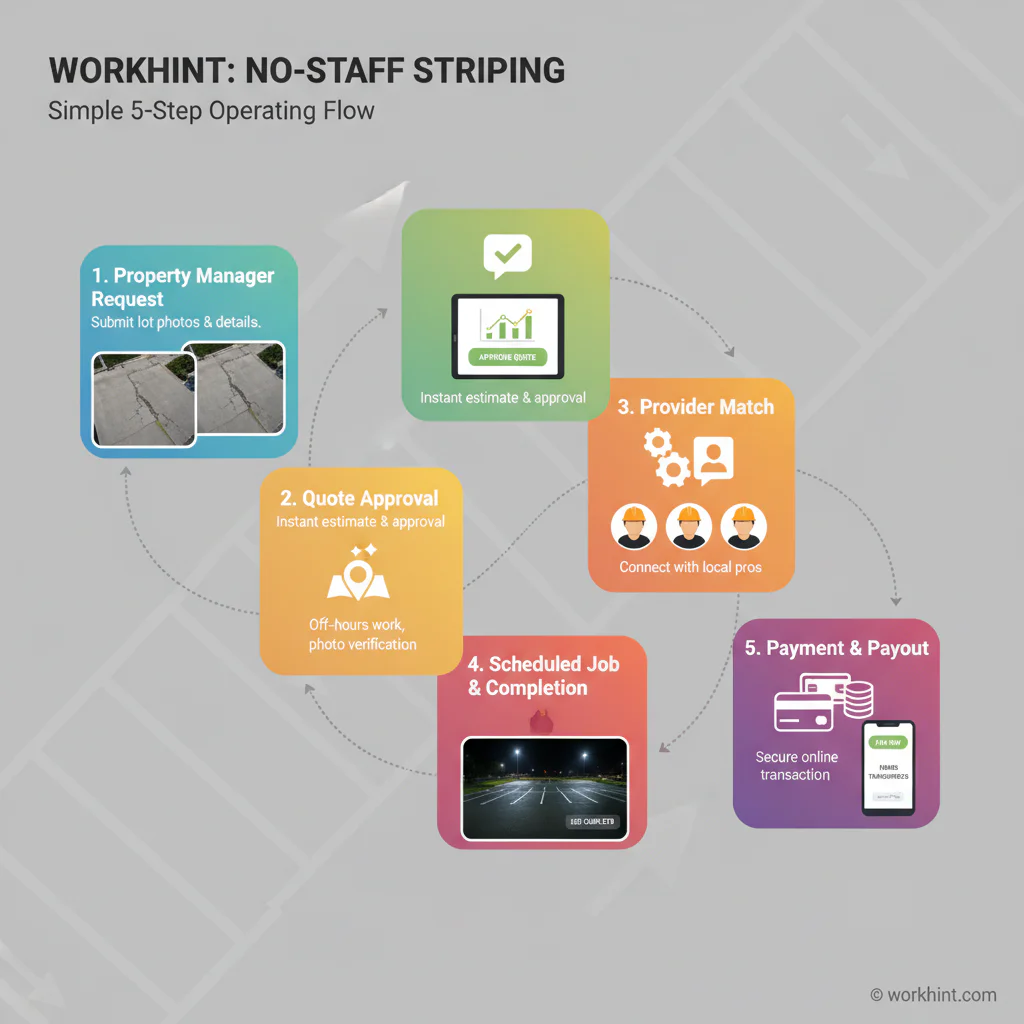
A customer requests restriping through your branded portal. Workhint routes the request to an internal dashboard, captures lot size and photos, helps organize the quote, and lets the customer approve the work. Once approved, the job goes to an independent striping provider with the right equipment and service area.
After the job, Workhint can help collect completion photos, trigger customer review requests, send invoices, record payment, and track contractor payout. The same job record becomes a reminder to rebid that lot in 12 to 18 months. That is the foundation of a real business: customer intake, provider coordination, quality control, and recurring maintenance.
First 7-day launch plan
- Day 1: Choose one market, one customer type, and one simple offer, such as small commercial restriping.
- Day 2: Set up the branded platform basics: request form, quote status, job schedule, invoice, and payment steps.
- Day 3: Build the provider process: invitation, insurance notes, equipment checklist, service area, pricing agreement, and payout rules.
- Day 4: Recruit three to five independent striping providers or asphalt partners.
- Day 5: Identify 25 faded lots and contact property managers with a specific inspection offer.
- Day 6: Route every response through the platform, collect photos, book site reviews, and send quotes quickly.
- Day 7: Review demand, provider readiness, quote conversion, and gaps before buying equipment or expanding the offer.
Final launch checklist
- Choose a business name, service area, and first customer segment
- Confirm local business, contractor, insurance, and parking compliance requirements
- Create a branded customer request and quote approval flow
- Recruit independent providers or partner contractors with proper equipment
- Define pricing rules for restriping, layouts, stencils, fire lanes, and follow-up work
- Build a before-and-after photo process for every job
- Contact first property managers, paving companies, and faded-lot prospects
- Track every completed job for maintenance follow-up
- Validate demand before buying expensive equipment or hiring staff
FAQ
How much does it cost to start a parking lot striping business?
An equipment-first launch often starts around a few thousand dollars and can go much higher with professional machines, insurance, paint, stencils, and transport. A platform-first launch can delay owned equipment by using vetted independent providers while you validate customer demand.
Can I start a parking lot striping business with no staff?
Yes, if you begin as the operator and coordinator. You can sell jobs, manage quotes, schedule independent providers, verify completion, collect payments, and pay providers without hiring employees immediately.
Do I need a license for parking lot striping?
It depends on your city and state. Check business license, contractor registration, traffic control, insurance, and local permit requirements before accepting work. ADA-related striping should be handled carefully because accessible spaces have specific rules.
How do parking lot striping businesses get customers?
The strongest early channels are property managers, visible faded-lot outreach, paving and sealcoating referrals, Google Business Profile, HOAs, churches, schools, warehouses, and commercial landlords.
How should I price parking lot striping jobs?
Most quotes use linear feet, number of spaces, complexity, stencils, accessible markings, travel, minimum job charges, and after-hours scheduling. Include enough margin for provider costs, materials, travel, admin, and quality checks.
Should I buy striping equipment right away?
Not always. If you know the trade and have demand, equipment can make sense. If you are testing the market, coordinate jobs through provider partners first, then buy equipment after revenue proves the model.
Conclusion
A parking lot striping business can start lean when you treat it as a branded commercial service platform, not just a paint-and-equipment business. Validate demand first, build property-manager relationships, recruit reliable providers, and use Workhint to run the operating foundation from quote to payout. Once jobs are real and repeatable, invest into equipment with better information.
Leave a Reply