


A contractor agreement should protect the business and make the work easier to start, approve, track, and pay.
An independent contractor agreement template gives a business a repeatable way to define the relationship before work begins. It should clarify the services, payment terms, ownership of work product, confidentiality, dispute handling, and the boundaries that help preserve the contractor relationship.
Use it as an operational checklist to review with counsel, finance, HR, or procurement.
What’s in this article?
- What an independent contractor agreement should cover
- The clauses most business teams need to review before work starts
- A practical agreement review table for operations, finance, and legal teams
- Common mistakes that create payment, scope, access, or classification problems
- Where Workhint fits when contractor agreements need to become a live workflow
Why contractor agreements matter
A contractor agreement is more than a signature packet. It becomes the source of truth for what work was approved, who owns deliverables, how invoices get paid, what information the contractor may access, and when the engagement ends. Without that structure, teams often start work from scattered emails, old templates, verbal promises, and payment assumptions that nobody has checked.
The agreement also needs to match the actual working relationship. The U.S. Department of Labor explains in its guidance on employment relationships under the FLSA that independent contractors are generally in business for themselves, while employees are economically dependent on an employer for work. A contract label alone does not decide classification, so the written terms and the day-to-day operating model should align.
Independent contractor agreement template essentials
A useful template should be simple enough for teams to use repeatedly, but specific enough to prevent the most common disputes. At minimum, review these areas before approving the contractor to begin work:
- Parties. Use the full legal names and addresses of the business and contractor.
- Services and deliverables. Define the work, milestones, acceptance criteria, deadlines, and exclusions.
- Independent contractor status. State that the contractor controls how the work is performed, supplies their own tools where appropriate, and is not treated as an employee.
- Payment terms. Include rate, invoice requirements, approval process, payment timing, expenses, taxes, and currency.
- Confidentiality. Explain what information is confidential and how it must be handled after the engagement ends.
- Intellectual property. State who owns deliverables, source files, inventions, drafts, data, and reusable contractor materials.
- Access and security. Define what systems, data, devices, and permissions the contractor may use.
- Term and termination. Include start date, end condition, renewal rules, notice period, and unfinished-work handling.
- Insurance, licenses, and compliance. Add requirements that fit the work and risk level.
- Dispute handling. Define governing law, escalation steps, and the process for resolving disagreements.
Agreement review checklist for business teams
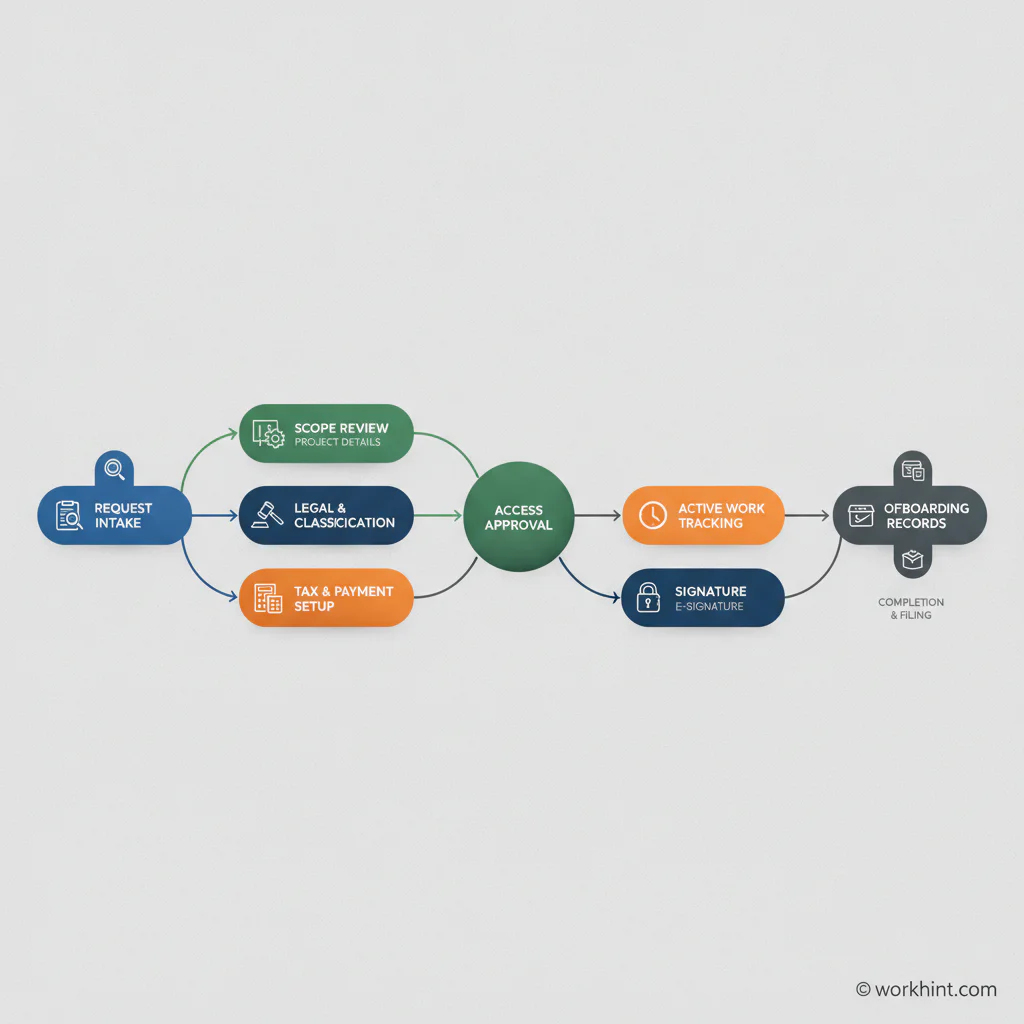
Use this table before a contractor starts work. It helps each team review the clause that affects its operating responsibility.
| Review area | What to confirm | Typical owner |
|---|---|---|
| Scope | Deliverables, timeline, success criteria, and exclusions are clear | Hiring manager or project owner |
| Classification | The contract and work model support contractor status | Legal, HR, or compliance |
| Tax setup | Required tax form and legal name are collected before payment | Finance or accounts payable |
| Payment | Rates, invoice rules, approvals, expenses, and payment schedule are documented | Finance and project owner |
| IP and confidentiality | Ownership, licenses, sensitive information, and return of materials are covered | Legal and business owner |
| Access | Systems, files, customer data, and permission levels match the approved work | IT, security, or operations |
| Offboarding | Access removal, final invoice, deliverable transfer, and record retention are assigned | Operations or contractor program owner |
Tax and compliance details to connect early
For U.S. contractors, the IRS says Form W-9 is used to request a taxpayer identification number and certain certifications from a U.S. person. Finance teams should collect the right tax information before invoices begin, using the official IRS requester instructions for Form W-9 as the source rather than relying on an outdated internal checklist.
For contractors or vendors with access to systems, data, or customer information, the agreement should connect to security review. NIST’s cybersecurity supply chain risk management guidance is a useful reference for thinking about supplier risk, especially when outside parties touch critical systems or sensitive information.
How to use the template before work starts
- Start with the work request. Define the business need, project owner, budget, expected timeline, and reason a contractor is the right model.
- Select the right agreement version. A one-time design project, advisory engagement, technical implementation, and field service job may need different clauses.
- Attach or reference the statement of work. The agreement sets legal terms; the SOW or project brief should define the actual deliverables.
- Route approvals before signature. Legal, finance, IT, security, and the business owner should review only the sections they own.
- Collect required documents. Tax forms, insurance certificates, licenses, compliance acknowledgments, and banking details should be stored securely.
- Provision access after approval. Do not invite the contractor into tools before the agreement, scope, and access level are approved.
- Track changes. If the scope, rate, timeline, or deliverables change, update the SOW or amendment rather than burying the change in email.
Common mistakes
- Using one template for every contractor. A low-risk writing project and a contractor touching production systems should not have the same review path.
- Letting work begin before signature. This creates disputes over scope, ownership, payment, and confidentiality before the business has leverage to fix them.
- Forgetting acceptance criteria. A deliverable is hard to approve when nobody defined what complete means.
- Separating contracts from payments. Accounts payable needs the signed agreement, tax record, invoice rules, and approval owner in the same operating flow.
- Ignoring offboarding. Agreements should point to what happens when work ends: access removal, final files, final invoice, and record retention.
Where Workhint fits
Workhint fits when contractor agreements need to become an operating workflow rather than a folder of signed PDFs. A team can use Workhint to turn the agreement process into intake forms, role-based approvals, document collection, contractor profiles, access requests, SOW tracking, invoice approval rules, payment status, reminders, and offboarding steps.
That matters when multiple teams share responsibility. Legal may own template language, finance may own tax and payment setup, IT may own access, and the business owner may own deliverables. Workhint helps connect those handoffs so the contractor is not approved in one place, provisioned in another, paid from a third, and tracked from a spreadsheet nobody trusts.
FAQ
What is an independent contractor agreement?
An independent contractor agreement is a contract between a business and a non-employee service provider. It defines the work, payment terms, responsibilities, confidentiality, ownership, and relationship between the parties.
What should an independent contractor agreement include?
It should include party details, services, deliverables, payment terms, contractor status, confidentiality, intellectual property, access rules, insurance or licenses where needed, term, termination, and dispute handling.
Is a contractor agreement enough to prove contractor status?
No. A written agreement helps document intent, but classification depends on the legal test that applies and how the work is actually performed. Review classification-sensitive engagements with counsel or qualified HR support.
Should the statement of work be separate from the agreement?
Often, yes. The master agreement can hold reusable legal terms, while the statement of work defines project-specific deliverables, milestones, rates, deadlines, and acceptance criteria.
Who should approve a contractor agreement?
The approvers depend on risk. Most businesses involve the business owner and finance. Legal, HR, IT, security, procurement, or compliance may need to review higher-risk work.
Conclusion
An independent contractor agreement template is useful only when it reflects the way the work will actually run. Keep the template clear, connect it to scope and payment, route the right approvals, and make sure access, tax records, deliverables, and offboarding are part of the same workflow. That is how the agreement becomes a practical control instead of paperwork teams sign and forget.
Leave a Reply