


When every project has many contributors but no clear owner, work slows down exactly when accountability matters most.
The DRI model gives a team one named person responsible for moving work to a defined outcome. DRI usually stands for directly responsible individual. It is not a job title, management layer, or blame mechanism. It is an operating pattern for making ownership visible before work starts.
Modern work is usually cross-functional. A launch may need product, operations, finance, legal, customer success, and partners. A process improvement may need data from one team, approvals from another, and execution from people with different managers. Without a single owner, status scatters, decisions reopen, and blockers wait for someone else to notice.
What’s in this article?
- What the DRI model means in business operations
- When to use a DRI instead of a RACI matrix or process owner
- A workflow for assigning and supporting DRIs
- A simple DRI operating table your team can reuse
Why the DRI model matters
Search demand around terms like “DRI model,” “directly responsible individual,” and “team accountability” points to a familiar problem: teams want clearer ownership without adding more meetings. The GitLab handbook describes DRIs as ultimately accountable for a project, initiative, or activity while still expected to collaborate with stakeholders. Atlassian’s DACI framework makes a similar point for decisions: clarify who drives, approves, contributes, and stays informed before work gets stuck.
A DRI is useful when work has ambiguity, multiple contributors, or meaningful consequences. It is less useful for routine tasks that already have a queue owner, SLA, and obvious next step. The model earns its keep when everyone is involved but nobody is clearly accountable for the outcome.
How to use the DRI model for team accountability
Start by defining the outcome, not the person. A weak assignment says, “Nadia owns onboarding.” A stronger assignment says, “Nadia is the DRI for reducing customer onboarding time from 21 days to 14 days by the end of Q3.” The second version gives the owner something measurable to drive.
Then define the DRI’s authority. Can they make tradeoff decisions, request work from other teams, escalate missed dependencies, or change the workflow? If not, the person is not really a DRI; they are a coordinator with responsibility but no control.
Use this operating sequence:
- Name the outcome. Write the result in business language: cycle time reduced, backlog cleared, launch completed, risk reviewed, or service level restored.
- Assign one DRI. Use one named person, not a department, committee, or shared inbox.
- List contributors. Identify who supplies work, expertise, approvals, data, budget, or execution support.
- Define decision rights. State what the DRI can decide, what requires approval, and what must be escalated.
- Set review points. Pick the operating rhythm: daily during launch, weekly for improvement, or milestone-based for longer initiatives.
- Make blockers visible. Require blockers to include owner, decision needed, and escalation path.
- Close with evidence. Tie completion to a measurable outcome, customer impact, handoff, or operating metric.
A practical DRI operating table
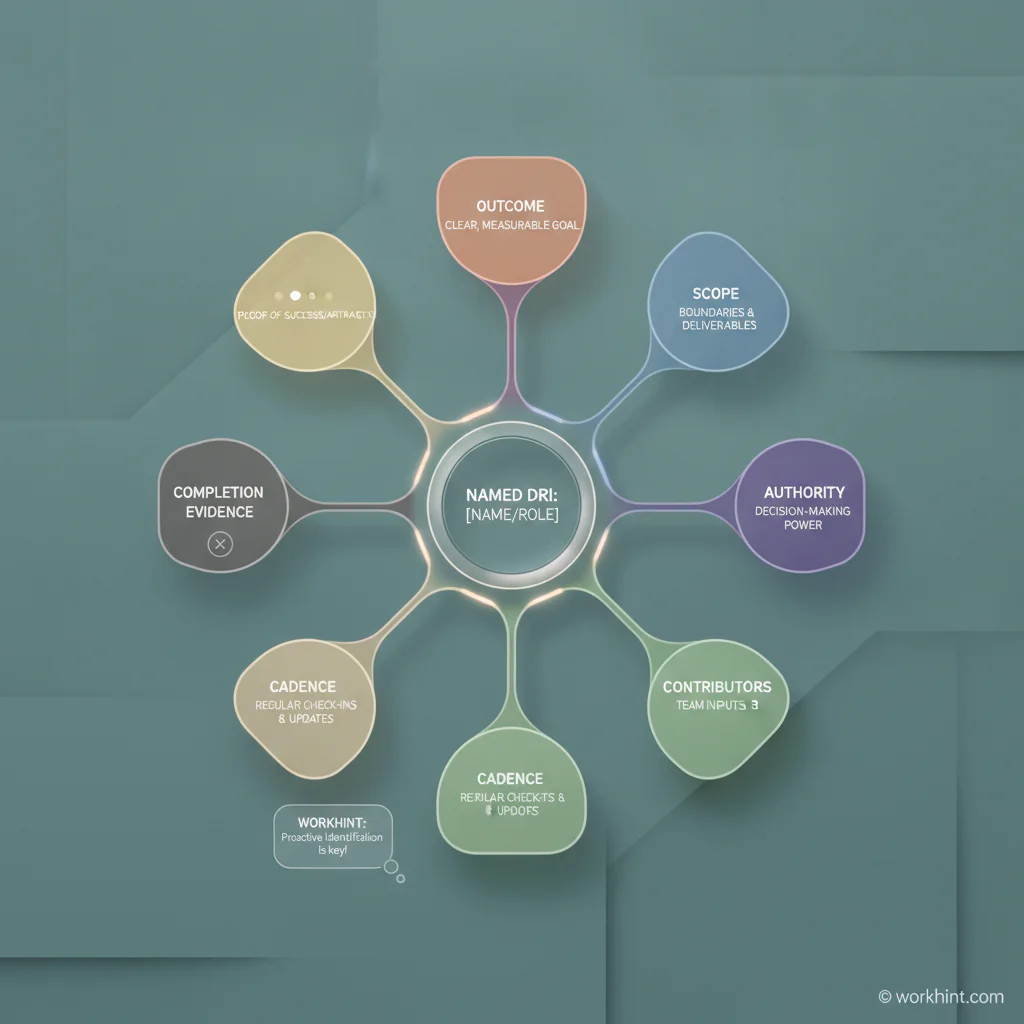
| Operating element | What to define | Why it matters |
|---|---|---|
| Outcome | The measurable result the DRI is driving | Prevents ownership from becoming vague task tracking |
| Scope | What is included and excluded | Stops the assignment from expanding without discussion |
| Authority | Decisions the DRI can make without escalation | Gives accountability enough control to be real |
| Contributors | Teams or people who provide input, execution, or approval | Keeps collaboration visible without creating shared ownership |
| Cadence | Review meetings, async updates, and escalation timing | Makes progress measurable before deadlines are missed |
| Completion evidence | Metric, handoff, shipped change, or documented decision | Defines done in operational terms |
DRI vs RACI vs process owner
The DRI model overlaps with other ownership tools, but each solves a different problem. A RACI chart maps responsibilities across roles: responsible, accountable, consulted, and informed. It is useful when many roles participate in a process and the team needs a full responsibility map.
A process owner is responsible for the health of a recurring process, such as procurement intake, customer onboarding, or incident review. A DRI is more specific: one person accountable for a project, initiative, decision, or operational change.
Use a DRI when the main risk is unclear ownership. Use RACI when participation is unclear. Use a process owner for long-term process drift.
How to make the model work in real operations
A DRI assignment should be paired with a simple operating system. The DRI needs an intake path for new information, a way to assign work, a place to track decisions, a status dashboard, and an escalation path when authority is not enough.
The most useful implementation pattern is a one-page DRI brief. Include outcome, scope, deadline, success metric, contributors, decision rights, approval points, dependencies, risks, and update cadence. Then connect tasks, requests, files, approvals, and decisions back to the same owner.
The model also needs executive discipline. Leaders should avoid bypassing the DRI by reopening decisions privately. They should ask the DRI for current state, unblock authority gaps, and match accountability with capacity. Recent Harvard Business Review coverage argues that accountability works better when people have real agency rather than only pressure from above.
Common DRI model mistakes
- Assigning ownership without authority. A DRI who cannot make decisions becomes a messenger.
- Naming multiple DRIs. Shared ownership is useful for collaboration, but final accountability should remain clear.
- Using DRI as blame language. The model should create clarity and support, not fear.
- Skipping contributors. The DRI owns the outcome, but they still need named input, review, and execution support.
- Failing to define done. If completion evidence is unclear, the work will close too early or drag on too long.
Where Workhint fits
Workhint fits when a team wants the DRI model to become part of how work moves. Instead of assigning an owner in a slide or spreadsheet, a team can use Workhint to turn the brief into a live work system: intake fields, owner roles, contributor permissions, tasks, approval gates, decision logs, reminders, dashboards, and escalation paths.
That is useful when DRIs operate across functions or external partners. The DRI can see what is waiting, who owns each dependency, which approvals are overdue, and which metrics show whether the outcome is moving. Workhint is not a substitute for judgment; it gives the ownership model structure people can follow.
FAQ
What does DRI mean in business?
DRI usually means directly responsible individual. In business operations, it refers to the one named person accountable for driving a project, decision, workflow, or outcome to completion.
Can a team have more than one DRI?
For a single outcome, one DRI is cleaner. Large programs can have multiple workstreams, each with its own DRI, but the overall program still needs one person accountable for tradeoffs.
Is a DRI the same as a project manager?
Not always. A project manager may coordinate timeline, communication, and execution. A DRI owns the outcome and decision path. Sometimes the same person does both.
How is DRI different from accountable in RACI?
They are similar in spirit, but RACI maps all participant roles across tasks. DRI is a simpler ownership pattern that names one person responsible for driving a specific outcome.
When should you not use a DRI?
Do not use a DRI assignment to cover missing capacity, unclear strategy, or absent support. If the owner lacks authority, resources, or a defined outcome, the model will create frustration instead of accountability.
Conclusion
The DRI model works because it makes ownership explicit. One person drives the outcome, contributors know how they fit, leaders know where to look, and blockers have a path instead of floating between teams.
Treat DRI as an operating design choice, not a label. Define the outcome, give the owner real authority, name contributors, set the cadence, and connect the model to the systems where work happens. That is how team accountability becomes repeatable.
Leave a Reply