


A strong contractor review process protects quality without turning independent workers into managed employees.
A contractor performance review process gives business teams a consistent way to evaluate external work before problems become renewals, payment disputes, missed service levels, or relationship damage. It is especially useful when contractors support client delivery, field operations, creative production, facilities work, implementation projects, or specialized expert work across multiple managers.
The goal is not to manage contractors like employees. The goal is to compare delivered work against the contract, statement of work, service level agreement, or project brief; document evidence; discuss issues clearly; and decide whether to continue, improve, pause, or end the relationship. That distinction matters because worker classification questions can create risk when companies control how independent contractors perform their work rather than managing agreed outcomes. The U.S. Department of Labor describes misclassification as treating a worker as an independent contractor when the facts show employee status.
What’s in this article?
- A practical review cadence for contractor work
- A contractor performance scorecard business teams can adapt
- What evidence to collect before a review
- How to discuss performance without micromanaging
- How Workhint fits when contractor reviews need to become a repeatable workflow
Why contractor reviews matter
Contractors often sit outside normal employee performance systems, which means their work can be approved informally until something breaks. One manager may track deadlines in a spreadsheet, another may rely on Slack messages, finance may only see invoices, and legal may only see contracts. That fragmentation makes it hard to know whether a contractor is actually performing well.
Public procurement offers a useful lesson: performance evaluation works best when it is evidence-based and documented. The federal Contractor Performance Assessment Reporting System exists to collect structured contractor performance information, and FAR Subpart 42.15 discusses past performance information for areas such as quality, schedule, cost control, management, and compliance. Most businesses do not need a government-style process, but they do need the same discipline: clear expectations, documented outcomes, and a fair review path.
Start with the contract, not opinions
The review should begin with the agreement that defines the work. For project contractors, that may be a statement of work. For vendors, it may be an MSA, service order, or SLA. For freelancers, it may be a project brief, rate card, milestone plan, or retainer scope.
Before scoring performance, pull the commitments into one place: deliverables, deadlines, acceptance criteria, response expectations, revision limits, communication norms, invoice terms, documentation requirements, security rules, and any compliance obligations. If the contract does not define an expectation, treat it carefully. You can discuss it as a working preference, but you should not score a contractor negatively for a standard that was never agreed.
Use the right review cadence
Different contractor relationships need different review rhythms. A one-time specialist may only need a closeout review. A monthly retainer may need a light monthly check and a quarterly renewal review. A high-risk vendor may need formal scorecards tied to service levels.
| Contractor type | Best review cadence | Main decision |
|---|---|---|
| One-time project contractor | Milestone and final review | Accept, revise, or rehire |
| Retainer freelancer | Monthly check and quarterly review | Continue, adjust scope, or replace |
| Field or service contractor | Weekly operational review and monthly scorecard | Improve service levels or escalate |
| Strategic vendor | Monthly dashboard and quarterly business review | Renew, expand, renegotiate, or exit |
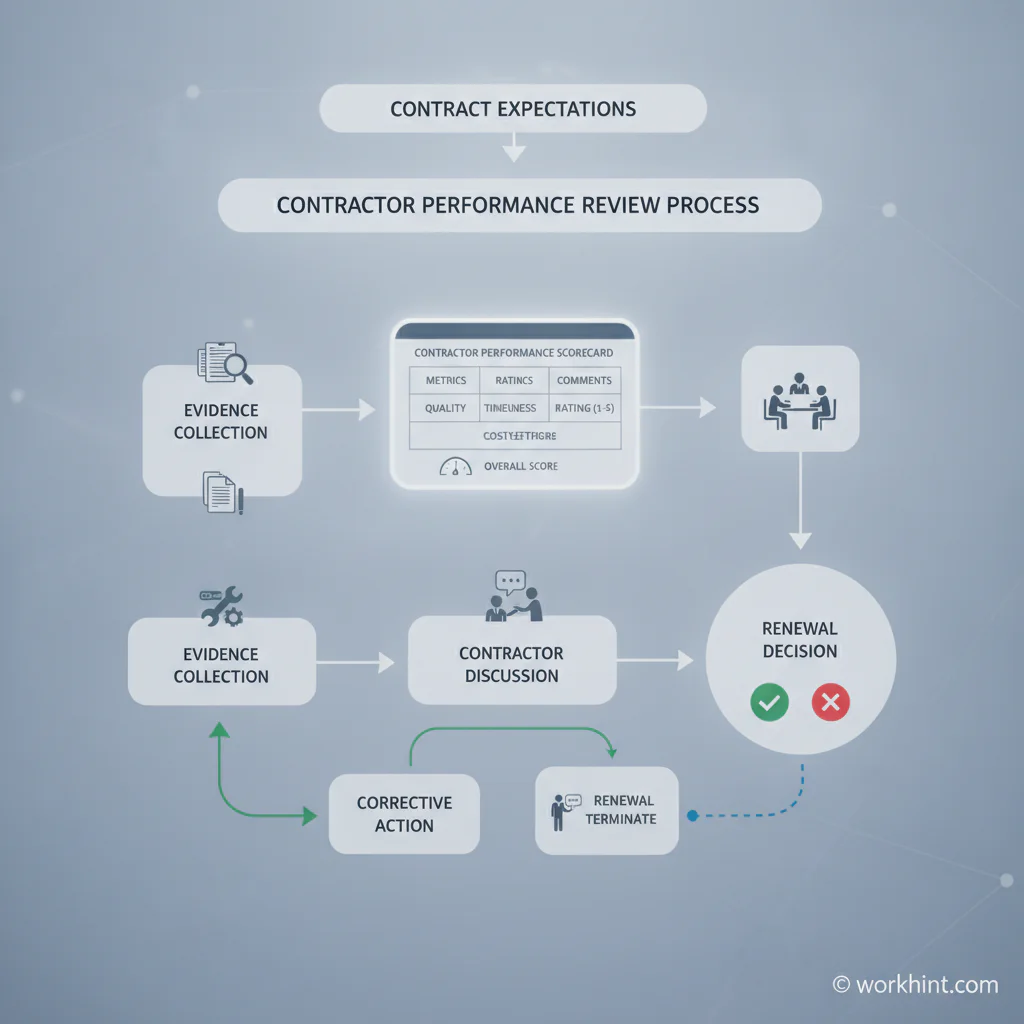
Contractor performance scorecard
A good scorecard is short enough to use and specific enough to defend. Avoid vague categories like attitude or culture fit. Focus on measurable outcomes and observable working behavior tied to the contract.
- Quality: Work meets agreed acceptance criteria, standards, and client expectations.
- Schedule: Milestones, response times, and turnaround commitments are met or risks are raised early.
- Communication: Updates are clear, blockers are visible, and the right people are informed.
- Cost control: Work stays within approved budget, change requests are documented, and invoices match approved work.
- Compliance: Required documents, safety rules, access policies, data handling, and tax or onboarding records are complete.
- Issue resolution: Problems are corrected quickly and do not repeat without a plan.
Use a simple rating scale, such as 1 to 5, but require a short evidence note for any very high or low score. Evidence could include accepted deliverables, missed dates, customer feedback, revision logs, incident reports, invoice exceptions, service tickets, or approval history.
Run the review workflow
- Collect evidence: Pull contract terms, deliverable status, approval notes, invoices, service data, and manager feedback.
- Score the work: Rate only against agreed expectations and observable outcomes.
- Identify the pattern: Separate one-off misses from recurring problems.
- Discuss with the contractor: Share the evidence, ask for context, and agree on next steps.
- Document the decision: Record whether the relationship continues unchanged, needs a corrective action plan, changes scope, or ends.
- Follow up: Assign owners and dates for any corrective action, access changes, payment holds, or renewal decisions.
For formal vendor or government-style evaluations, fairness and documentation matter even more. FAR 42.1503 describes procedures where contractors are given an opportunity to comment on evaluations. Private companies can borrow the principle without copying the bureaucracy: do not surprise contractors with secret scores. Share the issue, give them a chance to respond, and keep the record factual.
Common mistakes
The most common mistake is reviewing personality instead of performance. Another is mixing employee-style supervision into a contractor relationship. A manager can set deadlines, acceptance criteria, data security requirements, and approval gates. They should be careful about controlling every hour, method, and internal working pattern unless the legal structure supports that level of control.
Teams also fail when finance, operations, legal, and project owners keep separate records. A contractor can look strong to one stakeholder and risky to another. The review process should combine those views before renewal or expansion decisions are made.
Where Workhint fits
Workhint helps teams turn the contractor performance review process into a live operating workflow. Instead of chasing updates across forms, chat, spreadsheets, invoices, and contract folders, a team can structure the review around roles, intake, document collection, assignment records, approval steps, payment status, compliance reminders, and reporting.
That is useful when contractor performance depends on more than one manager. Operations can review service delivery, finance can confirm invoice exceptions, legal can verify required documents, and the business owner can make renewal decisions from one structured workflow. Workhint is not the review itself; it is the system that keeps the review consistent, visible, and actionable.
FAQ
How often should contractors be reviewed?
Review active contractors at the pace of risk and spend. Short projects may only need milestone and closeout reviews. Ongoing contractors usually need monthly operating checks and quarterly renewal reviews.
What should a contractor performance review measure?
Measure quality, schedule, communication, cost control, compliance, and issue resolution. Tie every score to the agreement, project brief, SLA, or documented expectation.
Should contractors receive feedback?
Yes. Contractors should understand what is working, what needs improvement, and how the business will make renewal or scope decisions. Keep feedback factual and tied to outcomes.
Can contractor reviews create compliance risk?
They can if the process starts managing contractors like employees instead of evaluating contracted outcomes. For classification-sensitive situations, involve legal or HR before changing control, schedule, or supervision expectations.
Conclusion
A contractor performance review process should make external work easier to trust. Start with the agreement, collect evidence, use a simple scorecard, discuss issues clearly, and document the decision. When the workflow is consistent, teams can improve quality, reduce renewal risk, and keep contractor relationships professional without adding unnecessary control.
Leave a Reply