


Use these questions to find what employees need, what managers can fix, and which feedback deserves action first.
Employee engagement survey questions work best when they are short, specific, and tied to decisions the business is willing to make. A survey should not become an annual ritual where employees give feedback and nothing changes. It should help leaders see where work is clear, where people are blocked, where managers need support, and where the company needs a better operating rhythm.
This resource gives you a practical question bank, a simple survey structure, and a follow-up workflow. It is written for founders, HR teams, people operations leaders, department heads, and managers who need useful feedback without turning the survey into a research project.
What’s included
- A copy-ready employee engagement survey question bank.
- Rating-scale questions grouped by business signal.
- Open-ended questions that reveal context behind scores.
- A follow-up workflow for turning feedback into action.
- Common mistakes that weaken survey participation and trust.
How to use these employee engagement survey questions
Start by deciding what you need to learn. Engagement surveys can measure broad sentiment, but the strongest surveys focus on signals the business can act on: role clarity, manager support, workload, recognition, growth, belonging, communication, tools, and intent to stay.
Keep most questions on the same scale so results are easier to compare across teams. SHRM’s employee survey resources include sample surveys across satisfaction, new hire, benefits, and diversity topics, which is a useful reminder that survey design should match the decision you need to make. SHRM also advises careful wording so questions are clear and familiar to employees.
Use a 1 to 5 agreement scale for most statements: strongly disagree, disagree, neutral, agree, strongly agree. Add a small number of open-ended questions at the end. Culture Amp notes that strong engagement surveys combine quantitative and qualitative questions so teams can see patterns and understand the reasons behind them.
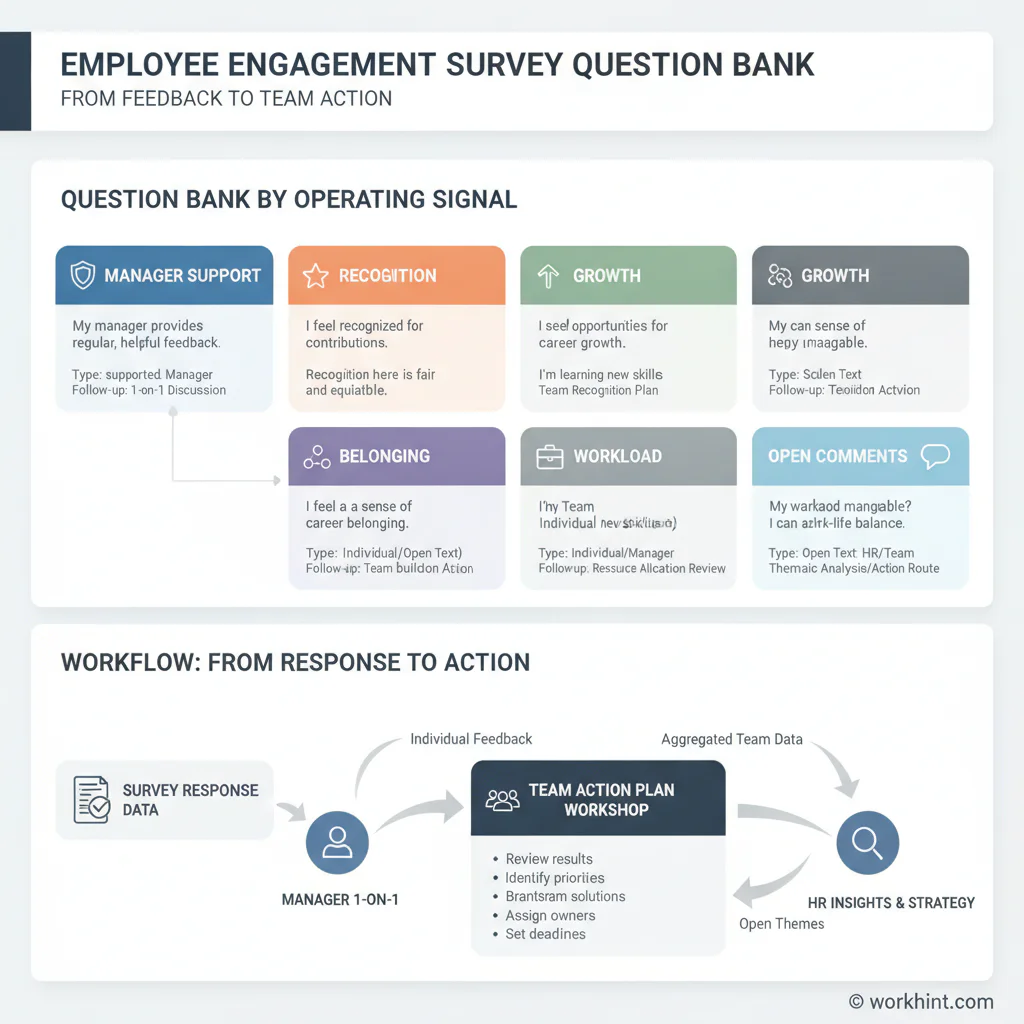
Employee engagement survey questions template
Use this question bank as a starting point. For a short pulse survey, choose 8 to 12 questions. For a fuller engagement survey, choose 20 to 30 questions and keep the open-ended section tight.
| Signal | Question | Best owner | Follow-up action |
|---|---|---|---|
| Role clarity | I understand what is expected of me in my role. | Manager | Review goals, responsibilities, and decision rights. |
| Tools and access | I have the tools, information, and access I need to do my work well. | Operations or IT | Fix access gaps and recurring tool blockers. |
| Manager support | My manager gives me useful guidance when priorities are unclear. | Department lead | Coach managers on prioritization and feedback rhythms. |
| Recognition | Good work is noticed and recognized on my team. | Manager | Create a consistent recognition habit tied to real outcomes. |
| Growth | I see opportunities to learn, grow, or take on meaningful new work. | People or manager | Clarify growth paths, training needs, and stretch assignments. |
| Belonging | I feel respected and included in the way work gets done here. | Leadership | Review team norms, meeting behavior, and inclusion risks. |
| Workload | My workload is sustainable for the quality of work expected. | Manager and operations | Rebalance capacity, deadlines, staffing, or scope. |
| Communication | I get the information I need before decisions affect my work. | Leadership or project owner | Improve update cadences, decision logs, and escalation paths. |
| Purpose | I understand how my work contributes to the company’s goals. | Leadership | Connect team work to company priorities in planning reviews. |
| Intent to stay | I can see myself working here one year from now. | People and leadership | Investigate retention risk by team, role, and tenure. |
Open-ended questions to include
Open-ended questions should explain the scores, not invite unlimited commentary. Use three to five of these:
- What is one thing that would make your work easier or more effective?
- What should we keep doing because it helps you do strong work?
- Where do priorities, ownership, or decisions feel unclear?
- What is one process or tool that creates avoidable friction?
- What would make you more likely to stay and grow here?
- What should your manager or leadership team understand better?
What to do after the survey closes
The survey is only valuable if employees see follow-through. Deloitte’s workforce listening guidance emphasizes collecting, analyzing, and acting on employee perceptions consistently. That action loop matters more than a perfect dashboard.
- Review participation before interpreting results. Low response rates may signal trust, timing, or communication problems.
- Look for patterns by team, role, location, tenure, and manager, while protecting anonymity.
- Choose two or three priority themes. Do not promise to fix everything at once.
- Assign an owner to each action. Feedback without ownership becomes another open loop.
- Share what was heard, what will change, what will not change yet, and why.
- Check progress within 30 to 60 days so employees know the survey mattered.
Common mistakes
- Asking questions the business will ignore. Do not ask about pay, flexibility, workload, or manager quality unless leaders are ready to review the answer seriously.
- Using too many questions. Long surveys reduce completion quality. Shorter surveys run more often can be more useful.
- Mixing several ideas in one question. “My manager communicates clearly and recognizes my work” should be two questions.
- Sharing results without action. A summary alone is not follow-through. Name the next decision, owner, and timing.
- Ignoring manager enablement. Managers often own the fixes, but they need time, coaching, and authority to act.
Where Workhint fits
Workhint helps organizations turn an employee engagement survey into a live improvement workflow. A team can collect survey inputs, group findings by theme, assign owners, route follow-up actions, set due dates, track manager commitments, and keep leadership visibility on progress.
That is useful when feedback touches several operating areas at once: HR owns the survey, managers own team-level changes, operations owns workflow blockers, IT owns access issues, and leadership owns company-wide priorities. Workhint can help connect those pieces so employee listening becomes a managed process instead of a static report.
FAQ
What are the best employee engagement survey questions?
The best questions measure signals the business can act on, such as role clarity, manager support, recognition, growth, belonging, workload, communication, tools, purpose, and intent to stay. Gallup’s Q12 framework is one established example of measuring foundational engagement needs such as expectations, resources, recognition, development, and purpose.
How many employee engagement survey questions should we ask?
For a pulse survey, 8 to 12 questions is usually enough. For a broader engagement survey, 20 to 30 well-written questions can work if employees understand why the survey matters and how results will be used.
Should engagement surveys be anonymous?
Anonymous surveys often produce more honest feedback, especially when trust is still developing. If anonymity is promised, protect it carefully. Avoid slicing results so narrowly that individual employees can be identified.
How often should we run an engagement survey?
Many teams run a deeper survey once or twice a year and lighter pulse surveys quarterly or monthly. The right cadence depends on company size, change level, and whether leaders can act on the results.
What should we do if scores are low?
Do not defend the scores or rush into vague culture fixes. Identify the lowest actionable themes, hold manager and leadership review sessions, choose a small number of concrete actions, and communicate progress within 30 to 60 days.
Conclusion
Employee engagement survey questions should help a business understand where work is clear, where employees feel supported, and where operating friction is making good work harder. Use a focused question bank, protect trust, analyze patterns carefully, and turn the results into owned actions. The strongest survey is not the longest one. It is the one employees can see the business use.
Leave a Reply