


Use this policy template to let teams use AI tools without guessing what is approved, risky, or off limits.
An AI acceptable use policy template gives employees clear rules for using generative AI, copilots, chatbots, automation tools, and AI features built into everyday software. The best version tells people which tools they may use, what data they may enter, when human review is required, and which uses need approval.
This resource is written for HR, operations, IT, security, legal, and department leaders who need practical guardrails now. It is not legal advice. For a stronger risk baseline, pair the policy with the NIST AI Risk Management Framework and NIST’s Generative AI Profile.
What is included
- A copy-ready AI acceptable use policy template
- A decision table for approved, restricted, and prohibited use
- A rollout checklist for HR, IT, security, legal, and managers
- Common mistakes that make AI policies hard to enforce
- FAQ for business teams implementing employee AI rules
How to use this AI acceptable use policy template
Start by deciding the policy’s operating model. A small team may need simple rules for public AI tools. A larger company may need approved tool lists, data classifications, vendor review, training, and exception approvals. The Texas Department of Information Resources published a useful AI Acceptable Use Policy in 2026.
Do not copy any template blindly. Customize the sections below to match your tools, data rules, customer promises, employment rules, industry obligations, and internal approval process.
AI acceptable use policy template
1. Purpose
This policy explains how employees, contractors, vendors, and other authorized users may use artificial intelligence tools for company work while protecting confidential information, personal data, customer trust, security, compliance, and decision quality.
2. Scope
This policy applies to AI systems used for company work, including generative AI chatbots, writing assistants, coding assistants, meeting assistants, image generators, analytics tools, embedded AI features, workflow automation tools, and any personal AI account used for work-related activity.
3. Approved tools
Employees may use only AI tools approved for the relevant use case and data type. The approved tools list is maintained by [Owner or Team] and reviewed [monthly/quarterly]. Tools not listed are not approved for company information unless an exception is granted in writing.
4. Data rules
Users may not enter confidential, restricted, regulated, customer, employee, payment, authentication, source code, contract, financial, legal, health, or personal information into an AI system unless the tool is approved for that data class.
5. Allowed uses
Approved AI tools may be used for low-risk work such as drafting outlines, summarizing public information, brainstorming internal options, cleaning nonconfidential notes, translating approved public copy, improving spreadsheet formulas, and suggesting code in approved development environments.
6. Restricted uses
The following uses require approval before use: customer-facing recommendations, employment decisions, vendor selection, pricing decisions, regulated communications, legal drafting, security review, customer data, employee data, and any workflow where AI output could affect a person’s rights, payment, access, or eligibility.
7. Prohibited uses
Users may not use AI tools to impersonate another person, bypass security controls, create deceptive content, make final employment decisions without human review, upload restricted data into unapproved tools, generate unlawful content, hide AI use where disclosure is required, or publish AI-generated work as verified fact without review.
8. Human review
AI output must be reviewed before it is sent to customers, used in a business decision, relied on for legal or compliance work, used in hiring, merged into production code, or added to an official company record. Reviewers must check accuracy, source quality, confidentiality, and fit.
9. Transparency and attribution
Employees should disclose AI assistance when required by law, contract, customer policy, platform rules, or company standards. Significant AI-generated content used in public materials, customer deliverables, or formal records should be documented according to [Company Documentation Rule].
10. Ownership, records, and retention
AI prompts, outputs, approvals, and related records may be company records when used for company work. Important AI-assisted work must be stored in approved company systems. Retention follows company records, privacy, security, and intellectual property policies.
11. Training and enforcement
All users must complete AI acceptable use training before using approved AI tools for company work. Violations may result in tool access removal, additional review, disciplinary action, vendor escalation, incident response, or legal review depending on severity.
12. Review cadence
This policy is reviewed at least quarterly and whenever the company approves a new AI tool, changes data rules, updates customer commitments, or identifies a material AI-related incident.
AI use decision table
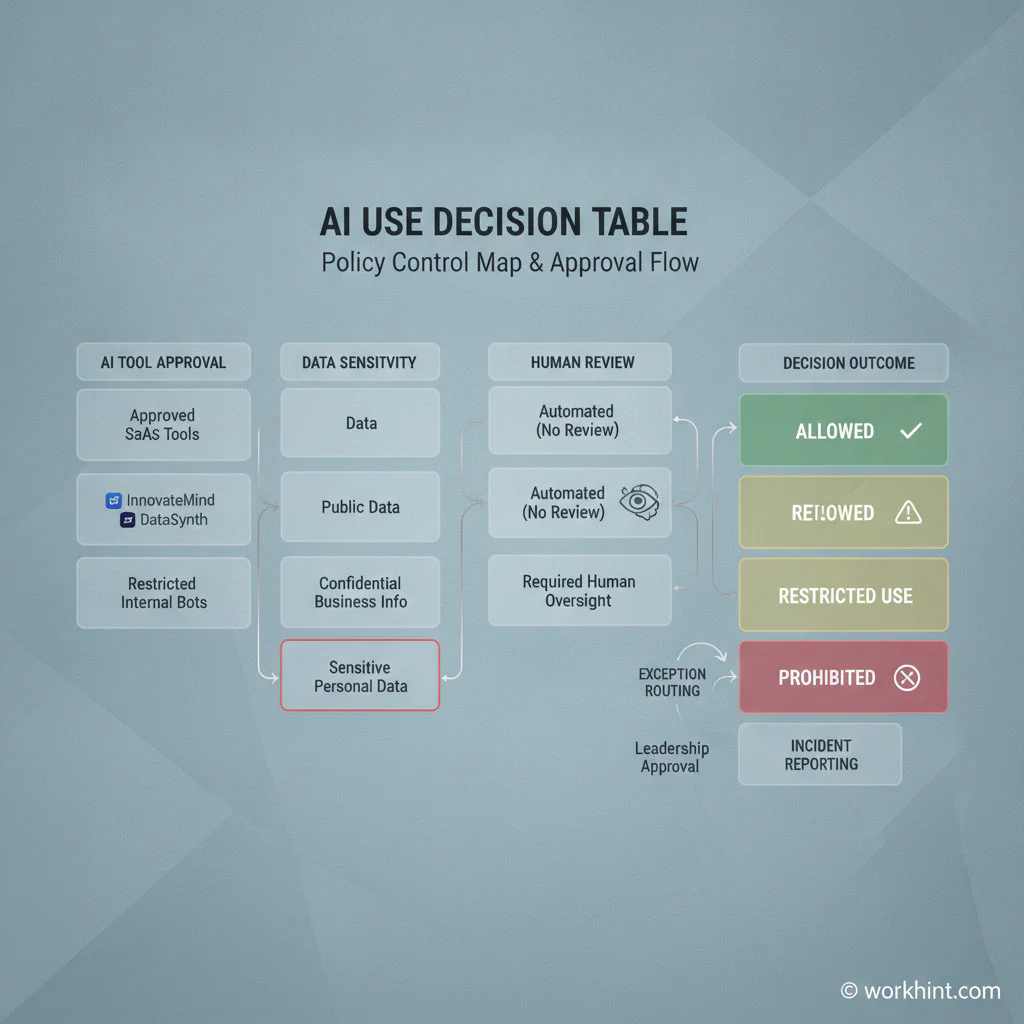
| Use type | Status | Example | Required control |
|---|---|---|---|
| Public-content drafting | Allowed | Drafting a blog outline from public research | Human review before publishing |
| Internal process help | Allowed | Turning a public checklist into an internal SOP draft | No restricted data in prompts |
| Customer data analysis | Restricted | Summarizing customer tickets with names or account details | Approved tool and data owner approval |
| People decisions | Restricted | Ranking candidates or flagging employees for review | Legal or HR approval and documented human decision |
| Unapproved sensitive upload | Prohibited | Pasting contracts, payroll data, source code, or credentials into a public chatbot | Do not use; escalate if already done |
Rollout checklist
- Name the policy owner and approvers.
- Create the approved tools list and map tools to allowed data classes.
- Define public, internal, confidential, restricted, and regulated data.
- Write examples employees will recognize.
- Set the exception request path for restricted AI use cases.
- Train managers on how to review AI-assisted work.
- Require employees and contractors to acknowledge the policy.
- Track incidents, exceptions, and tool changes.
- Review quarterly and update the approved tools appendix when tools change.
Common mistakes
The first mistake is saying “use AI responsibly” without defining approved tools, data rules, or review requirements. The second is banning everything, which usually drives AI use into personal accounts. The third is treating the policy as an HR document only. AI acceptable use touches security, privacy, legal, procurement, operations, IT, managers, and the teams using the tools.
Where Workhint fits
Workhint helps when the AI acceptable use policy needs to become a live operating workflow instead of a static document. A company can turn the policy into role-based onboarding, acknowledgments, approved tool requests, exception approvals, incident reports, training tasks, review reminders, and manager dashboards.
FAQ
What should an AI acceptable use policy include?
It should include purpose, scope, approved tools, data rules, allowed uses, restricted uses, prohibited uses, human review, disclosure rules, records retention, training, enforcement, and review cadence.
Who should own the AI acceptable use policy?
Ownership usually sits with IT, security, legal, HR, compliance, or operations. The practical owner should be able to update approved tools, manage exceptions, coordinate training, and respond to incidents.
Do contractors need to follow the same AI policy?
Usually yes. Contractors and vendors may handle confidential information or customer work. Include AI rules in onboarding, contracts, scopes of work, access approvals, and security acknowledgments.
How often should the policy be reviewed?
Review it at least quarterly. Review it sooner when new tools are approved, data rules change, a customer contract adds AI restrictions, a regulation affects the business, or an AI incident reveals a gap.
Is this the same as an AI governance policy?
No. An acceptable use policy is the employee-facing rulebook for day-to-day AI use. A broader AI governance policy may also cover model procurement, vendor risk, system evaluation, board reporting, audits, and enterprise risk management.
Conclusion
An AI acceptable use policy template works when it is specific enough for employees to follow. Define approved tools, protect sensitive data, separate low-risk and restricted use, require human review, and create a simple path for exceptions. Then turn the policy into a workflow so training, approvals, incidents, and updates do not depend on memory.
Leave a Reply