

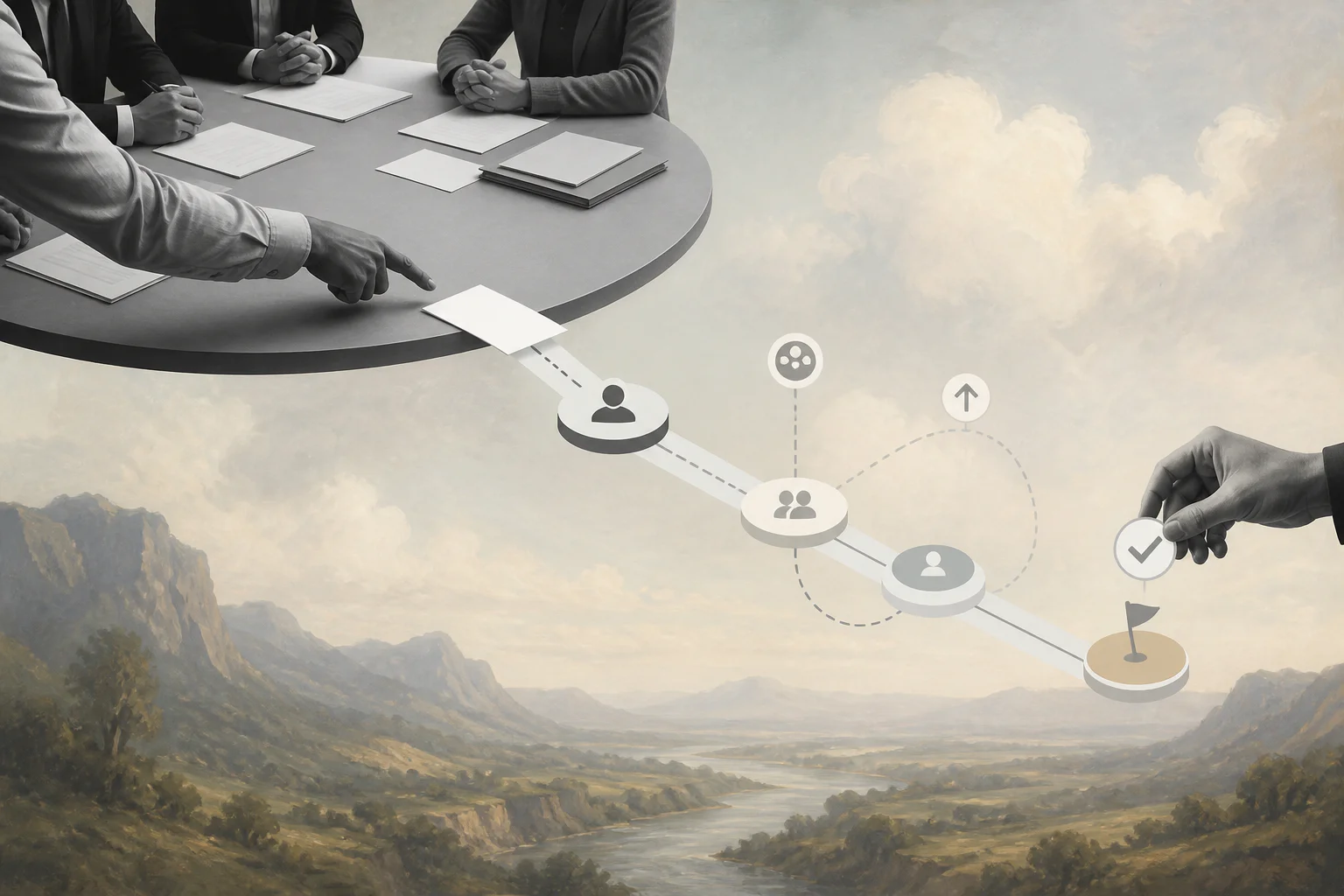
Meetings only create value when decisions turn into owned, visible, completed action.
An action item tracking process is the operating system that turns decisions, follow-ups, risks, and commitments into accountable work. It is not just a meeting-notes habit. It defines how action items are captured, assigned, prioritized, reviewed, escalated, and closed across the business.
Most teams do not lose execution because they lack ideas. They lose it because commitments scatter across meeting notes, Slack threads, email replies, spreadsheets, and personal task lists. By the next meeting, nobody knows which items were completed, which ones are blocked, and which decisions need to be reopened.
What’s in this article?
- What an action item tracking process should include
- Why action items disappear after meetings
- The fields every action item record needs
- A simple operating workflow for tracking commitments
- Metrics, failure points, and where Workhint fits
Why action item tracking matters
Action items are small, but the operating risk is large. A missed vendor follow-up delays procurement. An unclear compliance owner blocks a launch. A decision made in an executive meeting never reaches the team responsible for execution. The work looked assigned in conversation, but it was never converted into a managed record.
Asana’s guidance on action items makes the useful distinction that action items help teams track decisions made during a meeting. That is the right starting point, but operations teams need more than a list. They need a repeatable process that keeps commitments visible after the meeting ends.
The goal is not to create more administrative work. The goal is to reduce the manual chasing, repeated conversations, and status ambiguity that appear when action items live outside the operating system.
Action item tracking process design
A practical process starts with one rule: every real commitment needs a current owner and a next review point. If an item does not have both, it is only a note.
Design the process around six steps:
- Capture the action. Write the action as a clear outcome, not a vague topic. “Send revised vendor onboarding checklist to legal” is trackable. “Vendor checklist” is not.
- Assign one accountable owner. Contributors can help, but one person should own movement until the item is closed or transferred.
- Set the due date and decision context. Include why the date matters, what decision created the item, and what happens if it slips.
- Route the item into the right system. Meeting notes can capture the item, but the record should move into a tracker, workflow, CRM, ticket queue, or operating system where work is actually managed.
- Review by exception. Do not rehash every open item. Review overdue, blocked, high-risk, or decision-dependent items first.
- Close with evidence. Completion should include the output, link, decision, file, handoff, or updated status that proves the action is done.
Fields every action item record needs
The tracker can be simple, but the data model matters. Smartsheet’s action item templates commonly include fields such as description, assignee, priority, due date, status, and progress notes. For business operations, add enough context to make the item auditable and useful across teams.
| Field | Why it matters | Example |
|---|---|---|
| Action item | Defines the outcome to complete | Finalize vendor setup requirements |
| Owner | Creates one accountable person for movement | Operations manager |
| Source | Shows where the commitment came from | Weekly operations review |
| Decision context | Preserves why the work exists | Needed before expanding contractor onboarding |
| Due date | Turns intent into a time-bound commitment | Friday, end of day |
| Status | Shows whether work is open, blocked, done, or canceled | Blocked, waiting on legal |
| Escalation rule | Prevents aging items from disappearing | Escalate after two missed review cycles |
| Completion evidence | Proves the work actually closed | Checklist approved and linked |
Build the workflow around review rhythm
Action item tracking fails when it is treated as a separate spreadsheet someone updates before a meeting. It should connect to the team’s operating rhythm.
Atlassian describes meeting cadence as the rhythm teams use to share updates, solve problems, and make decisions. Action item tracking should sit inside that rhythm. Daily standups may review blocked items. Weekly reviews may check overdue commitments. Monthly operating reviews may look for recurring failure patterns.
Use different review levels for different work:
- Daily: critical blockers, urgent customer or compliance items, and handoffs due today.
- Weekly: overdue items, owner changes, unresolved decisions, and items without completion evidence.
- Monthly: recurring blockers, overloaded owners, cycle time trends, and commitments that should become repeatable workflows.
Track the health of the process
A good action item tracker is not measured by how many tasks it contains. It is measured by whether commitments move without constant manual chasing.
Track these operating metrics:
- Unowned items: any item captured without one accountable owner.
- Overdue rate: the percentage of open items past due.
- Blocked age: how long blocked items remain unresolved.
- Reopened items: items marked complete before the real outcome was delivered.
- Owner load: how many open items sit with each person or team.
- Decision-to-action time: how long it takes for a meeting decision to become a tracked record.
These metrics help leaders improve the system instead of blaming individuals. If many items are unowned, the capture process is weak. If blocked age is rising, escalation rules are unclear. If the same owners are overloaded every week, the issue may be capacity, not discipline.
Common mistakes
- Writing topics instead of outcomes. “Pricing model” is not an action item. “Send revised pricing model to finance for approval” is.
- Assigning groups instead of owners. “Ops team” creates ambiguity. One named owner should hold the next action.
- Letting meeting notes become the system of record. Notes are useful capture tools, but they are poor workflow systems.
- Reviewing everything equally. Mature teams review exceptions first: overdue, blocked, high-risk, or ownerless items.
- Closing without evidence. A checked box is not enough when the output matters to another workflow.
Where Workhint fits
Workhint fits when action item tracking needs to become part of a broader work system. A team can describe the operating problem, then use Workhint to define intake fields, owner rules, statuses, due dates, escalation paths, approvals, handoffs, dashboards, and automations around recurring commitments.
That matters when action items cross teams. A customer operations decision may create work for finance, legal, product, and an external partner. Workhint helps turn those commitments into routed, permissioned, measurable workflows instead of scattered notes that depend on memory and follow-up messages.
FAQ
What is action item tracking?
Action item tracking is the process of recording commitments, assigning owners, setting due dates, monitoring status, escalating blockers, and confirming completion evidence.
What should every action item include?
Every action item should include a clear outcome, one accountable owner, a due date, source context, current status, and completion evidence.
Should action items live in meeting notes or a task system?
Meeting notes are useful for capture, but action items should move into the system where work is managed. That may be a workflow tool, CRM, ticket queue, operations dashboard, or Workhint-generated work system.
How often should teams review action items?
Review critical blockers daily, overdue and high-risk items weekly, and process-level patterns monthly. The review cadence should match business risk and work volume.
Who owns action item tracking?
The meeting owner or process owner should own the tracking process. Each individual action item should still have one accountable owner responsible for the next action.
Conclusion
An action item tracking process turns business commitments into visible work. The useful version captures clear outcomes, assigns one owner, preserves decision context, connects to the team’s review rhythm, and closes items only when evidence exists.
When action items are managed as a system, teams stop reopening the same decisions and chasing the same follow-ups. Work becomes easier to see, easier to route, and easier to improve as operations scale.
Leave a Reply