


A concierge business can start as a branded service platform before you hire staff, lease office space, or build custom software.
If you want to start a concierge business, the easiest path is not to become everyone’s personal assistant overnight. The better path is to choose a focused customer, create a clear service menu, recruit trusted independent providers, and coordinate the work through one branded platform.
Concierge businesses work because busy people and businesses pay to remove friction. They need errands handled, reservations managed, appointments coordinated, homes watched, vendors scheduled, gifts sourced, travel details organized, and urgent tasks completed without chasing five different people.
The traditional version depends on the founder doing every task personally. The modern version can launch faster: build demand first, create a branded customer experience, and use a private provider network for fulfillment.
What’s in this article?
- Why a concierge business works as a low-overhead startup
- What you need before launch
- How to price concierge services
- Where first customers come from
- How Workhint can power the branded operating platform
- A practical 7-day launch plan
Why this business works
Concierge services sell time, trust, and coordination. Customers do not only pay for an errand. They pay for a reliable person or team that can understand the request, handle details, protect privacy, and report back clearly.
The business can be attractive because it does not require a storefront, expensive equipment, or inventory. Many services can be coordinated from home with a phone, laptop, insurance, a clear intake process, and vetted providers.
Search results for concierge startup guides show steady reader interest around costs, pricing, legal setup, service menus, and first customers. Competitor articles commonly mention business registration, choosing services, insurance, branding, websites, marketing, and hourly or package pricing. The gap is operations. Most guides do not show how to coordinate requests, providers, scheduling, approvals, payment, and proof of completion without turning the founder into the bottleneck.
That gap is the opportunity. A small concierge company can look professional quickly if the customer experience is organized from the first request.
What you need to launch
Start with one concierge niche. Good first versions include senior concierge services, executive errands, relocation help, home watch coordination, travel planning support, small business admin errands, or local lifestyle management.
Then define what you will do, what you will not do, which tasks require licensed professionals, and which requests will be fulfilled by independent providers. Avoid medical, financial, legal, childcare, driving, or property-access services unless you understand the licensing, insurance, and liability requirements.
| Startup item | Lean launch approach | Typical early budget |
|---|---|---|
| Business registration | Register the business and open a business bank account | $50 to $500 |
| Insurance | Start with general liability advice, then add coverage for specific services | $400 to $1,500+ |
| Brand and website | Simple local brand, service pages, and request form | $200 to $1,000 |
| Workhint platform | Customer portal, intake, scheduling, provider onboarding, payments, and payouts | Start lean before custom software |
| Provider network | Vetted assistants, errand runners, organizers, drivers, cleaners, and local specialists | $0 to $500 for onboarding and checks |
| Marketing tests | Google Business Profile, referral partners, local groups, and direct outreach | $100 to $1,000 |
The goal is not to build a luxury brand on day one. The goal is to prove that a specific customer segment will request, approve, and pay for organized help.
How to price it
Concierge pricing should be easy to understand and hard to abuse. Hourly rates are simple, but they can make customers nervous if the scope is unclear. Packages and retainers work better once customers trust the service.
| Pricing model | Best use | Example offer |
|---|---|---|
| Hourly | One-off errands or undefined requests | Two-hour minimum for local tasks |
| Task package | Repeatable services | New resident setup, senior errands, weekly home check |
| Monthly retainer | Busy professionals or families | Set number of monthly requests with priority scheduling |
| Project fee | Move coordination, event support, travel planning | Flat coordination fee plus provider costs |
| Membership | Premium local lifestyle service | Monthly access fee plus task charges |
Published concierge pricing guides commonly reference broad hourly ranges, often from around $30 to $150+ depending on the customer, urgency, market, and service type. Use those ranges as context, not as a rule. Price around value, risk, response time, provider cost, and margin.
How to get first customers
The first customers usually come from trust-heavy channels. Start with people who already serve your target customer: real estate agents, apartment managers, senior communities, relocation companies, executive assistants, coworking spaces, hotels, boutique gyms, personal trainers, estate managers, and local professional groups.
Offer one narrow launch package. For example, a senior concierge launch offer could include weekly errands, appointment coordination, grocery help, and home check-ins. An executive concierge launch offer could include local errands, restaurant reservations, gift sourcing, and vendor scheduling.
Do not spend heavily on ads until the service process works. The first goal is to learn which requests customers actually submit, which providers can fulfill them reliably, how long coordination takes, and where pricing breaks.
How Workhint helps launch it
Workhint lets the concierge business launch as a branded operating platform instead of a phone number, spreadsheet, and inbox. That matters because concierge work becomes messy quickly when requests, providers, approvals, schedules, and payments live in separate places.
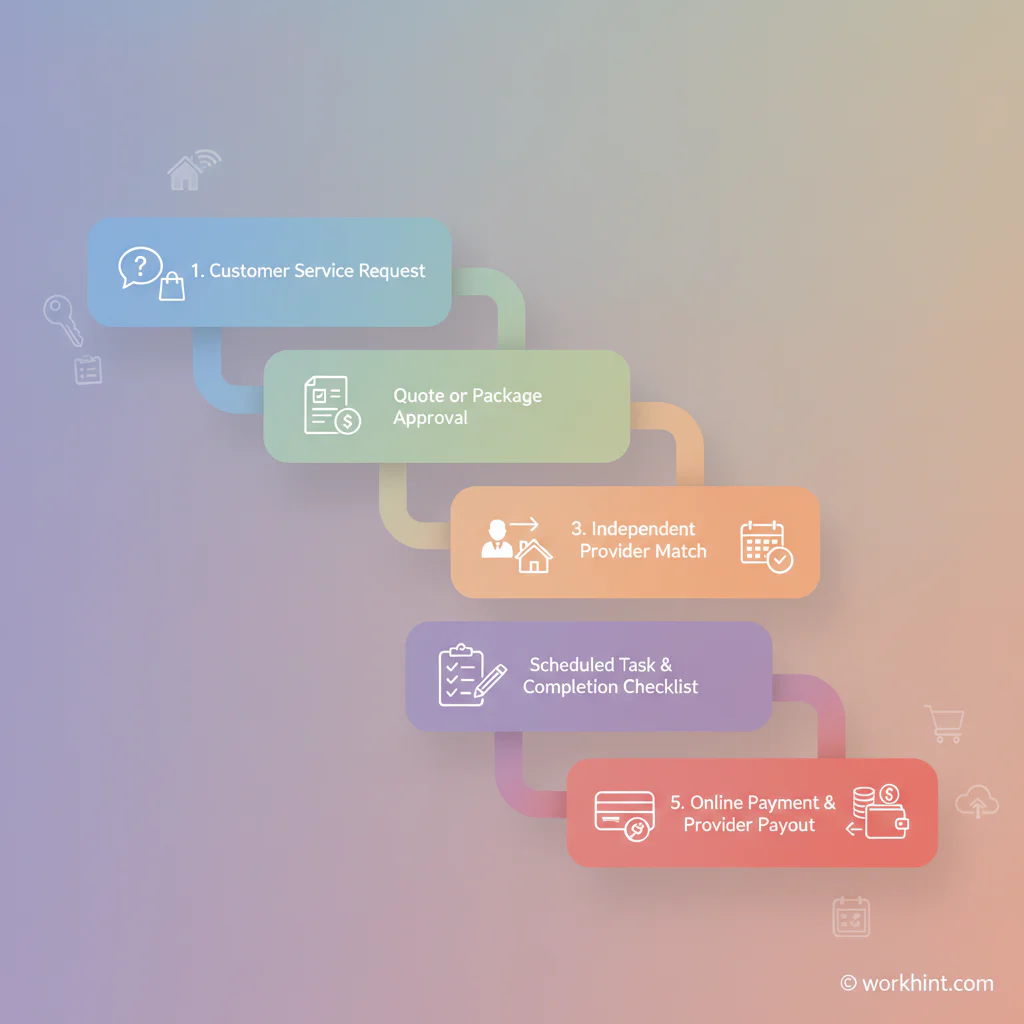
A customer can submit a request through your branded portal, choose a service package, upload details, approve a quote, and track progress. Your internal dashboard shows open requests, assigned providers, customer notes, deadlines, service status, and payments. Independent providers can complete onboarding, accept assignments, follow task checklists, upload proof of completion, and receive payouts after the customer pays.
This creates a professional customer experience before you hire employees. You can test senior concierge, executive errands, relocation support, or lifestyle management with a provider network first, then invest in employees, premium partnerships, or city expansion only after demand is proven.
First 7-day launch plan
- Day 1: Choose the customer, niche, launch area, and first offer. Avoid trying to serve every possible concierge request.
- Day 2: Set up the branded Workhint portal with intake questions, customer profiles, provider roles, and service categories.
- Day 3: Build quoting, scheduling, approval, payment, checklist, and provider payout flows.
- Day 4: Recruit the first independent providers or local service partners. Verify experience, availability, service boundaries, and documentation.
- Day 5: Contact referral partners and local demand sources with one clear launch offer.
- Day 6: Route every request through the platform and track response time, quote acceptance, provider fit, and customer concerns.
- Day 7: Review demand, margins, provider reliability, and repeated request types before expanding the service menu.
A useful first week gives you real signals. You should know who asks for help, what they ask for, what they will pay, and which providers can deliver.
Final launch checklist
- Pick one concierge niche and one service area.
- Register the business and separate business finances.
- Confirm licensing, privacy, insurance, and liability requirements for the services you will offer.
- Create three to five service packages with clear boundaries.
- Configure Workhint for customer intake, quote approvals, scheduling, assignments, payments, and provider payouts.
- Recruit and vet the first independent providers or service partners.
- Create customer terms, cancellation rules, privacy expectations, and proof-of-completion steps.
- Reach out to referral partners before spending heavily on ads.
- Validate demand before hiring employees or expanding into premium services.
FAQ
How much does it cost to start a concierge business?
A lean concierge business can often start with registration, insurance, a brand, a website, local marketing, and a provider onboarding process. Costs rise when you add vehicles, employees, specialized licenses, or premium partnerships.
Do I need a license to start a concierge business?
General concierge coordination may not require a special license, but specific services can. Driving, healthcare-related help, childcare, financial tasks, legal tasks, alcohol delivery, and property access may trigger extra rules.
What insurance does a concierge business need?
Start by discussing general liability with an insurance professional. Depending on your services, you may also need professional liability, commercial auto, bonding, cyber coverage, or workers’ compensation guidance.
Can I start a concierge business with no employees?
Yes. You can begin with a founder-led model and a vetted network of independent providers or service partners. Make sure your contracts, classification practices, insurance, and operating rules are reviewed properly.
What concierge services are easiest to start with?
Errands, appointment coordination, local vendor scheduling, home watch checklists, relocation support, gift sourcing, and senior non-medical errands can be practical first offers when scoped carefully.
How do concierge businesses make money?
They typically earn through hourly services, task packages, monthly retainers, project fees, memberships, or markup on coordinated provider work where appropriate and disclosed.
How do I find first concierge customers?
Start with referral partners who already know busy households or professionals: real estate agents, senior communities, apartment managers, executive assistants, boutique gyms, coworking spaces, and local business groups.
Conclusion
A concierge business is strongest when it starts focused. Choose a customer, create a clear offer, build a trusted provider network, and run every request through a professional operating process.
Workhint makes that possible before you invest in staff, office space, or custom software. Launch the branded platform, validate demand, learn which services customers buy repeatedly, and scale only after the operating model proves itself.
Leave a Reply