


The right metrics show whether your flexible workforce is creating speed, control, and predictable delivery.
Contingent workforce metrics are the signals that show how well your business manages contractors, freelancers, temporary staff, agencies, vendors, and other external contributors. Used well, they help leaders see whether external work is moving quickly, staying compliant, controlling cost, and producing work the business can trust.
The need is real because external work is now part of the normal operating model. The Bureau of Labor Statistics says alternative employment arrangements include independent contractors, on-call workers, temporary help agency workers, and workers provided by contract firms, and its 2023 release counted millions of workers in these arrangements. That scale makes informal tracking risky when contributors are spread across email, spreadsheets, finance tools, and project systems.
What’s in this article?
- The most useful contingent workforce metrics for business teams
- How to group metrics by speed, readiness, cost, quality, risk, and payment operations
- A simple dashboard structure you can use before building a mature VMS or MSP program
- Common reporting mistakes that create more noise than control
Why Contingent Workforce Metrics Matter
External workforce programs usually break down in predictable places: unclear requests, inconsistent onboarding, stalled approvals, late access removal, invoice mismatches, or weak vendor visibility. A metric should make one of those problems visible early enough to act.
Compliance also matters. The U.S. Department of Labor warns that misclassification can deny workers protections they may be entitled to under the Fair Labor Standards Act. Metrics cannot replace legal review, but they can surface operational behaviors that increase risk, such as long-term contractor relationships with no review, missing scope documents, or contractors managed like employees.
Deloitte has argued for a more integrated approach to managing contingent workers because external contributors touch HR, procurement, finance, legal, IT, and business unit leaders. That is the right lens: your dashboard should not belong to one department. It should show where the work is getting stuck across the entire operating system.
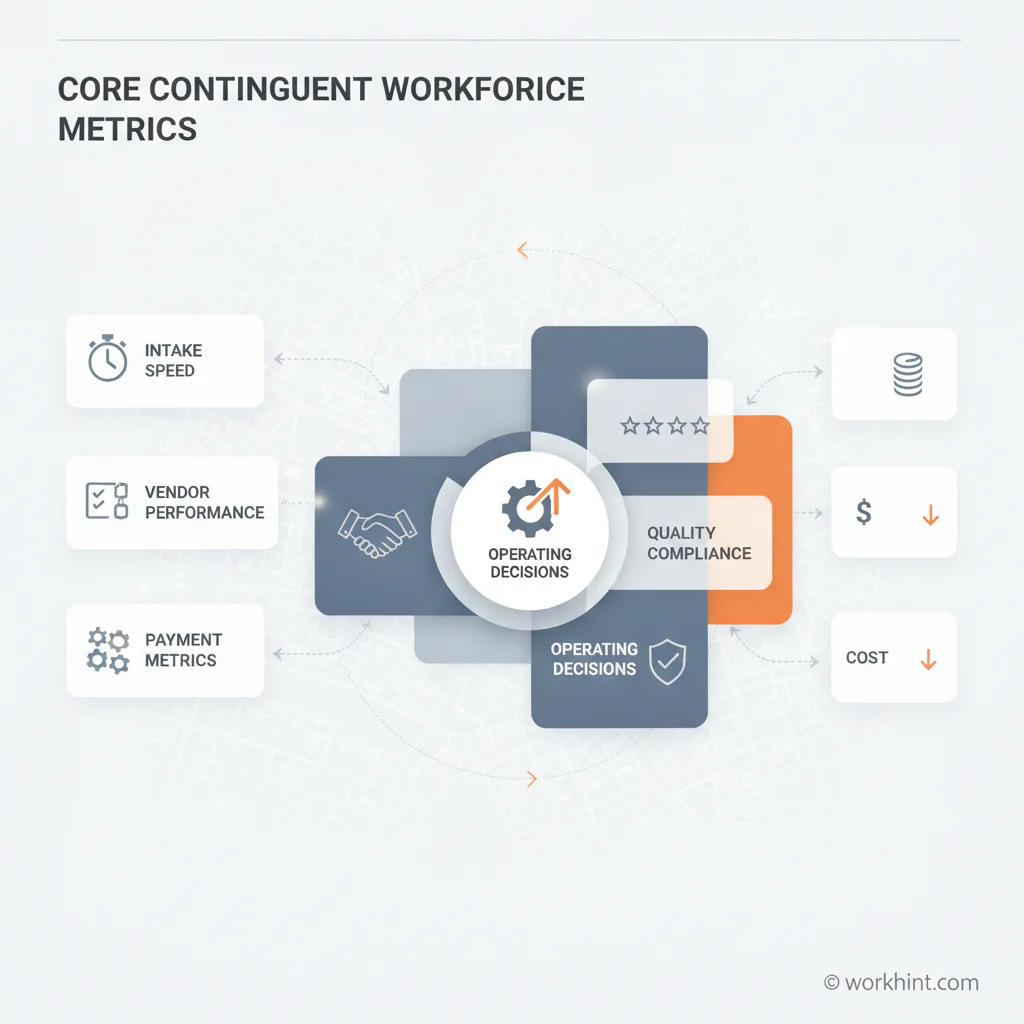
Core Contingent Workforce Metrics to Track
Start with a small set of metrics that tell you whether the program is healthy. Too many dashboards collect every available field instead of answering the questions leaders actually ask.
| Metric | What it shows | Owner | Action when it moves |
|---|---|---|---|
| Request-to-start time | How long it takes to move from approved need to productive contributor | Operations or talent lead | Find approval, vendor, document, or access delays |
| Onboarding completion rate | Whether required documents, tax forms, scope, orientation, and access steps are done before work starts | HR, operations, or vendor owner | Block work start until critical readiness items are complete |
| Assignment fill rate | Whether approved roles or shifts are staffed on time | Program manager | Adjust vendor mix, talent pools, or request lead times |
| Budget variance | Whether actual spend matches rate cards, scopes, purchase orders, and approved limits | Finance or procurement | Review scope creep, rate exceptions, and invoice mismatches |
| Accepted deliverables on time | Whether contractors and vendors are delivering usable work by the agreed date | Business owner | Clarify scope, acceptance criteria, dependencies, or vendor performance |
| Compliance readiness | Whether classification review, contracts, insurance, credentials, and renewals are current | Legal, HR, or compliance owner | Pause risky engagements and route exceptions for review |
| Invoice cycle time | How long payment takes after work is accepted | Finance operations | Fix missing approvals, PO mismatches, or payment status gaps |
Build the Metrics Around Decisions
The best contingent workforce metrics are attached to decisions. If a number changes and nobody knows what to do, it is probably a vanity metric. Total contractor count may help planning, but it is less actionable than contractor count by owner, project, country, status, and contract end date.
Use this test for every metric: what decision does this support, who owns it, and what threshold triggers action? Request-to-start time might trigger review above ten business days. Compliance readiness might trigger a hold if a required document expires. Invoice cycle time might trigger escalation if payment is not approved within five business days after acceptance.
A Practical Dashboard Workflow
You do not need a complex reporting program to start. Build a dashboard around the lifecycle of external work.
- Intake: Track request volume, request completeness, approval time, role type, budget owner, and business priority.
- Onboarding: Track classification review, contract status, tax form collection, credentials, security access, orientation, and start readiness.
- Work execution: Track assignments, milestones, deliverable acceptance, change requests, blockers, quality issues, and stakeholder feedback.
- Vendor or contributor performance: Track fill rate, completion rate, defect or rework rate, responsiveness, and repeat engagement rate.
- Finance: Track approved rates, budget variance, invoice match rate, approval cycle time, payment status, and aging exceptions.
- Risk and closeout: Track expired documents, overdue access removal, contract end dates, renewal reviews, and offboarding completion.
This structure follows the way external work actually moves. It helps each department see its part without losing the whole picture.
Common Mistakes in Workforce Reporting
The first mistake is measuring activity instead of control. A team may process many contractor requests, but if requests are incomplete and approvals loop, volume is not a sign of health. Pair activity metrics with cycle time, exception rate, and rework.
The second mistake is hiding exceptions in averages. Average onboarding time may look fine while one country, vendor, department, or approval step consistently creates delays. Segment by the dimensions that match your operating reality.
The third mistake is separating work quality from payment. If invoices are approved before deliverables are accepted, finance will report speed while business owners report frustration. Payment metrics should connect to acceptance, not just invoice receipt.
The fourth mistake is treating compliance as a one-time onboarding check. Independent contractor status, documents, insurance, access, location, and scope can change over time. The IRS explains that independent contractors are generally self-employed and that businesses may have reporting obligations such as Form 1099-NEC. Your metrics should show ongoing readiness, not just day-one completion.
Where Workhint Fits
Workhint fits when a business wants these metrics to come from the work itself instead of manual reporting. A team can use Workhint to define intake forms, roles, permissions, onboarding steps, document collection, assignments, approvals, payment status, compliance reminders, and reporting around the external workforce process. That gives leaders a live view of where contractors, freelancers, vendors, agencies, and internal approvers are in the workflow.
The value is a cleaner operating loop: request the worker, approve the need, onboard the contributor, assign the work, accept the deliverable, approve the invoice, and close out access with evidence attached to each step.
FAQ
What are contingent workforce metrics?
They are measurements that show how effectively a business manages nonpermanent workers and external providers, including speed, cost, quality, compliance, vendor performance, access, and payment operations.
What is the most important contingent workforce KPI?
There is no single best KPI. For most teams, request-to-start time, onboarding completion rate, compliance readiness, accepted deliverables on time, and invoice cycle time provide the clearest operating view.
How often should teams review contingent workforce metrics?
Operational metrics should be reviewed weekly when work is active. Risk, spend, vendor performance, and capacity trends should be reviewed monthly with HR, finance, procurement, legal, and business owners.
Should contractor performance metrics measure hours worked?
Hours can matter for time-based engagements, but many contractor relationships should focus on scope, milestones, accepted deliverables, quality, responsiveness, and budget adherence. Ask legal counsel before using employee-style controls for independent contractors.
Conclusion
Contingent workforce metrics should help leaders manage external work with more confidence. The goal is not to watch every move a contractor makes. It is to know whether the right people are approved, ready, assigned, productive, paid correctly, and closed out without avoidable risk.
Start small. Pick metrics that connect to decisions, assign owners, and review exceptions before they become missed deadlines, compliance issues, or payment disputes. Visible workflows make external teams easier to scale.
Leave a Reply