


Use this board meeting agenda template to focus directors on decisions, oversight, risks, and follow-up instead of passive updates.
A board meeting agenda template gives board chairs, CEOs, founders, corporate secretaries, executive directors, and operations leaders a repeatable way to prepare board meetings that produce decisions. The agenda should not be a list of reports people read aloud. It should show what requires approval, what needs discussion, what is informational, who owns each item, and what follow-up will happen after the meeting.
This resource is written for business, nonprofit, startup, advisory, and operating boards. Governance requirements vary, so have counsel or your governance lead review formal requirements where needed.
What is included
This article includes a copy-ready board meeting agenda template, a timing model, a board pack checklist, a consent agenda structure, an action-item tracker, common mistakes, and a simple way to turn board follow-up into an operating workflow.
How to use this board meeting agenda template
Start by deciding the purpose of the meeting. A quarterly board meeting, emergency meeting, committee meeting, and annual planning meeting should not all use the same agenda.
Build the agenda with the board chair and CEO or executive lead. The National Association of Corporate Directors notes in its governance guidelines that the chair and CEO jointly establish board meeting agendas, while directors are encouraged to add matters they believe should be included. For nonprofits, the National Council of Nonprofits emphasizes sending the agenda beforehand and designing meetings around engagement, not just formalities.
Send the agenda with the board materials early enough for preparation. Separate pre-read items from live discussion items, mark decision points clearly, and name the person responsible for each topic.
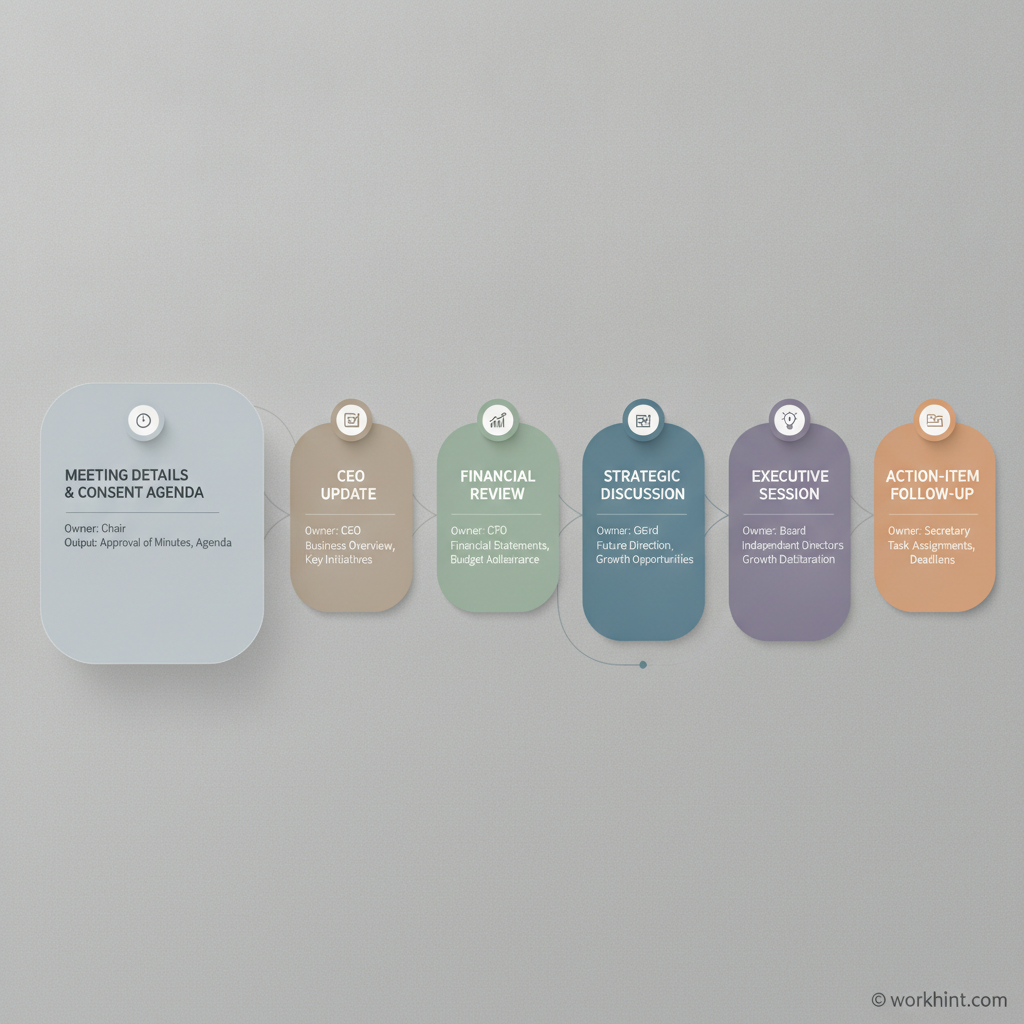
Board meeting agenda template
Copy this structure into your board portal, document workspace, calendar invite, or operating system. Adjust the order to match your bylaws, governance rules, and meeting norms.
| Agenda section | Purpose | Owner | Output |
|---|---|---|---|
| Meeting details | Date, time, location, attendees, quorum, and materials link. | Secretary or admin | Confirmed record |
| Opening and agenda review | Confirm meeting goals, urgent changes, and conflicts. | Chair | Approved agenda |
| Consent agenda | Approve routine items such as prior minutes or standard reports. | Chair | Single vote or pulled items |
| CEO or executive update | Summarize performance, priorities, major changes, and asks. | CEO or executive director | Shared context |
| Financial review | Review budget, cash, forecast, risks, and approvals. | CFO or treasurer | Decisions or watch items |
| Strategic discussion | Address the most important business, market, product, people, or risk topic. | Chair and executive lead | Direction or decision |
| Committee or functional updates | Cover audit, compensation, governance, people, program, or operating matters. | Committee chairs | Actions or approvals |
| Executive session | Discuss sensitive board-only or management-free items if appropriate. | Chair | Confidential guidance |
| Action review and close | Confirm decisions, owners, due dates, communications, and next meeting items. | Secretary and chair | Action log |
Board pack checklist
The agenda works only if the materials support the conversation. Include the agenda, prior minutes, KPI summary, financial statements, CEO memo, decision briefs, committee reports, risk items, legal or compliance items, and the prior action log.
Use decision briefs for major topics. A good brief states the question, options, recommendation, financial impact, risks, decision needed, and follow-up owner. The NACD board calendar and meeting agenda guidance frames agendas around timely oversight areas such as governance, stakeholder engagement, education, and recurring board responsibilities. That is a useful reminder: board agendas should cover the board’s actual oversight job, not just management’s preferred update order.
Consent agenda structure
A consent agenda groups routine, noncontroversial items into one approval so the board can spend live time on judgment-heavy issues. Typical consent items include prior meeting minutes, routine committee reports, standard policy confirmations, and informational updates that do not need discussion.
Do not hide important issues inside consent. Any director should be able to pull an item for discussion. BoardEffect’s guidance on consent agendas describes the core operating benefit: routine protocol items can be consolidated so boards have more time for planning, oversight, and important matters.
Example 90 minute board meeting agenda
- 0-5 minutes: Opening, quorum, agenda changes, and meeting goals.
- 5-10 minutes: Consent agenda approval and pulled items.
- 10-25 minutes: CEO update focused on progress, risks, and decisions needed.
- 25-40 minutes: Financial review, cash position, forecast, and budget approvals.
- 40-70 minutes: Strategic discussion on the highest-value decision or risk.
- 70-80 minutes: Committee or functional approvals.
- 80-88 minutes: Executive session or director-only discussion if needed.
- 88-90 minutes: Confirm decisions, action owners, dates, and next agenda items.
Action item tracker
Every board meeting should end with an action log. Capture the decision, owner, due date, evidence, communication plan, and status. A board meeting is only useful if decisions move into work.
| Decision or action | Owner | Due date | Evidence | Status |
|---|---|---|---|---|
| Approve Q4 hiring plan after revised cash scenario | CFO | Aug 5 | Updated forecast and board note | Open |
| Review customer concentration risk | CEO | Next meeting | Top account risk memo | Open |
| Update compensation committee charter | Governance chair | Sep 1 | Redlined charter | Not started |
Common mistakes
- Letting reports consume the meeting. Move read-only updates into the board pack and reserve live time for questions, risks, and decisions.
- Missing the decision ask. If the board needs to approve, advise, or choose, say that in the agenda.
- No owner for follow-up. Decisions without owners become memory.
- Too many strategic topics. One serious discussion is usually better than four shallow ones.
- Late materials. Late board packs reduce the quality of oversight and waste live meeting time.
Where Workhint fits
Workhint helps when board meeting preparation and follow-up need to become a live workflow instead of a folder of agendas and minutes. A team can use Workhint to collect agenda requests, route board pack approvals, assign owners, track decisions, manage access, schedule follow-up tasks, and report open actions across executives, finance, legal, committees, and board administrators.
The agenda remains the governance artifact. Workhint helps operationalize the preparation, decisions, and accountability around it.
FAQ
What should be included in a board meeting agenda?
Include meeting details, agenda approval, consent agenda, executive update, financial review, strategic discussion, committee reports, approvals, executive session if needed, and action-item review.
Who prepares the board meeting agenda?
The board chair usually leads agenda preparation with the CEO, executive director, or governance lead. A corporate secretary, board administrator, or operations leader often manages formatting, materials, distribution, and records.
How far in advance should the agenda be sent?
Send the agenda and board materials far enough ahead for directors to review them thoughtfully. Many organizations aim for about a week, while complex meetings may need more time. Public or regulated bodies should follow applicable notice rules.
What is a consent agenda?
A consent agenda combines routine items into one approval so the board can spend meeting time on discussion and oversight. Directors should still be able to pull any item for separate discussion.
Should every board meeting include an executive session?
Not always, but many boards use executive sessions for sensitive topics, board-only reflection, CEO feedback, or confidential oversight matters. The need depends on the board’s role, governance practices, and meeting purpose.
Conclusion
A good board meeting agenda template protects the board’s time and improves the quality of decisions. Keep the agenda clear, send materials early, separate consent items from discussion items, name the decision needed, and close with owners and deadlines. The result is a meeting that moves governance, strategy, and follow-up forward instead of simply recording that people met.
Leave a Reply