

External labor scales faster than internal controls unless risk ownership is designed before work begins.
Contingent workforce risk management is the operating discipline businesses use to control the risks that come with contractors, freelancers, temporary staff, staffing suppliers, agencies, consultants, and other external teams. It is not one policy owned by one department. It is a connected set of decisions: who may request external labor, how the relationship is classified, what access is allowed, how work is approved, and what evidence must exist before payment or renewal.
The risk appears when teams hire external help through different paths. HR reviews requests. Procurement handles vendors. Finance sees invoices late. IT grants access. Legal joins late. Then, the company may have speed, but not control.
What’s in this article?
- Why contingent workforce risk management matters.
- The main risks to review before work starts.
- A practical checklist with owners, controls, and evidence.
- Common mistakes that make external workforce programs harder to govern.
- Where Workhint fits when the checklist needs to become a live workflow.
Why contingent workforce risk matters
A contingent workforce can give a business speed, flexibility, and specialized capacity. It can also create classification risk, safety exposure, data access problems, payment disputes, inconsistent vendor oversight, and poor visibility.
Classification is a good example. The IRS guidance on independent contractors points businesses toward behavioral control, financial control, and the relationship of the parties. The Department of Labor’s FLSA guidance looks at economic realities. Those are operating questions about who controls the work, how the person is paid, what relationship the parties created, and whether the record matches reality.
Safety and access create similar issues. OSHA has stated that temporary agencies and host employers may both have responsibility for training, hazard communication, and recordkeeping depending on the arrangement. NIST’s work on cybersecurity supply chain risk management is a reminder that third-party risk is not limited to vendors with formal procurement records.
Start with the relationship type
Do not run every external worker through the same checklist. A freelance designer, staffing agency temp, SOW consulting team, field subcontractor, and software vendor do not create the same risk. Start by naming the relationship type, then route unclear cases to HR, legal, procurement, finance, IT, or security.
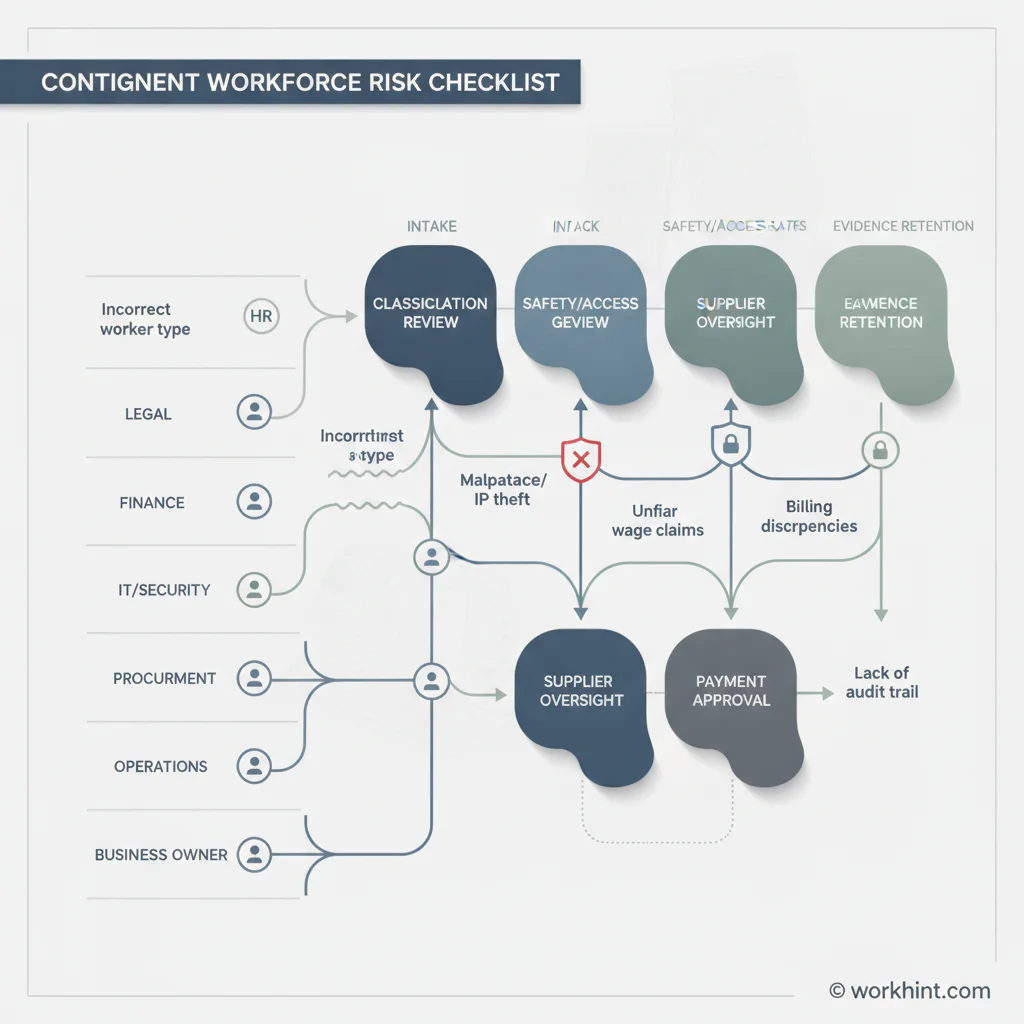
Contingent workforce risk checklist
The checklist below gives teams a practical starting point. Adapt it by industry, country, role, and risk tier. This is not legal advice; sensitive classification, employment, tax, safety, or privacy decisions need qualified review.
| Risk area | Owner | Control before work starts | Evidence to keep |
|---|---|---|---|
| Relationship type | Business owner | Define whether the need is contractor, freelancer, staffing, vendor, agency, consultant, or employee work. | Approved request, business reason, role description, relationship type. |
| Classification | HR and legal | Review control, independence, scope, supervision, tools, payment model, and local rules. | Classification review notes, agreement, SOW, approval record. |
| Contract and scope | Legal and operations | Confirm deliverables, acceptance criteria, change process, IP, confidentiality, and termination terms. | Signed agreement, SOW, change approvals, acceptance criteria. |
| Safety and worksite readiness | Operations and safety owner | Confirm hazards, training, PPE, reporting channel, and agency or host responsibilities. | Training records, safety acknowledgment, hazard communication, incident process. |
| Systems and data access | IT or security | Grant least-privilege access only after approval, identity check, and start date confirmation. | Access request, permissions, approver, start and end dates, revocation task. |
| Payment and invoices | Finance | Set tax forms, payment method, invoice rules, terms, expenses, and approval owner. | Tax record, payment setup, invoice instructions, accepted work evidence. |
| Supplier or agency oversight | Procurement | Check vendor status, owner, insurance, security review, expectations, and renewal date. | Vendor record, risk tier, insurance or compliance records, review cadence. |
| Performance and renewal | Business owner and operations | Track delivery, blockers, quality, responsiveness, cost, issues, and renewal triggers. | Milestone records, issue log, performance notes, renewal decision. |
Use risk tiers instead of one heavy process
The fastest way to make risk management unpopular is to force a low-risk copyediting project through the same process as a vendor team with production data access. Use risk tiers. Low-risk work may need a short request, agreement, payment setup, and limited access. Higher-risk work may need classification review, security approval, legal review, safety review, data terms, audit evidence, and renewal checks.
Risk tiering lets teams move quickly when risk is low and slow down when work touches regulated data, customer environments, jobsite safety, high spend, critical operations, or worker classification ambiguity.
Build the operating rhythm
A checklist helps only if it becomes part of how work runs. Set a monthly review for active external workforce records. Look for missing end dates, expired documents, open access after work ended, unapproved invoices, aging disputes, unresolved safety items, unclear classification notes, and vendors without owners. For high-volume programs, review the dashboard weekly.
The review should produce decisions, not just reports. Renew, pause, offboard, reclassify, escalate, update access, request missing documents, or change the approval path.
Common mistakes to avoid
- Letting managers decide relationship type alone: business owners understand the need, but HR, legal, procurement, finance, and security own different risk controls.
- Approving access before paperwork is complete: access should follow the relationship record, not an informal message.
- Using payment as the first control point: finance often sees the problem too late if the request, contract, and acceptance workflow were never connected.
- Treating suppliers and people separately: staffing agencies, subcontractors, and consulting teams still affect readiness, safety, access, performance, and payment.
- Keeping evidence in email: decisions about classification, scope changes, safety, access, and payment need durable records.
Where Workhint fits
Workhint fits when contingent workforce risk management needs to move from a checklist into a live operating workflow. A business can use Workhint to capture requests, classify relationship types, assign HR, legal, finance, IT, procurement, operations, and business-owner steps, collect documents, control access readiness, track evidence, route approvals, connect accepted work to payment status, and trigger renewal or offboarding tasks.
The value is not adding another policy page. It is making the policy executable. Each external worker, vendor, agency, or supplier can have a visible status: requested, under review, approved, document-ready, access-ready, active, blocked, payment-ready, renewal-review, or offboarding. That gives the business a practical way to scale flexible labor without losing control of the records that matter.
FAQ
What is contingent workforce risk management?
Contingent workforce risk management is the process of identifying, approving, monitoring, and documenting risks tied to non-employee labor, including contractors, freelancers, temporary workers, staffing suppliers, consultants, agencies, and vendor teams.
Who should own contingent workforce risk?
Ownership is shared. The business owner owns the need and delivery expectations. HR and legal often own classification review. Procurement owns vendor controls. Finance owns payment setup and invoice rules. IT or security owns access. Operations owns workflow visibility and follow-through.
What should a contingent workforce risk checklist include?
It should include relationship type, classification review, contract and scope, safety readiness, system access, data risk, tax and payment setup, supplier oversight, work acceptance, performance review, renewal, and offboarding evidence.
How often should contingent workforce risk be reviewed?
Review high-risk external workforce activity weekly or monthly, depending on volume and exposure. At minimum, review active records before renewal, before access changes, before final payment, and before a worker or vendor is offboarded.
Can software reduce contingent workforce risk?
Software can reduce operational risk when it connects intake, approvals, documents, access, work evidence, payment status, and reporting. Human review still matters for legal, tax, safety, classification, and high-risk security decisions.
Conclusion
Contingent workforce risk management works best when it is practical enough for managers to use and structured enough for control owners to trust. Start with the relationship type, route approvals, keep evidence in one place, tie access and payment to readiness, and review active external work before small gaps become expensive problems.
The goal is not to make external work slow. The goal is to make it visible, accountable, and easier to scale.
Leave a Reply