


Use this retention plan to turn turnover worries into specific actions, owners, signals, and follow-up rhythms.
An employee retention plan template helps a company move beyond vague concerns about people leaving. It gives HR, managers, finance, and leadership a shared way to identify retention risks, decide which actions matter most, and track whether those actions are working.
Retention is not just an HR initiative. It affects hiring costs, customer continuity, manager capacity, team morale, and institutional knowledge. The U.S. Bureau of Labor Statistics Job Openings and Labor Turnover Survey tracks quits, layoffs, hires, openings, and other separations because movement in and out of jobs is a core operating signal.
What is included in this employee retention plan template?
This template gives you a working structure for reviewing retention risk by team, role, manager, and employee segment. It includes fields for retention signals, likely root causes, owner, action, due date, measurement, and review cadence.
- Turnover and quit-rate signals by team or role
- Engagement, manager feedback, pulse survey, and exit interview themes
- Retention risk level and likely cause
- Actions tied to compensation, workload, growth, manager support, flexibility, recognition, or role clarity
- Named owners and review dates
- Metrics that show whether the plan is improving retention
How to use the template
Start with a narrow business question: which employees, roles, teams, or locations are most important to retain over the next 90 days? A focused plan lets you spot the handful of problems actually driving risk.
Review hard data first: quits, regrettable departures, first-year turnover, absenteeism, promotion rates, internal mobility, manager changes, workload spikes, compensation pressure, and open roles. Then add human evidence from engagement surveys, stay interviews, exit interviews, manager one-on-ones, and workload reviews. Gallup’s State of the Global Workplace 2026 reports that global employee engagement fell to 20%, which is a useful reminder that retention risks often build before someone resigns.
Once you know the risk area, assign actions a real owner can complete. “Improve culture” is not an action. “Run stay interviews, summarize blockers, and approve one workload fix by August 15” is an action.
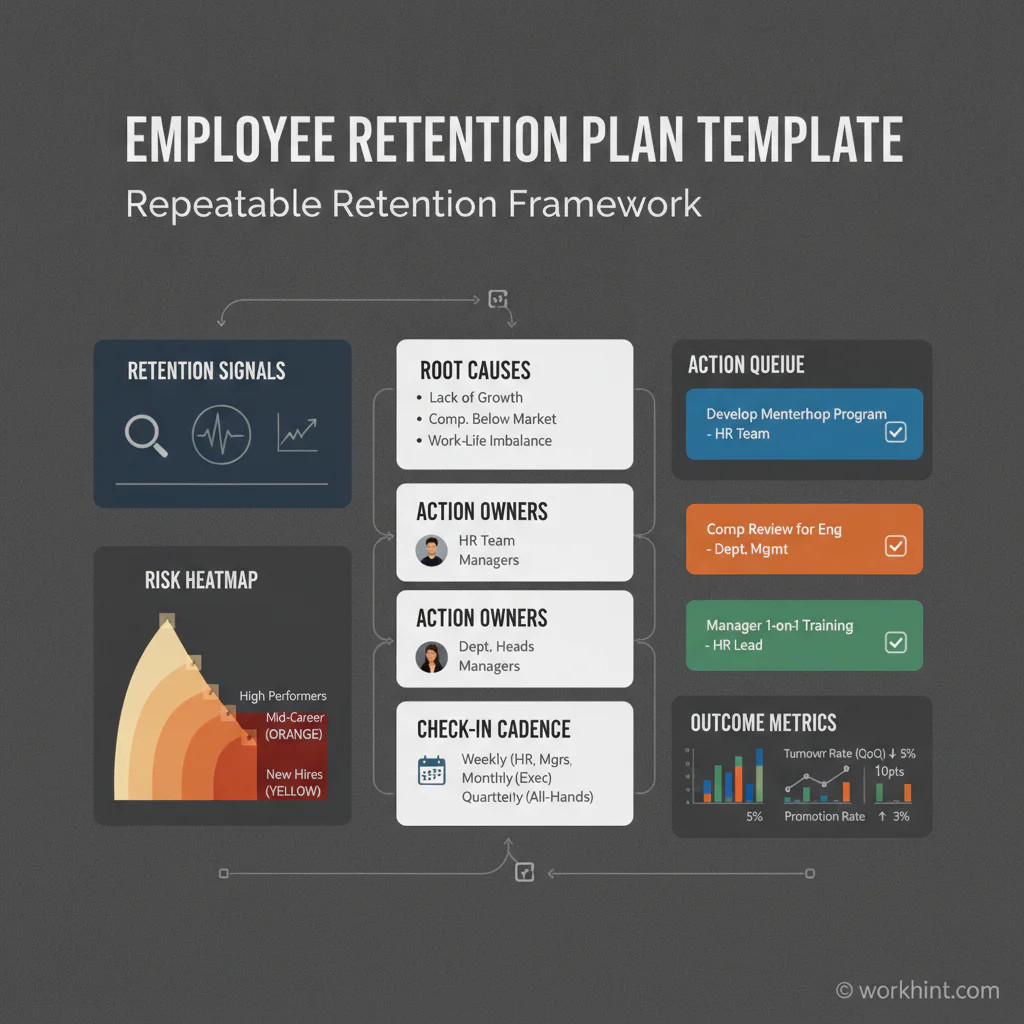
Employee retention plan template
| Plan field | What to enter | Example |
|---|---|---|
| Focus group | Team, role, location, tenure group, or manager group | Customer onboarding specialists with 6-18 months tenure |
| Risk signal | The data or observation that triggered concern | Three resignations in one quarter and lower manager-support scores |
| Likely cause | The most plausible reason, marked as confirmed or assumed | Assumption: workload spikes after new customer launches |
| Retention action | A specific intervention with a clear owner | Shift launch coverage, add peer backup, and clarify escalation rules |
| Owner | One person accountable for follow-through | Head of Customer Operations |
| Due date | Date for the first completed action, not a vague timeline | August 15, 2026 |
| Measurement | How you will know whether the action helped | Pulse score, workload hours, resignations, internal transfer requests |
| Review cadence | How often leadership reviews progress | Biweekly until risk returns to normal |
Build the plan in five steps
1. Define the retention risk
Do not treat all turnover the same. Separate regrettable attrition from expected churn, early-tenure departures from late-career exits, and role-specific risk from company-wide sentiment.
2. Find the root cause before choosing perks
Retention actions should match the reason people might leave. Compensation pressure requires a different plan than poor manager support, unclear growth paths, scheduling friction, burnout, or weak onboarding. SHRM’s retention guidance emphasizes that retention is shaped by job satisfaction, work environment, development, management, rewards, and employee relations, not a single lever.
3. Prioritize the roles that create business risk
Some departures are painful because the role is hard to replace, the person owns customer knowledge, or the team is understaffed. Score each risk area by business impact, replacement difficulty, employee experience impact, and urgency.
4. Turn ideas into assigned actions
A retention plan fails when it becomes a list of suggestions. Each action needs one owner, a deadline, a communication owner, and a measurement method. If senior operators feel blocked from growth, the action might be a progression map, manager training, and monthly mobility review.
5. Review progress on a fixed cadence
Retention work needs a rhythm. Review the plan weekly for urgent segments and monthly for stable teams. Track whether actions were completed, whether risk signals changed, and whether managers are closing the loop with employees. The Work Institute 2026 Retention Report is built around turnover interviews and retention drivers, which reinforces the value of listening to why people leave and acting before those reasons repeat.
Example retention action plan
Imagine a services company sees rising turnover among implementation managers. Exit interviews mention workload, unpredictable customer escalations, and limited growth path. The retention plan should not start with a generic engagement campaign. It should focus on the operating model.
- Risk: high resignation risk in implementation roles
- Confirmed causes: uneven account loads, unclear escalation ownership, limited senior path
- Actions: rebalance account assignments, define escalation tiers, create senior implementation manager criteria, and run stay interviews with current team members
- Owners: COO for staffing model, Head of Customer Success for escalation rules, People lead for career path
- Measurement: resignation rate, pulse survey comments, overdue escalations, average account load, internal applications
This is a retention plan because it connects symptoms to operational changes. It also gives leadership a way to inspect progress instead of waiting for the next resignation.
Common mistakes to avoid
- Using one plan for every team. Sales, operations, support, finance, and field teams often leave for different reasons.
- Relying only on exit interviews. Exit data is useful, but it arrives after the employee has already decided to leave.
- Confusing benefits with retention strategy. Benefits help, but many retention problems come from manager behavior, workload design, role clarity, and growth paths.
- Leaving actions unowned. If no one owns the fix, the plan is documentation, not management.
- Not closing the loop. Employees notice when companies ask for feedback and never explain what changed.
Where Workhint fits
Workhint helps organizations turn an employee retention plan template into a live operating workflow. Instead of scattered spreadsheets, teams can structure intake, risk signals, owner assignments, manager follow-ups, approvals, reminders, and reporting in one system.
For example, HR can collect stay interview themes, route workload issues to operations, assign manager follow-ups, track due dates, and report which actions are complete. Finance can be pulled into compensation reviews, leadership can approve policy changes, and managers can see exactly what they own. The template remains useful on its own, but Workhint helps the retention plan keep moving after the document is written.
FAQ
Who should own an employee retention plan?
HR usually coordinates the plan, but business leaders and managers must own the actions. Retention issues often depend on workload, management, growth, pay, scheduling, and operating design, so HR cannot fix them alone.
How often should a retention plan be reviewed?
Review high-risk teams every one or two weeks until actions are complete. Review company-wide retention trends monthly or quarterly depending on company size and turnover volume.
What metrics should be included?
Useful metrics include voluntary turnover, regrettable attrition, first-year turnover, internal mobility, engagement scores, manager-support scores, absenteeism, workload indicators, offer acceptance, and reasons from exit or stay interviews.
Is a retention plan only for employees who might quit?
No. A good plan also protects critical teams, improves manager follow-through, supports career growth, and reduces avoidable friction before employees become flight risks.
Conclusion
An employee retention plan template is most valuable when it forces specificity. Identify the risk, confirm the cause, assign the action, name the owner, set the cadence, and measure whether anything improved.
The goal is not to prevent every departure. The goal is to stop avoidable turnover, protect important teams, and build a management rhythm that helps people stay for reasons the business can actually influence.
Leave a Reply