


A useful contractor policy does more than set rules; it turns external work into a repeatable control system.
A contractor management policy tells a business how independent contractors, freelancers, consultants, agency workers, and external specialists can be requested, approved, onboarded, managed, paid, and offboarded. The policy should not replace legal advice or a contractor agreement. Its job is to give internal teams a consistent operating standard before external work starts.
Contractor work crosses departments. Without one policy, each team invents its own version, and the business gets inconsistent approvals, missing records, access risk, delayed payments, and unclear accountability.
What’s in this article?
- What a contractor management policy should include.
- A practical policy template business teams can adapt.
- A role table for HR, legal, finance, IT, operations, and managers.
- Common mistakes that make contractor policies hard to enforce.
- Where Workhint fits when the policy needs to become a live workflow.
Why a contractor management policy matters
Contractors are not managed the same way as employees. The company still needs controls, but those controls should respect the nature of independent work. The IRS explains worker classification through facts related to behavioral control, financial control, and the relationship between the parties. The U.S. Department of Labor also explains that FLSA status depends on the economic realities of the working relationship.
The policy should define decision rules before work begins. It should answer when a contractor can be used, who must approve the engagement, what documents are required, what systems may be accessed, how work is accepted, and how invoices are approved. For compliance-sensitive situations, require legal, HR, tax, or local counsel review.
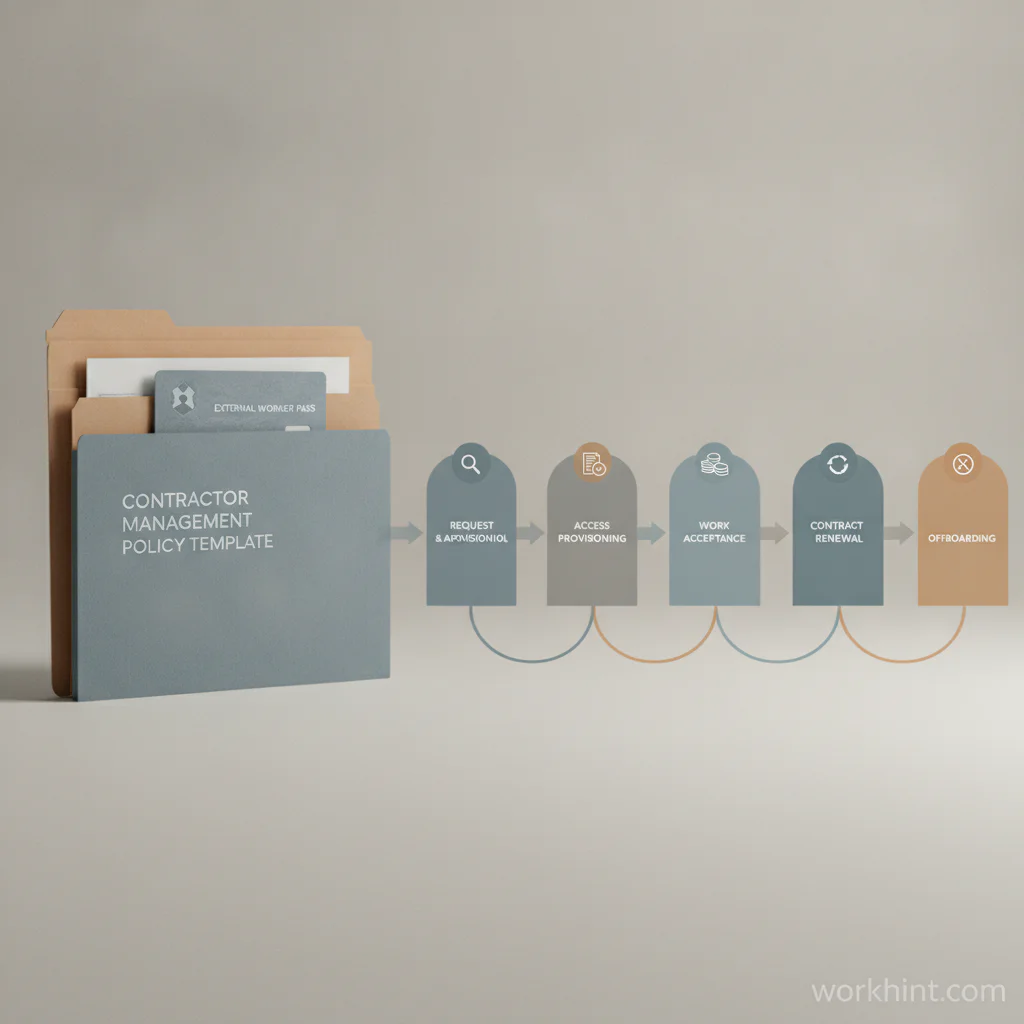
Contractor management policy template
Use this template as a starting structure. Adapt the details to your industry, locations, risk level, and legal requirements.
1. Purpose
State why the policy exists. A practical purpose might be: “This policy establishes the rules for requesting, approving, onboarding, paying, and offboarding contractors so external work is controlled and documented.”
2. Scope
Define which relationships are covered. Include independent contractors, freelancers, consultants, subcontractors, agency workers, vendor-provided specialists, and external workers who need company access or payment.
3. Approved use cases
List when contractors may be used. Common cases include defined project work, specialized expertise, short-term capacity, field services, creative production, consulting, and temporary operational coverage. Require a business reason, expected outcome, budget owner, and planned end date.
4. Classification and legal review
Require classification review before work starts. The review should look at control, independence, supervision, duration, exclusivity, payment method, and whether the work resembles an employee role. If the contractor is outside the company’s home country, add local law, tax, privacy, and payment review. This section should include a legal caveat: the policy is an internal operating guide, not legal advice.
5. Required documents
Define the documents that must be complete before activation. Depending on the engagement, these may include a contractor agreement, statement of work, tax form, insurance evidence, confidentiality agreement, safety acknowledgment, banking details, and work authorization documentation where applicable.
6. Access and security
State that access must be limited to the approved scope and removed when the engagement ends. CISA’s cybersecurity guidance emphasizes access control and credential hardening. For contractors, require named accounts, role-based permissions, no shared logins, approval before production or customer data access, and a clear offboarding trigger.
7. Work management and acceptance
Define how contractor work is assigned and accepted. Require a written scope, internal owner, deliverables, milestones, communication channel, acceptance criteria, and exception path. Manage outcomes and evidence, not every working hour unless the engagement requires time-based billing.
8. Payment and invoice controls
Connect payment to approved terms. State when invoices may be submitted, who reviews them, what evidence is required, how disputes are handled, and how approved invoices move to finance. If they bill time, require project codes, work summaries, and manager approval.
9. Safety and worksite rules
If contractors enter a worksite, the policy should address site access, hazards, PPE, permits, incident reporting, and safety orientation. OSHA says employers must provide required safety training in language and vocabulary workers can understand. A contractor policy should make safety responsibilities explicit before work begins.
10. Renewal, change, and offboarding
Set rules for extending work, changing scope, increasing budget, or renewing a contractor. Any material change should route through the original approval logic. Offboarding should close work, revoke access, recover assets, confirm final invoice status, and store records.
Role ownership table
| Area | Primary owner | Required record |
|---|---|---|
| Business need and scope | Hiring manager or project owner | Request, scope, deliverables, budget |
| Classification and contract risk | Legal or HR | Classification review and agreement |
| Payment setup | Finance | Tax form, payment terms, invoice route |
| System access | IT or security | Approved access request and removal date |
| Work acceptance | Operations or project owner | Milestone evidence and approval record |
| Offboarding | Operations with IT and finance | Access removal, asset return, final payment status |
How to enforce the policy without slowing work
The policy should create gates, not bureaucracy. Start with a short request form that captures who needs the contractor, expected outcome, location, access, payment method, and whether the work touches sensitive data, regulated activity, or physical worksites.
Then route only the relevant reviews. A low-risk creative project may need scope, agreement, payment setup, and limited file access. Customer data may need security review. Field work may need safety orientation. Global work may need local classification and payment review.
Common contractor policy mistakes
- Using the policy as a contract. A policy tells internal teams what to do. The contractor agreement defines the legal terms with the contractor.
- Skipping classification review. A signed agreement does not automatically make someone an independent contractor.
- Giving access before approvals finish. Access should follow approval, not create pressure to approve after the fact.
- Managing contractors like employees. Control scope, milestones, evidence, and acceptance criteria; avoid unnecessary day-to-day supervision.
- Leaving offboarding vague. Contractors often retain file access, chat access, equipment, or payment ambiguity because nobody owns the exit step.
Where Workhint fits
Workhint helps turn a contractor management policy into the operating system around the work. Instead of storing the policy in a document and hoping teams follow it, a business can use Workhint to route contractor requests, assign role-based reviews, collect documents, control onboarding gates, connect access tasks, manage invoice approvals, and trigger offboarding steps.
The value is not that Workhint replaces legal, HR, finance, or IT judgment. The value is that the policy becomes visible work: every request has an owner, every approval has a record, and every payment or access decision is tied back to the approved scope.
FAQ
What should a contractor management policy include?
It should include purpose, scope, approved use cases, classification review, required documents, access controls, work acceptance rules, payment controls, safety requirements, renewal rules, offboarding, ownership, and record retention.
Is a contractor management policy the same as a contractor agreement?
No. A contractor management policy is an internal rulebook for how the company approves and manages contractors. A contractor agreement is the legal contract between the company and the contractor.
Who should own contractor management policy?
Operations is often the best process owner because contractor work crosses multiple departments. Legal, HR, finance, IT, security, procurement, and business owners should each own their policy controls.
How often should the policy be reviewed?
Review it at least annually and whenever the company expands into new countries, changes payment methods, adds higher-risk work, updates security requirements, or changes how external workers are classified or managed.
Conclusion
A contractor management policy is useful only when it changes how work happens. The best version gives managers a clear request path, gives reviewers the facts they need, and gives operations one record from approval through offboarding. Start with the policy structure, assign owners, connect each rule to a workflow gate, and keep the process practical enough that teams actually use it.
Leave a Reply