


You can validate a data annotation business before hiring a labeling team, leasing space, or building custom software.
A data annotation business helps AI teams turn raw images, text, audio, or video into labeled training data. Demand is being pushed by companies building computer vision, healthcare AI, robotics, retail analytics, and generative AI systems that need accurate human-reviewed data.
The mistake is assuming you need a full employee team before you can start. A leaner path is to build a branded service platform, recruit a small network of independent reviewers, run paid pilots, and prove demand before adding fixed cost.
What’s in this article?
- Why a data annotation business works now
- What you need to launch with no staff
- How to price annotation projects
- How to get first customers
- How Workhint helps run the business
- A practical 7-day launch plan and FAQ
Why this business works
AI teams need clean training data, but annotation is repetitive, detail-heavy, and hard to manage internally. Many companies would rather outsource the work to a specialist that can organize reviewers, maintain quality rules, and deliver consistent batches.
Research demand is real. Market reports continue to show strong growth for data annotation tools and AI annotation services, while pricing guides show wide variation by task type, complexity, volume, and quality requirements. That creates room for focused operators who serve one niche well instead of trying to compete with every large labeling platform.
The best first offer is narrow. You might start with product image tagging for ecommerce teams, document classification for operations teams, chatbot response evaluation for AI startups, or simple bounding-box review for computer vision pilots. A focused offer makes it easier to recruit reviewers, define quality checks, and explain pricing.
What you need to launch
You do not need a large team. You need a clear offer, a small reviewer network, quality standards, client intake, secure file handling, project tracking, invoicing, and a way to pay contributors after work is approved.
| Startup item | Lean launch approach | Estimated early budget |
|---|---|---|
| Branded platform | Client intake, project dashboard, reviewer onboarding, approvals, invoices, and payouts | $0-$500 |
| Annotation tools | Use client tools or low-cost labeling tools until volume justifies paid seats | $0-$300 |
| Reviewer network | Recruit independent contractors for one annotation type and pay per task or batch | Variable |
| Quality process | Guidelines, sample tasks, double review, dispute resolution, and acceptance criteria | $0-$200 |
| Sales and marketing | Landing page, LinkedIn outreach, founder communities, AI directories, referrals | $100-$500 |
| Legal and insurance | Business registration, contractor agreements, confidentiality terms, basic coverage | $300-$1,500 |
Your first goal is not scale. It is a paid pilot with clear instructions, a small dataset, a defined delivery window, and feedback from a real customer. Only add expensive tools, full-time managers, or specialized review layers after volume proves the need.
How to price it
Data annotation pricing depends on complexity. Simple tagging is different from medical image segmentation, legal document review, or multilingual model evaluation. Start with pricing that protects reviewer pay, QA time, client communication, revisions, and your margin.
| Pricing model | Best for | Example starting point |
|---|---|---|
| Per item | Simple images, records, prompts, or entities | $0.03-$0.50 per item |
| Per hour | Exploratory review, guideline creation, or complex tasks | $35-$95 per hour |
| Per batch | Defined pilot projects with fixed volume and acceptance rules | $500-$5,000 per batch |
| Managed service retainer | Recurring annotation, QA, and reporting | $2,000-$15,000 per month |
For early customers, sell a pilot before selling a big engagement. A clean offer might be: 2,000 product records cleaned and labeled in seven days, with two review passes and a summary of ambiguous items.
How to get first customers
Start where data-heavy teams already feel the pain: AI startups, ecommerce operators, healthcare software teams, robotics companies, research labs, and agencies building AI features for clients.
- Search for companies hiring machine learning engineers and data operations roles.
- Offer a paid pilot around one dataset and one clear acceptance standard.
- Use LinkedIn to contact founders, product leaders, ML leads, and operations managers.
- Partner with AI consultants who need labeling capacity for client projects.
- Create landing pages for specific use cases, such as ecommerce image tagging or chatbot evaluation.
- Ask every pilot customer for a referral once quality is proven.
The sales message should be practical: you help teams get labeled data back faster without hiring and managing temporary annotators themselves.
How Workhint helps launch it
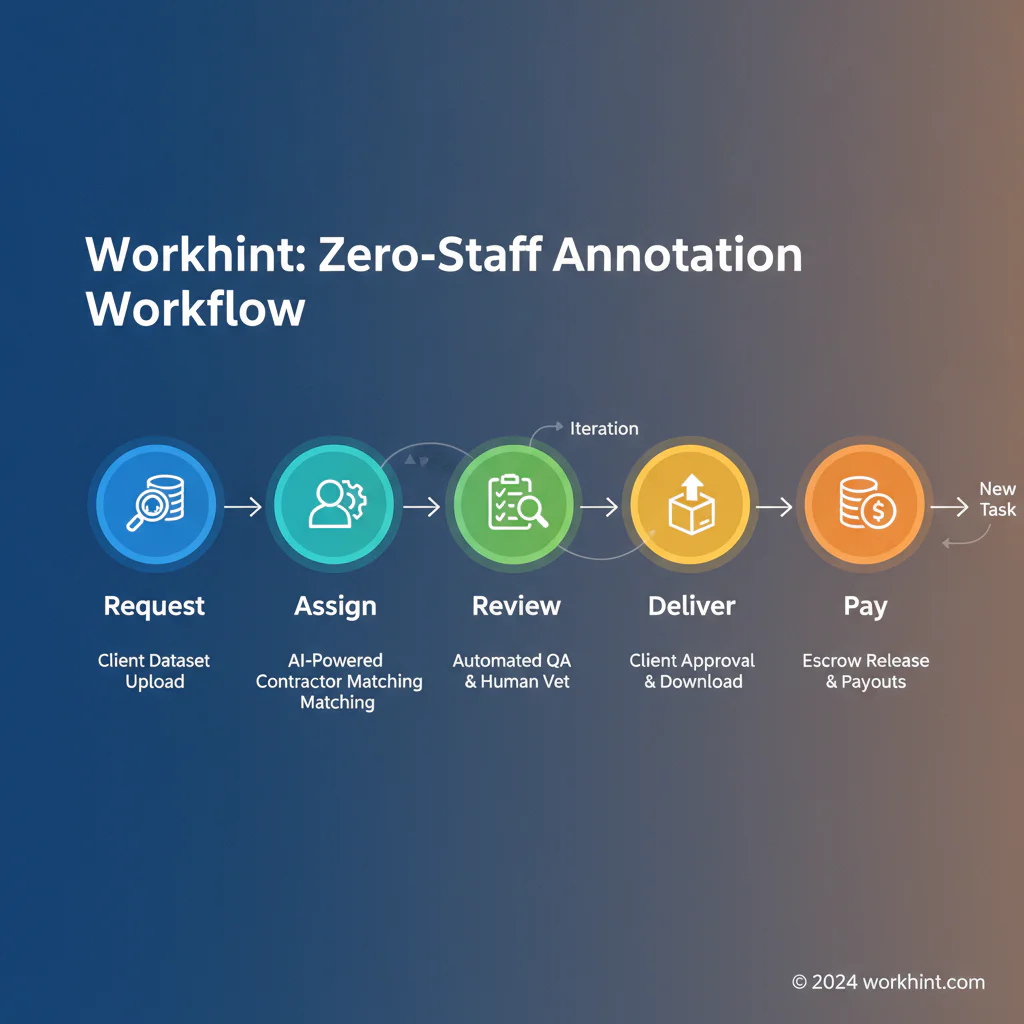
Workhint can become the branded operating foundation for the business before you invest in a large annotation team. Instead of stitching together forms, spreadsheets, project tools, payment tools, file handoffs, and contractor tracking, you can create a platform that runs the business from the first client request to final payout.
A client submits a dataset request through your branded portal. Workhint collects the project type, volume, deadline, data handling requirements, sample files, and budget. Your operations dashboard turns that request into a quote, approval flow, project workspace, reviewer assignment, quality checklist, and invoice.
Independent reviewers join through onboarding, accept your confidentiality terms, complete sample tasks, and get assigned only to approved project types. Workhint can route batches to reviewers, track completion, collect QA notes, request corrections, approve delivery, invoice the customer, and manage contractor payouts after acceptance.
That platform-first model lets you sell and validate demand before building custom software or hiring employees. You focus on niche positioning, customer acquisition, reviewer quality, and delivery standards while Workhint gives the business its operational backbone.
First 7-day launch plan
- Day 1: Choose one annotation niche, one buyer, and one pilot offer.
- Day 2: Set up the branded Workhint platform with client intake, reviewer onboarding, and project statuses.
- Day 3: Define pricing, QA rules, delivery format, quote approval, invoicing, and contractor payout logic.
- Day 4: Recruit 5 to 10 independent reviewers with relevant domain familiarity and test them on sample work.
- Day 5: Contact 30 to 50 AI startups, agencies, ecommerce teams, or data-heavy operators with a paid pilot offer.
- Day 6: Route interested prospects through the platform and quote one tightly scoped batch.
- Day 7: Review demand, reviewer readiness, pricing, turnaround time, and quality risk before investing more.
Final launch checklist
- Choose a focused data annotation niche.
- Create a simple service name, landing page, and buyer promise.
- Register the business and prepare confidentiality and contractor agreements.
- Configure your branded Workhint customer portal and operations dashboard.
- Create client intake, quote approval, project tracking, QA, invoice, and payout flows.
- Recruit and test the first independent reviewers.
- Build one sample project and one paid pilot package.
- Contact first prospects and validate demand before hiring staff.
FAQ
How much does it cost to start a data annotation business?
A lean launch can start for a few hundred to a few thousand dollars if you use a branded platform, client-provided tools, independent reviewers, and paid pilots before investing in expensive software or employees.
Do I need employees to start?
No. You can begin with independent contractors or specialist reviewers as long as your contracts, quality controls, confidentiality terms, and payment process are clear.
What kind of data annotation should I offer first?
Start with one narrow service, such as ecommerce image tagging, document classification, chatbot response review, prompt evaluation, or simple computer vision labeling. Narrow offers are easier to sell and manage.
Do I need my own annotation software?
Not at first. Many early projects can use client tools, existing labeling tools, or lightweight workflows. Build or buy deeper tooling after paid demand justifies it.
How do I find first customers?
Target AI startups, agencies, ecommerce teams, robotics companies, and software teams that need training data but do not want to manage temporary annotators internally.
Is data annotation profitable?
It can be profitable when pricing accounts for reviewer pay, QA time, rework, project management, security, and margin. Profit comes from repeatable processes, not from underpricing labor.
What is the biggest beginner mistake?
The biggest mistake is accepting broad, messy projects before you have a niche, reviewer standards, QA rules, and a clear delivery process.
Conclusion
A data annotation business is a practical AI-enabled service business when you launch narrowly, validate demand, and keep fixed costs low. Start with one customer problem, one reviewer network, one quality process, and one platform that connects the work.
Workhint helps you launch the branded operating system first, so you can test the business with real customers before hiring staff, buying complex tools, or building custom infrastructure.
Leave a Reply