


Most intake problems are not form problems. They are decision, capacity, and ownership problems hiding behind a form.
A project intake process is the operating system for deciding what new work enters the business, who owns it, when it starts, and how progress will be tracked. It protects teams from scattered requests, hidden commitments, and priority changes that arrive through email, chat, meetings, and executive side channels.
Good intake is not bureaucracy. It is a practical way to slow the request down just enough to make a better decision. PMI describes intake as the bridge between business stakeholders defining what should be done and delivery teams that will build or execute the work. That bridge matters because every accepted request consumes capacity, creates dependencies, and changes what other teams can promise.
What’s in this article?
- What a project intake process should decide before work starts.
- The intake workflow business operations teams can use across departments.
- The fields, scoring rules, owners, and service levels that keep intake measurable.
- How Workhint fits when intake needs to become a live operating system.
Why project intake process design matters
Without a clear project intake process, teams usually create three parallel systems: the official request form, the real request path through personal messages, and the hidden priority list maintained by managers. The result is predictable. Low-value work starts early, high-value work waits for missing context, and delivery teams are blamed for delays they never had the authority to prevent.
ISO’s process approach to quality management is useful here because it treats work as connected inputs, activities, outputs, checks, and measures rather than isolated tasks. Intake should work the same way. A request is the input. Triage, scoring, approval, and routing are the activities. The output is not merely an approved request; it is an executable work record with an owner, scope, timeline, dependencies, and reporting path.
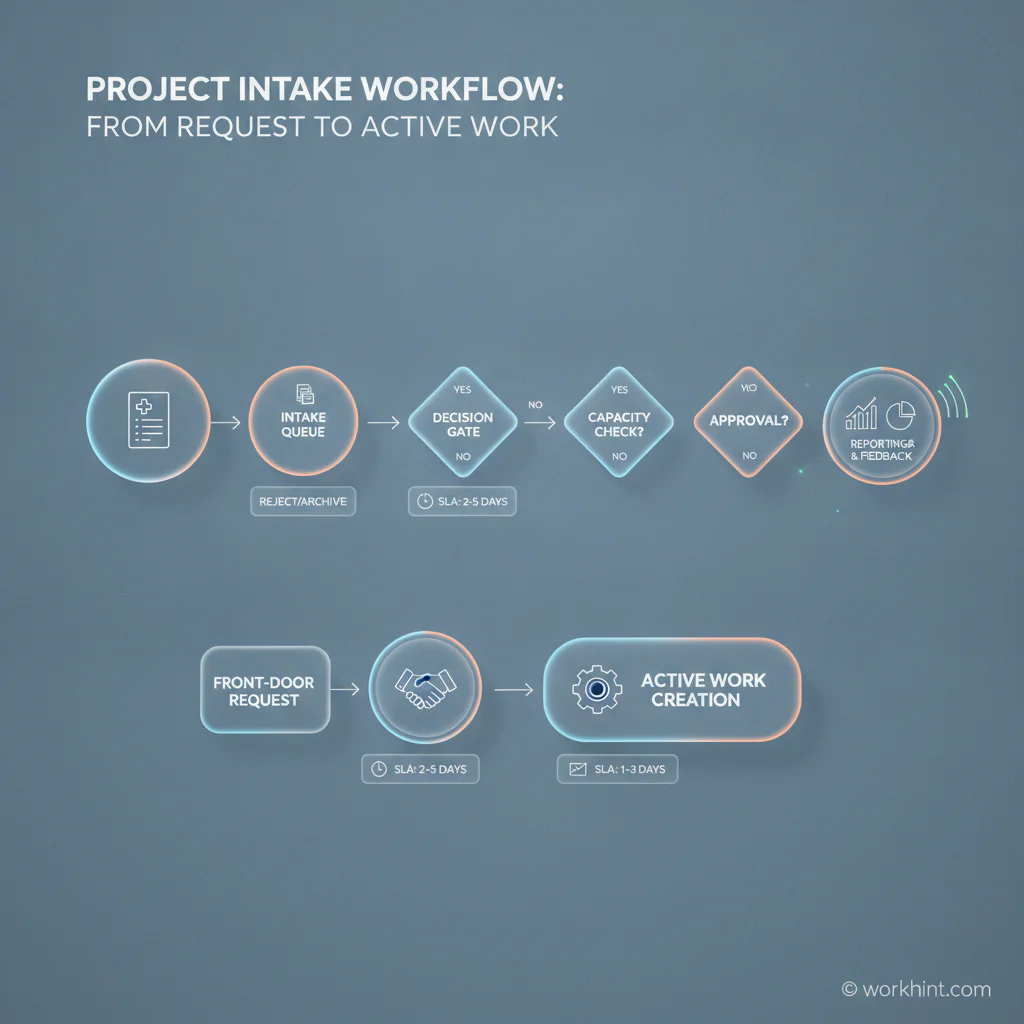
Project intake workflow from request to active work
A scalable intake workflow has seven stages. Each stage should answer one business question and either move the request forward, return it for clarification, reject it, or park it for later review.
| Stage | Decision | System output |
|---|---|---|
| Capture | Is the request complete enough to review? | Standardized request record |
| Qualify | Is this real work, a question, or a duplicate? | Request type and triage status |
| Score | How valuable, urgent, risky, and effort-heavy is it? | Priority score and rationale |
| Check capacity | Can the team take this on without breaking existing commitments? | Capacity fit and earliest start window |
| Approve | Should this work start, wait, change, or stop? | Decision, approver, and timestamp |
| Route | Who owns execution and what workflow should it enter? | Owner, workflow, SLA, and dependencies |
| Review | Is intake improving decision quality and throughput? | Metrics, bottlenecks, and process changes |
Step-by-step intake process
1. Create one front door for requests
The first rule is simple: new work should enter through one visible path. That path can be a form, portal, or structured workspace, but it must create a consistent record. Quickbase notes that project intake forms help standardize request information and move details into a central system for evaluation and prioritization. The important part is not the form itself; it is the consistent data structure behind it.
At minimum, capture requester, business problem, desired outcome, deadline, affected teams, customer or revenue impact, risk, required approvals, dependencies, and what happens if the work is not done. Avoid fields that nobody uses for decisions.
2. Separate clarification from approval
Many intake processes stall because the first reviewer tries to approve incomplete requests. Add a qualification step before approval. The reviewer should check whether the request is understandable, aligned to a real business need, and distinct from existing work. If not, send it back with specific missing information.
3. Score work before debating priority
Scoring does not replace judgment, but it makes tradeoffs visible. Use a simple model that scores business impact, urgency, customer impact, regulatory or operational risk, strategic alignment, and estimated effort. A high-impact, low-effort request may move quickly. A high-impact, high-effort request may need planning. A low-impact request with an artificial deadline should not jump the queue.
4. Add a capacity check
Approval without capacity is theater. Before approving the work, check whether the receiving team has people, budget, time, and dependency coverage. The intake owner should be able to say: approved for now, approved for the next cycle, rejected, merged with another request, or returned for redesign.
5. Route approved work into execution
Once approved, intake should create an execution object: project, task group, workflow, case, ticket, or operational process. That object needs an accountable owner, collaborators, due dates, status definitions, escalation path, files, and reporting cadence. Smartsheet describes intake as moving through phases such as discovery, assessment, and planning; the handoff to planning is where many teams lose context unless the system carries the request data forward.
6. Review intake metrics weekly
Track request volume, approval rate, average time in triage, average time to decision, requests returned for missing information, work waiting on capacity, and work started outside the official intake path. These metrics show whether intake is helping the business make better decisions or simply collecting paperwork.
Common intake process mistakes
- Making the form too long: Teams avoid intake when every request feels like a grant application.
- Skipping decision rights: If nobody knows who can approve, every request waits for the loudest stakeholder.
- Ignoring capacity: Approved work still fails when teams cannot realistically start it.
- Using one workflow for every request: Legal, finance, operations, product, and customer requests often need different routing after the same front door.
- Failing to close the loop: Requesters need status visibility, even when the answer is no or not now.
Where Workhint fits
Workhint fits when a project intake process needs to become a working system rather than a static form. A team can describe the intake challenge, then use Workhint to shape the roles, request fields, permissions, routing rules, approval steps, assignments, status views, escalation paths, documents, notifications, and reporting needed to run the process.
That matters when intake spans multiple departments or external contributors. A request may need finance approval, legal review, operations assignment, vendor onboarding, contractor work, customer updates, or payment tracking. Workhint helps turn the intake model into a connected operating system so approved work does not disappear into another spreadsheet or chat thread.
FAQ
What is a project intake process?
A project intake process is the structured way a business captures, evaluates, prioritizes, approves, and routes new project or work requests before execution begins.
What should be included in a project intake form?
Include requester, business need, desired outcome, deadline, impacted teams, expected value, risk, dependencies, required approvals, effort estimate, and consequences of not doing the work.
Who should own project intake?
Ownership depends on the operating model. Common owners include operations, PMO, business systems, department leads, or a shared intake council. The key is having one accountable intake owner and clear approvers.
How do you prioritize intake requests?
Use a scoring model that considers impact, urgency, risk, strategic alignment, effort, and capacity. Then review the score with human judgment before approving or rejecting the request.
Conclusion
A strong project intake process gives the business a clear front door for work. It captures the right information, filters weak requests, makes tradeoffs visible, protects team capacity, and routes approved work into an accountable execution system.
The goal is not to slow people down. The goal is to make sure the right work starts with the right owner, context, timing, and measurement. When intake works, teams stop reacting to scattered requests and start running a repeatable system for deciding what deserves attention next.
Leave a Reply