


A better freelance interview separates proven operators from available resumes before scope, access, and payment problems start.
Freelance interview questions should test more than talent. For business teams, the goal is to confirm whether a freelancer can understand the work, manage handoffs, communicate clearly, protect sensitive access, and operate independently without being treated like an employee.
That balance matters. The IRS explains worker classification through behavioral control, financial control, and the relationship between the parties. The Department of Labor also looks at economic reality factors when evaluating whether a worker is truly in business for themselves under the Fair Labor Standards Act. Interviews should help you assess fit without drifting into employee-style supervision.
What’s in this article?
- What strong freelance interview questions should reveal before work starts.
- A practical question bank for project, communication, availability, compliance, and payment fit.
- A simple scorecard hiring teams can reuse across freelancers.
- Common mistakes that create rework, misalignment, or compliance risk.
- Where Workhint fits when freelancer hiring needs to become a repeatable workflow.
Why freelance interviews need a different approach
A freelancer is not being hired into a job description in the same way as an employee. You are usually buying a defined outcome, specialist capacity, or project-based expertise. That means the best interview is closer to an operating review than a personality screen.
Competing guides often list broad behavioral prompts or marketplace-style questions. Those are useful, but they often miss the operational layer: who owns the brief, what access is required, how approvals happen, and how the freelancer will flag risk.
Freelance interview questions to ask before hiring
Use these questions as a structured screen. You do not need to ask every question in every call. Pick the ones that match the risk, complexity, and value of the work.
Project understanding
- Can you explain the outcome you think we are trying to create?
- What information would you need before you could give a reliable estimate?
- What assumptions would you want confirmed before work starts?
- What would make this project harder than it looks?
- What does a strong brief look like for this type of work?
Relevant experience
- What similar projects have you completed, and what made them successful?
- Can you walk through your process from kickoff to final delivery?
- What examples can you share that match this scope or industry?
- What parts of this work do you handle directly, and what would you subcontract or outsource?
- How do you handle work when the client changes direction midway through a project?
Communication and collaboration
- How do you prefer to receive feedback?
- How often do you typically send progress updates?
- What should we do if a stakeholder misses a review deadline?
- How do you document decisions, open questions, and approvals?
- What is your escalation process when scope, timing, or quality is at risk?
Availability and independence
- What is your current project load?
- What turnaround time can we realistically expect?
- Which parts of the schedule are fixed, and which are flexible?
- How do you manage multiple clients at the same time?
Commercial and compliance fit
- Do you work by milestone, retainer, hourly rate, or fixed fee?
- What payment terms do you normally use?
- What contract, statement of work, or purchase order details do you need before starting?
- Do you carry any insurance, certifications, or licenses relevant to this work?
- What data, systems, or client materials would you need access to?
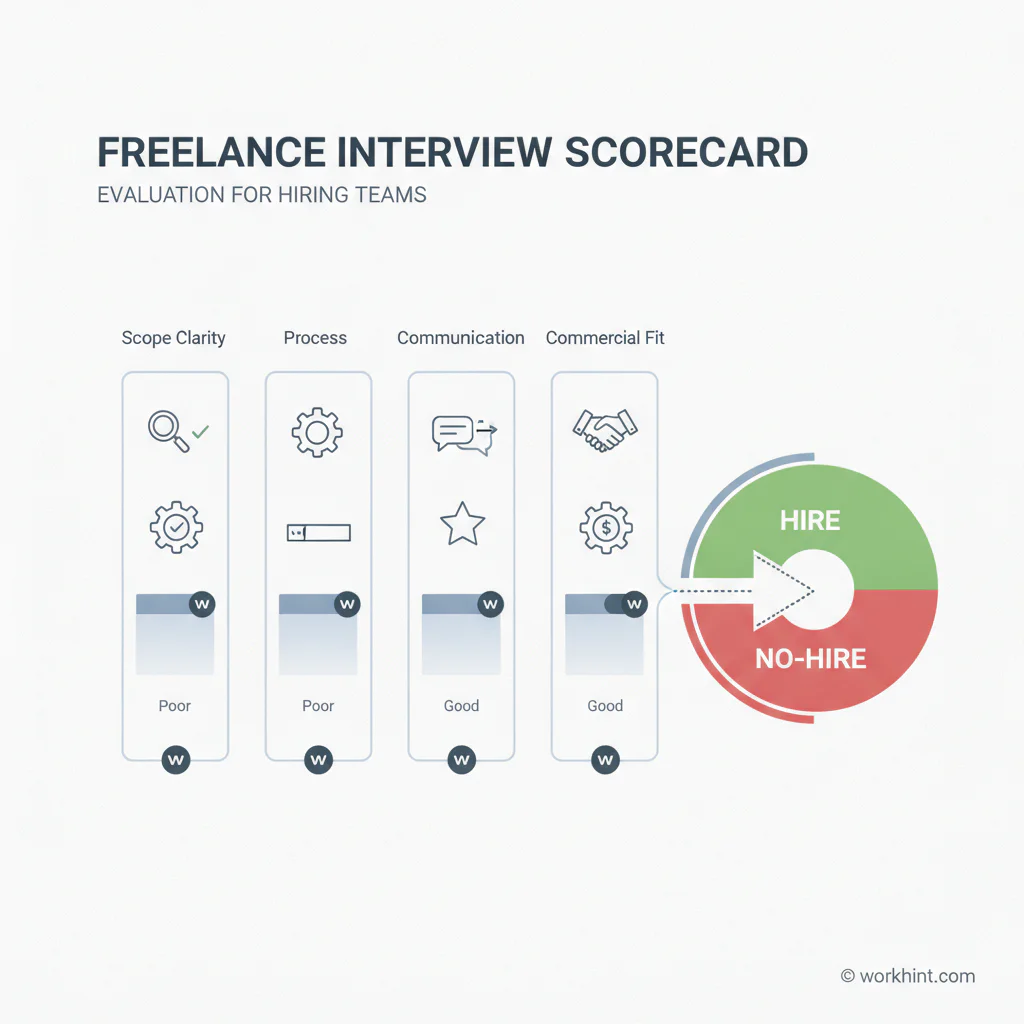
A simple freelance interview scorecard
A scorecard keeps the interview from becoming a gut-feel conversation. It also makes it easier to compare multiple freelancers without changing the criteria for each person.
| Area | What to evaluate | Strong signal | Weak signal |
|---|---|---|---|
| Scope clarity | Understanding of deliverables, dependencies, and assumptions | Identifies missing inputs and project risks | Accepts vague scope without questions |
| Process | How work moves from kickoff to approval | Describes clear steps, reviews, and handoffs | Cannot explain how progress will be managed |
| Communication | Update cadence, documentation, and escalation | Sets expectations for status, feedback, and blockers | Relies on ad hoc messages only |
| Independence | Ability to work without employee-style supervision | Uses own methods, tools, and judgment | Requires daily direction on how to do the work |
| Commercial fit | Pricing, payment terms, contract needs, and access requirements | States terms before kickoff | Leaves payment, ownership, or access vague |
How to run the interview workflow
- Write the outcome first. Define the business result, deliverables, deadline, stakeholders, and approval owner before speaking with candidates.
- Send a short brief. Give each freelancer the same context so the interview tests judgment, not guessing ability.
- Ask for process, not just portfolio. Good samples show capability, but process tells you whether the freelancer can operate inside your business.
- Score immediately after the call. Use the same criteria while the conversation is fresh.
- Confirm scope in writing. Capture deliverables, timing, access, payment terms, ownership, and review cycles before work starts.
- Separate evaluation from control. Ask how the freelancer works, but avoid dictating the exact manner and means of work unless legal counsel has confirmed the engagement model supports that level of direction.
For compliance-sensitive engagements, do not rely on an interview alone. The DOL’s Fact Sheet 13 explains employment relationship factors under the FLSA, and SHRM provides a practical checklist for utilizing independent contractors. Use those as prompts for legal, HR, finance, or procurement review where needed.
Common mistakes when interviewing freelancers
- Asking only skill questions. Skill matters, but most freelance failures come from unclear scope, slow approvals, missing access, or mismatched expectations.
- Skipping payment terms. Payment timing, invoicing format, milestone rules, and tax documentation should be clear before kickoff.
- Ignoring access risk. If the freelancer needs systems, files, customer data, or production credentials, define permissions and offboarding before work begins.
- Comparing freelancers inconsistently. Changing the questions for every candidate makes decisions harder to defend and repeat.
- Managing the freelancer like an employee. Business teams should define outcomes and constraints, not turn the engagement into day-to-day employee supervision.
Where Workhint fits
Workhint helps teams turn freelance hiring from a scattered conversation into a repeatable work system. A company can define the intake form, candidate questions, scorecard, approval owner, contract checklist, system access request, milestone schedule, invoice workflow, and offboarding steps in one place.
That is especially useful when multiple departments hire freelancers differently. Workhint can help standardize what must be collected before work starts, route approvals to the right people, remind teams about documents and payment milestones, and keep a record of who was approved for what work. The interview remains human, but the workflow around it becomes easier to control.
FAQ
How many freelance interview questions should I ask?
Most teams only need eight to twelve strong questions. Cover project understanding, relevant experience, communication, availability, commercial terms, and access requirements. Ask more only when the work is high risk or highly specialized.
Should I ask freelancers about other clients?
Yes, but keep it practical. Ask about availability, capacity, and conflict management. Do not ask for confidential client details or anything that would pressure the freelancer to disclose another client’s private information.
What is the best question to ask a freelancer?
Ask, “What would you need to know before you could commit to this scope?” Strong freelancers identify missing inputs, risks, dependencies, and decision points instead of giving an instant yes.
Do freelance interviews affect contractor classification?
The interview itself is not the classification test, but the way you define and manage the relationship matters. Use the interview to confirm independent operating style, then review classification, contract terms, payment setup, and control factors with the appropriate advisor.
Conclusion
The best freelance interview questions reveal how someone will operate once the project is real. Look for clarity, judgment, communication, independence, and commercial discipline. When those answers are captured in a consistent workflow, hiring freelancers becomes less dependent on memory and more dependent on a system your team can reuse.
Leave a Reply