


You can validate mobile IV demand before opening a clinic, buying a fleet, or hiring a full medical team.
Learning how to start a mobile IV business is attractive because customers want convenient wellness services, recovery support, and at-home care options. But IV therapy is also a regulated medical service, so speed only works when compliance comes first.
The lean version is a focused mobile service built around licensed clinical providers, medical oversight, safe scheduling, documented visits, and disciplined demand validation before heavy investment.
What’s in this article?
- Why mobile IV can work as a low-overhead service business
- What you need before taking the first client
- How to price basic hydration, wellness, and event packages
- How to find first customers without pretending to be a large clinic
- How Workhint can become the branded operating platform behind the business
- A 7-day launch plan, final checklist, and FAQ
Why this business works
Mobile IV therapy works because it combines convenience with high-intent demand for hydration, recovery, wellness, and at-home service.
The strongest early markets are usually dense, event-driven, or wellness-oriented: hotels, fitness communities, athletic events, wedding weekends, corporate retreats, and neighborhoods where convenience services already sell.
The business can be tested before building a clinic. A founder can create a branded booking platform, recruit qualified providers, define a small compliant menu, and route early requests through a controlled process.
State rules, scope of practice, prescription authority, medical director requirements, pharmacy sourcing, patient screening, HIPAA, insurance, and documentation must be handled before selling treatments.
What you need to launch
A lean mobile IV launch starts with the operating model, not equipment. Decide who can own the clinical practice, who provides medical direction, which professionals can administer IVs, and which treatments are allowed.
Many founders need a healthcare attorney, medical director or physician partner, malpractice and general liability insurance, consent forms, treatment protocols, provider credential checks, secure records, and safe medication sourcing.
Keep the first offer narrow. A small menu is easier to price, supervise, fulfill, and validate than a long list of wellness packages.
| Launch item | Lean starting range | Why it matters |
|---|---|---|
| Business formation and legal review | $1,000 to $5,000 | Confirms ownership structure, medical oversight, contracts, and state-specific rules. |
| Medical director or clinical oversight | $500 to $2,000 per month | Supports protocols, orders, supervision, and clinical governance where required. |
| Insurance | $1,500 to $5,000 per year | Covers professional liability, general liability, and mobile service risk. |
| Initial supplies and equipment | $1,500 to $6,000 | Includes essential medical supplies, PPE, kits, storage, and disposal setup. |
| Branded platform and first marketing | $1,000 to $4,000 | Lets customers request service, providers receive assignments, and the owner track operations. |
Do not buy a van, lease a drip lounge, or stock a large inventory before demand is proven. Use qualified providers, validate a focused market, and invest into owned assets only after repeat bookings justify them.
How to price it
Pricing must cover clinical labor, supplies, medical oversight, travel time, insurance, marketing, payment fees, and cancellation risk.
Many mobile IV businesses use a mix of single appointments, group events, premium add-ons, and memberships. Keep claims conservative and compliant.
| Offer | Example price | Best use |
|---|---|---|
| Basic hydration visit | $149 to $249 | First-time customers, athletes, travel recovery, and simple wellness demand. |
| Premium wellness package | $225 to $399 | Higher-margin service when protocols and ingredients are approved. |
| Group or event package | $600 to $2,500+ | Hotels, weddings, retreats, athletic events, and corporate wellness days. |
| Membership plan | $199 to $499 per month | Recurring demand after customers prove repeat usage. |
Before discounting, calculate provider payout, supply cost, drive time, no-show risk, and acquisition cost.
How to get first customers
The first goal is not to dominate a city. It is to prove that one narrow audience will book, pay, and refer. Choose a launch market with obvious demand: gyms, wellness studios, bridal planners, hotels, sports clubs, or event organizers.
Start with direct partnerships. Hotels, fitness studios, planners, and corporate wellness consultants can test demand faster than broad ads.
Use local SEO for searches like mobile IV therapy near me, IV hydration at home, and mobile IV for events. Only advertise services you can safely fulfill with licensed providers and compliant protocols.
How Workhint helps launch it
Workhint can serve as the branded operating platform for the mobile IV business before the founder invests in custom software, a clinic, or a full employee team.
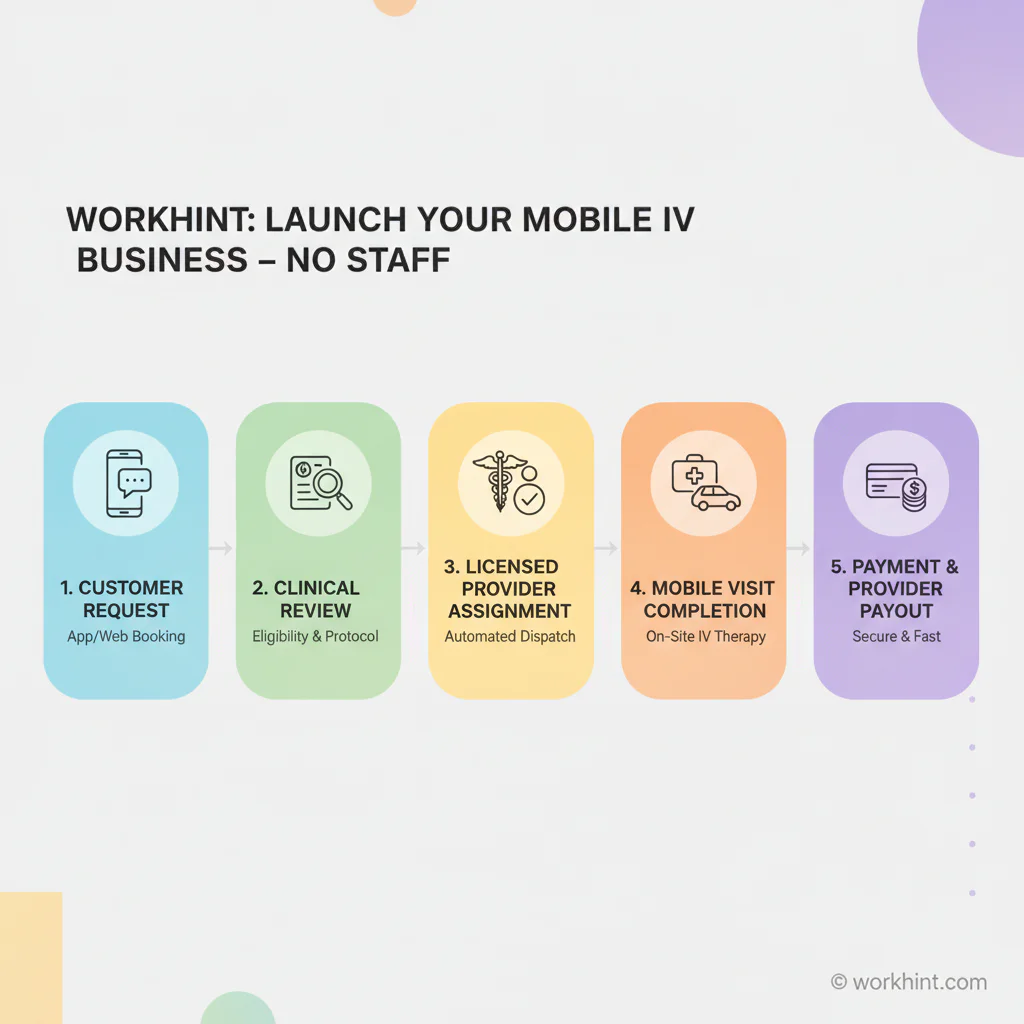
A customer requests a mobile IV appointment through a branded portal. The intake flow collects location, timing, service interest, consent requirements, eligibility questions, and the information the clinical team needs to review.
The owner can invite licensed nurses or approved provider partners, collect credentials, define service areas, set availability, route bookings, assign visits, and track completion. A medical director or clinical reviewer can receive role-based access for approvals and oversight.
After approval, Workhint can coordinate scheduling, reminders, provider instructions, forms, checklists, invoices, online payments, provider payouts, and follow-up reviews. That gives the founder one operating foundation for demand validation and service delivery.
First 7-day launch plan
Day 1: Choose one launch market, one customer segment, and a small compliant service menu. Avoid broad claims and complex treatments until your clinical model is reviewed.
Day 2: Set up the branded Workhint platform basics: customer request form, provider roles, intake questions, approval steps, and internal dashboard.
Day 3: Build the pricing, approval, scheduling, payment, cancellation, and provider payout process. Test one request from intake to completion.
Day 4: Recruit the first licensed providers or clinical partners. Verify credentials, availability, service area, documentation standards, and payout expectations.
Day 5: Contact first demand sources: hotels, gyms, event planners, wellness studios, concierge offices, and local business groups.
Day 6: Route early inquiries through the platform. Track what people ask for, what they book, and which offers create friction.
Day 7: Review demand, compliance readiness, provider coverage, pricing, and operational gaps before buying more supplies or spending heavily on ads.
Final launch checklist
- Confirm state ownership, scope of practice, medical director, pharmacy, and supervision rules.
- Form the right business entity and clinical or management structure.
- Get legal review, insurance, consent forms, protocols, and secure records in place.
- Create a focused first menu with compliant claims and clear pricing.
- Configure the branded Workhint portal, intake, scheduling, approvals, payments, and payout flows.
- Recruit qualified licensed providers and verify credentials before accepting bookings.
- Build partnerships with hotels, gyms, planners, wellness studios, and event organizers.
- Validate paid demand before leasing space, buying a vehicle, hiring employees, or expanding inventory.
FAQ
How much does it cost to start a mobile IV business?
A lean launch may start in the low five figures if you avoid a clinic buildout, vehicle purchase, and full employee team. Legal setup, medical oversight, insurance, supplies, provider onboarding, and customer acquisition are the core costs.
Do I need to be a nurse to start a mobile IV business?
Rules vary by state. IV therapy involves medical treatment, so ownership, supervision, prescribing, and administration requirements can differ.
Can I start a mobile IV business with no employees?
You may be able to start without employees by working with licensed independent providers or clinical partners, but you still need compliant contracts, credential checks, supervision, documentation, insurance, and service protocols.
What licenses are needed for mobile IV therapy?
Common requirements may include business registration, professional licenses, medical director arrangements, pharmacy compliance, local permits, malpractice insurance, and HIPAA-compliant systems. Confirm requirements with a healthcare attorney in your state.
Is mobile IV therapy profitable?
It can be profitable when pricing covers clinical labor, supplies, travel, oversight, insurance, cancellations, and marketing. Profit depends on utilization, repeat customers, provider costs, and scheduling efficiency.
What customers should I target first?
Start with narrow, reachable groups such as hotels, fitness studios, bridal parties, athletic events, wellness communities, and corporate retreat planners.
Should I buy a vehicle before launching?
Usually no. If providers can travel safely with approved supplies and procedures, validate demand first. Buy or brand a vehicle only after booking volume, routes, and economics justify the investment.
Conclusion
A mobile IV business can be launched faster than a traditional clinic, but only if the founder treats compliance and operations as the foundation. The lean path is to validate one market, build a licensed provider network, sell a narrow service menu, and keep heavy investment until demand is proven.
Workhint gives the business a customer platform and operating system. That lets the founder focus on customer acquisition, provider quality, fulfillment, and demand before growth.
Leave a Reply