


A home staging business can start lean when you sell the service before buying a warehouse full of furniture.
If you are researching how to start a home staging business, the opportunity is simple: sellers and agents want homes to look better, photograph better, and feel easier to imagine as a buyer.
The mistake is assuming you need a large inventory, truck, warehouse, and employees before you can start. A leaner path is to launch with a branded service platform, a small staging kit, rental partners, virtual staging partners, and a network of independent stylists, movers, cleaners, photographers, and repair vendors.
This guide shows how to validate demand first, keep startup costs controlled, price the first offers, and use Workhint as the operating foundation before making heavy investments.
What’s In This Article?
- Why home staging works as a low-overhead service business
- What you need before booking the first project
- Startup costs, pricing examples, and first customer channels
- How Workhint can run the business from agent request to provider payout
- A practical 7-day launch plan and final checklist
Why This Business Works
Home staging sits close to a high-value transaction. Sellers want faster showings, stronger photos, and fewer buyer objections. Agents want listings that look polished without managing every detail themselves.
The business can also start with flexible offers. You can begin with occupied staging consultations, room-by-room styling, pre-listing checklists, virtual staging coordination, or rental-based vacant staging. That lets you prove demand before buying expensive furniture.
Customers buy confidence. Agents want a reliable partner who can assess a home, recommend the right package, schedule work quickly, coordinate access, and deliver photos or staged rooms before the listing goes live.
Independent providers make the model scalable. Instead of hiring a full crew immediately, build a trusted network of stagers, organizers, cleaners, handypeople, movers, rental suppliers, and photographers. Your role is to package the service and make fulfillment dependable.
What You Need To Launch
Most markets do not require a special home staging license, but you still need a legal business, insurance, clear contracts, safe property access rules, and local compliance checks. Certification can help credibility, but it is not the same as demand validation.
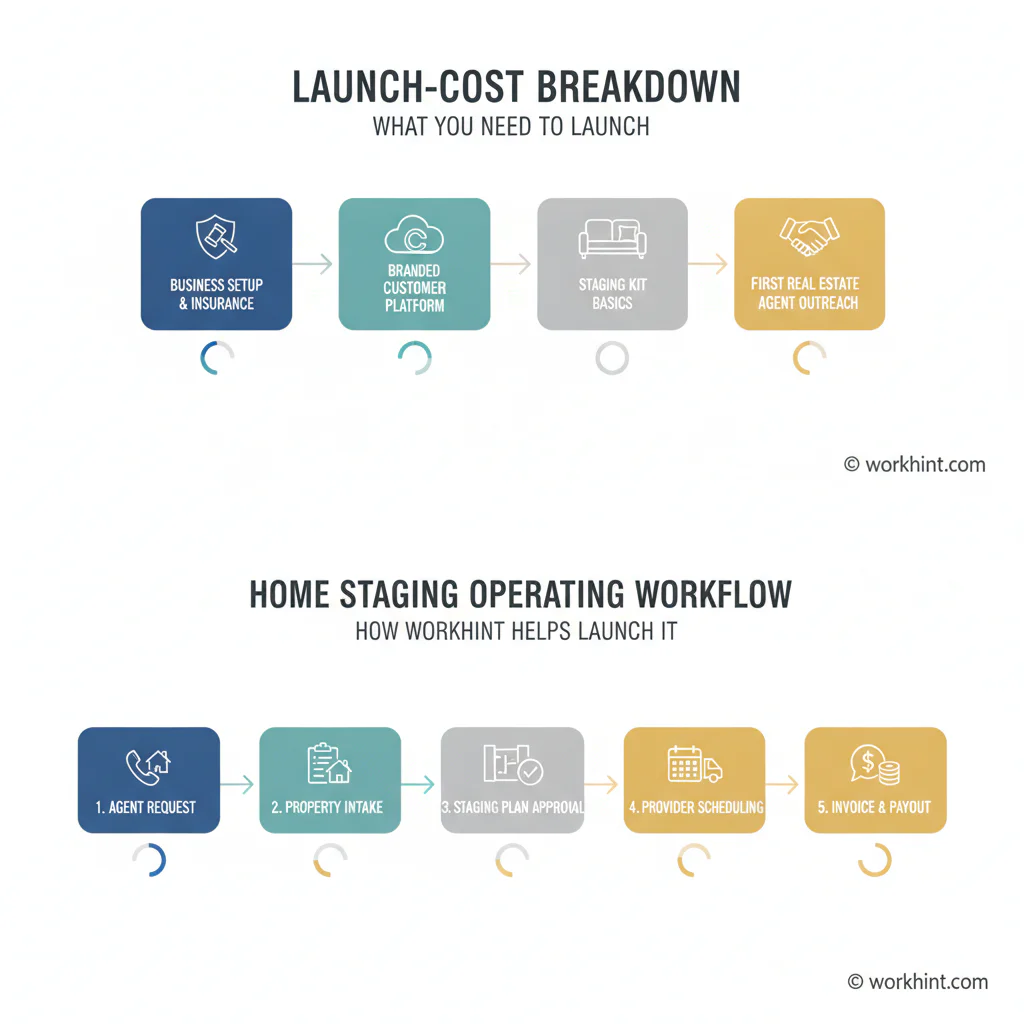
Start with the assets that help you sell and coordinate the first jobs: a branded request flow, simple packages, before-and-after examples, provider agreements, rental relationships, and a small styling kit for consultations.
| Launch item | Lean budget | Why it matters |
|---|---|---|
| Business registration and insurance | $400 to $1,500 | Creates a basic legal and risk foundation before entering client homes. |
| Branded customer platform | $500 to $2,000 | Handles requests, quotes, approvals, scheduling, invoices, and provider coordination. |
| Basic staging kit | $300 to $1,500 | Supports consultations, occupied staging, small accessories, and sample styling. |
| Rental and virtual staging partners | $0 to $1,000 setup | Lets you fulfill larger jobs without buying inventory first. |
| Agent outreach and portfolio materials | $300 to $1,500 | Gets you in front of listing agents, sellers, investors, and local brokerages. |
A lean launch should prioritize demand, repeatable operations, and provider relationships over furniture ownership. Buy inventory after booked projects prove what your market actually needs.
How To Price It
Home staging pricing depends on property size, location, whether the home is occupied or vacant, and whether furniture rental is included. Keep early pricing easy to explain.
| Offer | Example pricing | Best use |
|---|---|---|
| Initial consultation | $150 to $600 | Walkthrough, recommendations, and a written pre-listing plan. |
| Occupied staging | $200 to $800 per room | Rearranging, styling, and improving rooms with existing furniture. |
| Vacant staging coordination | $500 to $1,500 per room per month | Higher-value listings using rental furniture and partner providers. |
| Virtual staging coordination | $75 to $300 per photo | Budget-conscious listings, investors, or empty rooms where physical staging is not required. |
Your first goal is not to copy every local competitor. It is to package one offer agents understand, price it profitably, and make delivery predictable.
How To Get First Customers
Start with the people closest to listings: real estate agents, brokerages, small investors, property managers, builders, photographers, and homeowners preparing to sell.
Offer a narrow first package, such as a pre-listing consultation for occupied homes or a virtual staging coordination package for vacant listings. Narrow offers are easier to sell, easier to deliver, and easier to improve.
Build proof quickly. Stage one room, help an agent prepare a listing, create a sample consultation report, and document before-and-after results.
How Workhint Helps Launch It
Workhint can become the branded operating system for the staging business before you invest in custom software, inventory management tools, or a back office. The business can launch with a customer request portal, agent intake form, quote approvals, provider onboarding, scheduling, task checklists, invoices, payments, and contractor payouts in one connected platform.
An agent submits a listing through your branded portal. Workhint captures address, listing date, access instructions, rooms, budget, photos, and preferred staging package. The platform routes the request to the right provider, creates a staging checklist, sends a quote for approval, schedules the visit, tracks completion, stores before-and-after photos, sends the invoice, collects payment, and records the payout owed to the independent provider.
That matters because staging is not just design. It is timing, access, approvals, vendors, rentals, photos, invoices, and follow-up. Workhint lets you sell a professional staging experience while keeping the first version lean and partner-powered.
First 7-Day Launch Plan
- Day 1: Choose your launch market, target client, and first offer, such as occupied staging consultations for agents.
- Day 2: Set up the branded Workhint request flow, customer dashboard, quote approval, and scheduling basics.
- Day 3: Create the pricing menu, intake questions, consultation report template, invoice flow, and provider payout rules.
- Day 4: Recruit independent stylists, cleaners, movers, photographers, and rental or virtual staging partners.
- Day 5: Contact local agents, brokerages, investors, and listing photographers with one clear first offer.
- Day 6: Route first requests, sample walkthroughs, and provider availability through the platform.
- Day 7: Review demand, objections, provider readiness, pricing, and delivery steps before buying inventory.
The first week should prove whether agents and sellers want the offer. Do not turn early enthusiasm into premature overhead.
Final Launch Checklist
- Choose one market, one buyer, and one first staging package.
- Register the business and confirm local requirements.
- Secure insurance and create simple client terms.
- Configure a branded Workhint intake, quote, scheduling, payment, and provider payout flow.
- Create a small styling kit and avoid large inventory purchases at launch.
- Build relationships with rental, virtual staging, cleaning, photography, moving, and handyman partners.
- Create a short consultation report template and before-and-after portfolio examples.
- Contact first agents and validate demand before leasing storage, buying furniture, or hiring employees.
FAQ
How much does it cost to start a home staging business?
A lean launch can often start with a few thousand dollars for registration, insurance, a branded platform, basic staging materials, portfolio creation, and local outreach. Costs rise quickly if you buy furniture, rent storage, or hire staff before proving demand.
Do I need a license to start a home staging business?
Most markets do not require a specific home staging license, but you should still register the business, check local rules, use clear contracts, and carry appropriate insurance before working inside client homes.
Do I need certification?
Certification is optional, but it can help new stagers build skills and credibility. Treat it as a trust builder, not a substitute for sales, operations, and real client feedback.
Can I start without buying furniture?
Yes. Start with consultations, occupied staging, virtual staging coordination, rental partners, or small accessory packages. Buy inventory only after repeated demand proves which items are worth owning.
How do home staging businesses make money?
Common revenue comes from consultations, occupied staging, vacant staging, monthly furniture rental coordination, virtual staging, project management fees, and add-on services such as decluttering or photo preparation.
How do I get my first home staging clients?
Start with real estate agents, brokerages, listing photographers, investors, and homeowners preparing to sell. Lead with one clear offer and proof that you can make listings easier to market.
Conclusion
A home staging business is worth starting when you validate demand before buying heavy assets. Begin with a focused offer, a provider network, rental options, and a branded platform that makes the service easy to request and approve.
Workhint gives the business a launch foundation for requests, quotes, scheduling, provider coordination, invoices, payments, and payouts from day one. Start lean, prove the workflow, then invest into inventory when the market earns it.
Leave a Reply