


The right operational KPIs do not just report performance; they tell the team what to fix next.
Operational KPIs are the measures a team uses to understand whether daily work is moving the business in the right direction. A useful KPI system connects goals, workflows, owners, targets, review cadence, and action rules. Without that system, a dashboard becomes a museum of numbers: interesting to look at, easy to ignore, and rarely responsible for better execution.
The mistake is starting with a list of popular metrics. Cycle time, throughput, utilization, backlog, response time, rework, and customer satisfaction can all be useful. But the right operational KPIs depend on the operating model, the decisions the team needs to make, and the problems the team is trying to prevent.
What’s in this article?
- What operational KPIs should do inside a work system.
- How to choose metrics that connect to real business outcomes.
- A practical KPI selection framework for operations teams.
- A simple table for mapping KPIs to owners, thresholds, and actions.
- Where Workhint fits when KPI tracking needs to become part of execution.
Why operational KPIs matter
Investopedia defines KPIs as quantifiable measures used to evaluate progress toward specific business objectives. That last phrase matters. A number is not a KPI just because it appears on a dashboard. It becomes a KPI when it helps a team evaluate progress toward an outcome and decide what to do next.
Operational KPIs sit close to the work. They show whether requests are moving, handoffs are clean, capacity is healthy, quality is holding, decisions are timely, and service promises are being met. NetSuite’s guide to operational metrics frames them as indicators that show performance across business processes such as production, sales, service, and finance.
The benefit is not measurement for its own sake. The benefit is earlier correction. If backlog is rising, cycle time is slipping, or rework is increasing, the team can adjust owners, routing, approvals, staffing, templates, or escalation rules before the issue becomes a customer problem.
How to choose operational KPIs
Start with the business question, not the metric. A customer support team might ask, “Are customers getting reliable answers quickly?” A marketplace operations team might ask, “Can we match demand to supply without missed commitments?” A finance operations team might ask, “Are invoices moving through review without avoidable delays?” Each question points to different KPIs.
ClearPoint’s operational metrics guide emphasizes alignment with business goals, measurability, relevance, targets, review cadence, and data quality. Those are good filters. If a metric is not tied to a decision, cannot be measured reliably, or has no owner, it is probably dashboard noise.
Use this sequence:
- Name the outcome. Define the result the process must protect, such as faster delivery, fewer errors, better capacity balance, or higher customer retention.
- Map the work. Identify the stages where the outcome is created or lost: intake, assignment, review, approval, delivery, closeout, billing, or follow-up.
- Choose leading signals. Pick metrics that reveal problems early, such as aging requests, missed handoffs, overdue approvals, capacity load, or first-response time.
- Keep lagging indicators. Track final results such as customer satisfaction, revenue impact, margin, error rate, or SLA attainment, but do not rely on them alone.
- Assign one owner. Every KPI needs one accountable owner who reviews it, explains movement, and triggers action.
- Define thresholds. Decide what green, watch, and intervene mean before the number changes.
- Create action rules. Specify what happens when a threshold is crossed: reroute work, escalate, rebalance capacity, change intake, update an SOP, or review root cause.
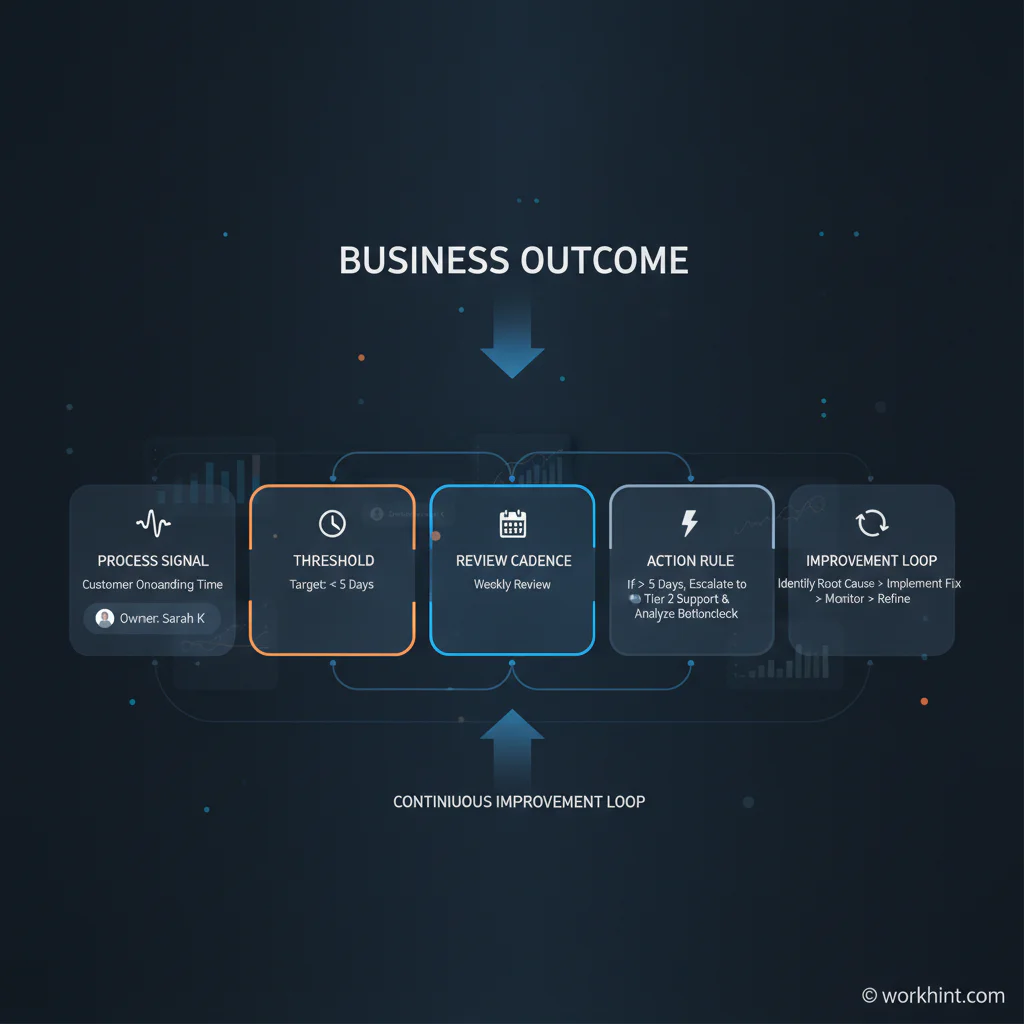
Build a simple operational KPI system
A strong KPI system is small enough to use every week and specific enough to change behavior. For most workflows, start with five to seven KPIs: one outcome metric, two or three process health metrics, one quality metric, one capacity metric, and one customer or stakeholder signal. monday.com’s operational metrics guide makes a similar distinction between strategic KPIs that validate outcomes and operational metrics that show how execution is performing day to day.
| KPI type | What it answers | Example | Action rule |
|---|---|---|---|
| Outcome | Is the process delivering the intended result? | SLA attainment, renewal rate, on-time delivery | Review root cause when target is missed twice. |
| Flow | Is work moving without delay? | Cycle time, backlog age, approval wait time | Escalate stalled items after threshold. |
| Quality | Is work correct the first time? | Error rate, rework rate, defect rate | Update SOP or review training when trend rises. |
| Capacity | Is workload balanced against available resources? | Utilization, queue depth, assignments per owner | Rebalance assignments or adjust intake priority. |
| Experience | Are customers or internal stakeholders getting what they need? | CSAT, response time, complaint rate | Trigger service review when sentiment declines. |
The table is only the start. The operating habit matters more. Each KPI should have a review rhythm: daily for live queues, weekly for team execution, monthly for process improvement, and quarterly for whether the metric still matters. A stale KPI is worse than no KPI because it creates false confidence.
Common KPI mistakes
The first mistake is tracking too many numbers. Investopedia notes that overloading reports can make it harder to know which metrics deserve attention. Cut any KPI that does not inform a decision, expose a risk, or trigger an action.
The second mistake is mixing ownership. If three leaders own a KPI, nobody owns it. Many people may influence cycle time, but one person must own the review and improvement process.
The third mistake is measuring only outcomes. Lagging KPIs confirm what happened. Leading indicators help the team act while there is still time. A team that only tracks monthly customer satisfaction may miss daily signs of overload, unclear intake, and slow approvals.
The fourth mistake is building a dashboard without a workflow. A KPI is useful only when it is connected to how work is routed, escalated, improved, and reviewed. Otherwise, the team notices the same issue every week without changing the system that produced it.
Where Workhint fits
Workhint fits when operational KPIs need to become part of how work actually runs. A team can use Workhint to turn a KPI model into a live work system: intake forms that capture the right data, role-based ownership, assignment rules, approval steps, escalation paths, dashboards, recurring reviews, and reporting tied to the workflow itself.
Instead of measuring work after it moves through disconnected tools, teams can design the process and the measurement system together. For example, an internal request system can track queue age, owner load, approval delays, SLA status, and rework because those signals are built into the workflow. The result is not a prettier report. It is an operating system that helps teams see, decide, and adjust faster.
FAQ
What are operational KPIs?
Operational KPIs are measurable indicators that show how well daily business processes are performing. They usually track speed, quality, capacity, cost, service, or workflow reliability.
How many operational KPIs should a team track?
Most teams should start with five to seven KPIs per critical workflow. That is enough to balance outcome, flow, quality, capacity, and experience without overwhelming the team.
What is the difference between operational KPIs and operational metrics?
Operational metrics measure process activity. Operational KPIs are the most important metrics tied to a specific business objective, target, owner, and action rule.
Who should own operational KPIs?
Each KPI should have one accountable owner. That person does not control every input, but they are responsible for review cadence, explanation, escalation, and improvement actions.
Conclusion
Operational KPIs work when they are designed as part of the operating system, not bolted onto it later. Choose metrics that answer real business questions, connect them to workflow stages, assign owners, set thresholds, and define what the team will do when a signal changes. The goal is not to track more. The goal is to make work more scalable, repeatable, and measurable.
Leave a Reply