


A junk removal business can start as a booked service network before you buy a truck.
How to start a junk removal business is a strong search because the service is visible, local, urgent, and easy for customers to understand.
The traditional advice starts with buying a truck, trailer, tools, uniforms, and ads. A leaner path is to validate demand first: build a branded booking platform, define a narrow first offer, recruit independent haulers or removal partners, and route every request through a repeatable operating system.
What’s in this article?
- Why junk removal works as a local service business
- What you need to launch before buying a truck
- How to price junk removal jobs
- How to get first customers
- How Workhint helps launch the operating platform
- A 7-day launch plan, checklist, and FAQ
Why this business works
Junk removal works because customers often have an immediate problem: old furniture, renovation debris, mattresses, appliances, garage clutter, estate cleanouts, rental turnovers, or office items that need to disappear quickly.
Current search results show active demand around startup costs, truck requirements, pricing, licensing, insurance, disposal fees, and profitability in 2026. Top guides cover equipment, vehicles, permits, marketing, and pricing. The gap is operations: most do not show intake, quoting, provider matching, scheduling, payment, completion proof, reviews, and payouts as one business system.
The best first offer is narrow. Start with small residential pickups, curbside removal, single-item haul-away, apartment move-outs, or property manager overflow jobs. Avoid hazardous materials, complex debris, hoarding situations, and specialized equipment until your provider network, insurance, disposal rules, and pricing are proven.
What you need to launch
You do not need to own the truck on day one. You do need business setup, insurance review, disposal research, customer intake, quote rules, scheduling, payment collection, provider standards, and reliable independent haulers or removal partners.
Rules vary by city and state. Basic junk hauling may require business registration, insurance, and local permits, while some waste types, oversized vehicles, dump access, recycling rules, and hazardous materials can trigger stricter requirements.
| Launch item | Lean first version | Typical early budget |
|---|---|---|
| Business setup | Registration, bank account, terms, provider agreement review | $150 to $900 |
| Branded platform | Booking, photos, quote approvals, scheduling, payments, reviews | $0 to $500 to configure |
| Insurance and compliance | General liability, auto coverage review, disposal rules, local permits | $500 to $1,500+ |
| Provider network | Independent haulers with vehicles, tools, availability, and standards | $100 to $700 for recruiting |
| Customer acquisition | Local landing page, Google Business Profile, partnerships, flyers, small tests | $200 to $1,000 |
Startup cost ranges vary widely. Some guides assume a full truck setup or franchise; others show lean starts at a few thousand dollars when the operator already has a vehicle. A platform-first model lets you test demand with vetted providers before buying trucks, trailers, or heavy equipment.
How to price it
Junk removal pricing depends on volume, item type, weight, stairs, distance, disposal fees, labor time, and urgency. Quote from photos when possible, but leave room for adjustment if the load is larger than described.
| Offer | Customer price | Provider payout logic | Best use |
|---|---|---|---|
| Single-item pickup | $75 to $175 | Fixed payout plus disposal surcharge if needed | Mattress, appliance, couch, or desk removal |
| Small load | $150 to $300 | Load-based payout with dump-fee reimbursement | Garage, apartment, or curbside cleanup |
| Half-truck equivalent | $300 to $550 | Higher payout for labor, volume, and disposal cost | Move-outs and landlord turnovers |
| Recurring property pickup | $250 to $900 per month | Route payout per stop or scheduled pickup | Property managers, offices, and storage operators |
Do not compete only on cheap hauling. Make the value clear: fast booking, transparent quotes, insured providers, completion photos, disposal notes, online payment, and reliable scheduling.
How to get first customers
Start where junk removal pain is frequent: property managers, apartment communities, real estate agents, storage facilities, moving companies, estate sale organizers, contractors, landlords, local Facebook groups, and neighborhood associations.
Use a specific offer: “Same-week furniture and garage junk pickup in North Austin” is stronger than “full-service junk removal.” Send every lead to the intake form so you collect photos, item type, stairs, parking, access notes, timing, and disposal constraints before quoting.
How Workhint helps launch it
Workhint helps you launch the junk removal business as a branded operating system before you invest in trucks or custom software.
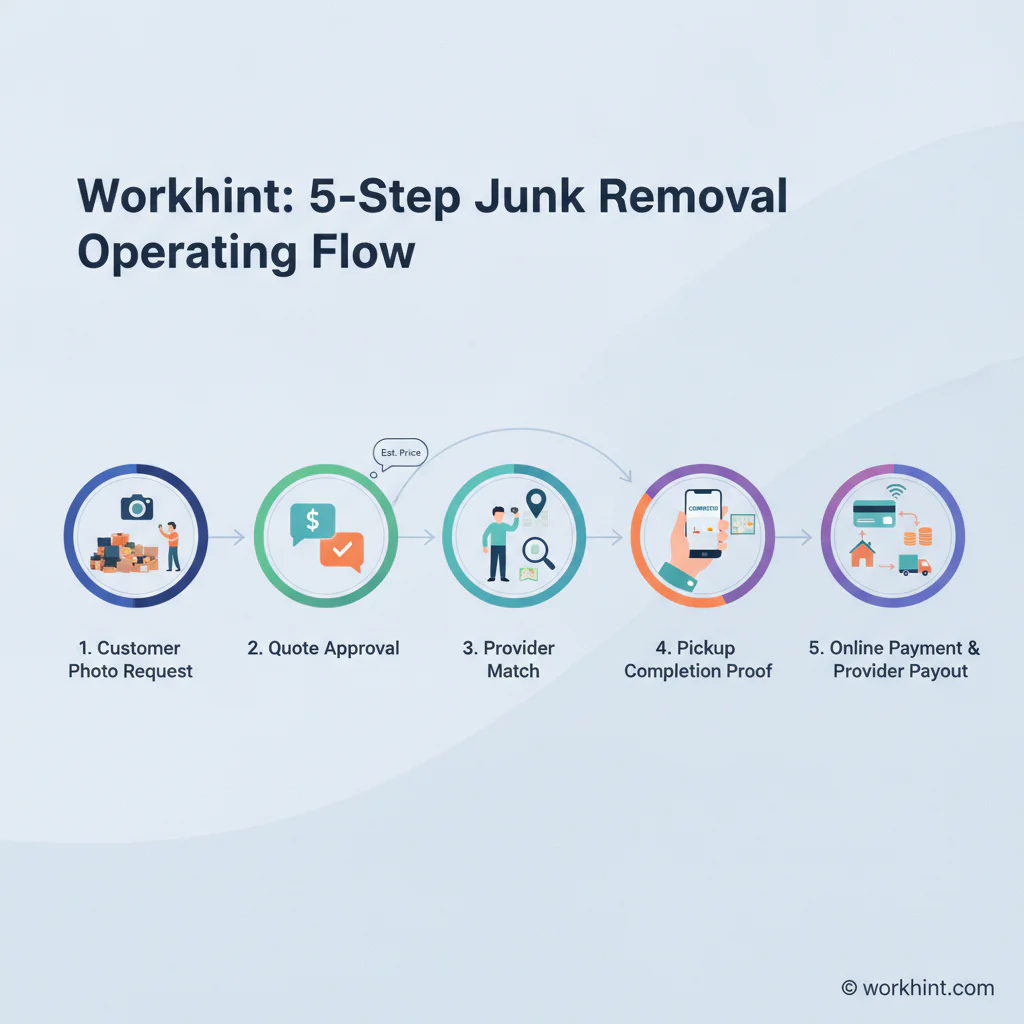
A customer can request pickup through your branded portal, upload photos, describe items, choose a time window, approve a quote, and pay online. Inside the operations dashboard, you can review the request, match it to an independent hauler, confirm vehicle capacity, assign the job, collect before-and-after photos, record disposal or donation notes, request a review, and track the provider payout.
For providers, Workhint can manage invitations, onboarding documents, vehicle details, service areas, insurance records, availability, assignments, mobile checklists, completion proof, disposal receipts, payouts, and reporting. That lets you build a private hauler network and validate demand before owning the expensive assets yourself.
First 7-day launch plan
- Day 1: Choose one launch area, one customer segment, and one first offer, such as single-item pickup or apartment move-out removal.
- Day 2: Set up the branded Workhint platform basics: customer portal, photo intake, quote fields, provider profiles, and admin dashboard.
- Day 3: Configure pricing rules, quote approval, scheduling, payment, completion photos, disposal notes, reviews, and payout tracking.
- Day 4: Recruit three to five independent haulers or service partners with vehicles, basic tools, availability, and clear standards.
- Day 5: Contact property managers, realtors, movers, storage facilities, contractors, and neighborhood groups with one clear offer.
- Day 6: Route every request through the platform, quote quickly, and only accept jobs that fit provider capacity and local disposal rules.
- Day 7: Review demand, quote acceptance, provider reliability, dump fees, job duration, feedback, and margin before investing more.
Final launch checklist
- Choose one local service area and one first junk removal offer
- Check business registration, insurance, disposal, vehicle, and permit requirements
- Create branded intake, quote, scheduling, payment, review, and payout flows
- Recruit independent haulers or partners with clear standards
- Define minimum job fees, photo requirements, restricted items, and disposal surcharges
- Publish a local landing page and claim the Google Business Profile
- Run outreach to property managers, realtors, movers, contractors, and neighborhood groups
- Validate demand before buying trucks, trailers, storage space, or hiring a crew
FAQ
How much does it cost to start a junk removal business?
A traditional launch can cost thousands to tens of thousands of dollars if you buy a truck, trailer, equipment, and heavy marketing upfront. A lean launch can start with business setup, insurance review, a branded booking platform, local marketing, and a vetted provider network.
Do I need a truck to start a junk removal business?
You need reliable hauling capacity, but you do not always need to own it on day one. You can validate demand with independent haulers or partners who already have vehicles and tools.
Do I need a license for junk removal?
Requirements depend on your location and materials. Basic hauling may require business registration, insurance, and permits. Hazardous waste, oversized vehicles, construction debris, and dump access may require additional rules.
How should I price junk removal jobs?
Price by volume, item type, labor, stairs, distance, disposal fees, and urgency. Use photos, set a minimum job fee, and add surcharges for mattresses, electronics, heavy materials, or special handling.
Can I start without employees?
Yes. A private network of independent haulers can handle fulfillment while you focus on customers, quoting, scheduling, quality control, and payments. Make sure provider classification, insurance, safety, and payout terms are handled carefully.
How do junk removal businesses get first customers?
First customers often come from property managers, landlords, real estate agents, movers, contractors, storage facilities, local search, neighborhood groups, and related home service referrals.
Is junk removal profitable?
It can be profitable when quotes cover labor, disposal, travel, provider payout, marketing, and margin. Profit gets harder when dump fees are underestimated, providers are unreliable, routes are inefficient, or jobs are priced before the load is understood.
Conclusion
A junk removal business does not have to begin with a truck purchase. Start with demand, a branded platform, a clear first offer, and a reliable provider network. Once customers are booking, providers are delivering, and margins are clear, then invest in owned vehicles and equipment with evidence instead of guesswork.
Leave a Reply