


You can validate a medical billing business before hiring billers, leasing an office, or building healthcare operations from scratch.
A medical billing business helps healthcare providers submit claims, follow up on denials, post payments, and keep revenue moving. It is attractive because small practices often need better billing support, but many founders overbuild too early.
The smarter path is to start with a focused offer, a branded operating platform, and a small network of experienced independent billers or revenue cycle partners. Then you can sell, route work, coordinate clients, and prove demand before carrying a full payroll.
What’s in this article?
- Why medical billing can work as a low-overhead startup
- What you need before selling your first client
- How to price medical billing services
- How to get first healthcare clients
- How Workhint helps launch the business as a branded platform
- A first 7-day launch plan and FAQ
Why this business works
Medical practices need clean claims, faster collections, denial follow-up, and reliable reporting. Many do not want to hire and manage an internal billing team, especially small clinics, specialists, therapy practices, home care providers, and independent physicians.
That creates room for a focused medical billing company that starts narrow. Instead of offering every revenue cycle service on day one, pick one niche, such as small specialty practices, behavioral health clinics, therapy providers, or home health operators.
The no-employee model works because the founder does not need to personally perform every billing task. The founder can recruit experienced independent billers, coders, denial specialists, or implementation partners, then coordinate delivery through a controlled operating system.
What you need to launch
You need credibility, compliance discipline, client intake, provider onboarding, secure document handling, and a simple service package. You do not need an office, a large internal team, or expensive enterprise software before you know whether practices will buy.
Medical billing handles sensitive health information, so HIPAA compliance, secure systems, business associate agreements, and clear data access rules matter from the beginning. Certification is not always legally required, but billing knowledge and healthcare revenue cycle experience are not optional.
| Startup item | Lean launch approach | Estimated early budget |
|---|---|---|
| Business registration and contracts | Register the company, create client agreements, and prepare business associate agreement templates | $300-$1,500 |
| Insurance and compliance support | Start with professional liability, cyber coverage, and HIPAA guidance where needed | $500-$2,500 |
| Training or certification | Use existing experience or targeted billing, coding, and denial management training | $300-$2,000 |
| Branded platform | Create customer intake, client dashboard, provider onboarding, task routing, approvals, payments, and reporting in Workhint | Start lean |
| Marketing and outreach | Build a simple website, niche landing page, email list, and local healthcare outreach process | $200-$1,500 |
How to price medical billing services
Medical billing pricing usually depends on claim volume, specialty complexity, denial workload, and whether you are doing full-service billing or a narrower task. Common models include a percentage of collections, a per-claim fee, a monthly retainer, or a hybrid.
For a small-budget launch, avoid promising full revenue cycle management to every practice. Start with a package you can deliver reliably through your provider network, then expand only after you understand workload and margins.
| Pricing model | How it works | Best fit |
|---|---|---|
| Percentage of collections | Charge a percentage of collected revenue, often used for outsourced billing | Practices that want aligned incentives |
| Per claim | Charge a fixed fee for each submitted claim | Predictable, lower-complexity claim volume |
| Monthly retainer | Charge a fixed monthly amount for a defined scope | Small practices that want budget certainty |
| Hybrid | Combine setup fee, monthly minimum, and volume-based pricing | Founders who need predictable revenue and margin protection |
How to get first customers
Start with a specific healthcare niche and a specific pain. A better message is not, “we do medical billing.” A better message is, “we help small therapy practices reduce denial follow-up time and keep claims moving without hiring a billing employee.”
Good first channels include local healthcare associations, independent practice groups, LinkedIn outreach to practice managers, referral partnerships with accountants or consultants serving clinics, and direct outreach to practices that are hiring billing roles.
Your goal is not to close a large contract immediately. Your first goal is to book conversations, learn the practice’s billing bottleneck, and offer a narrow starter engagement that proves you can improve the workflow.
How Workhint helps launch it
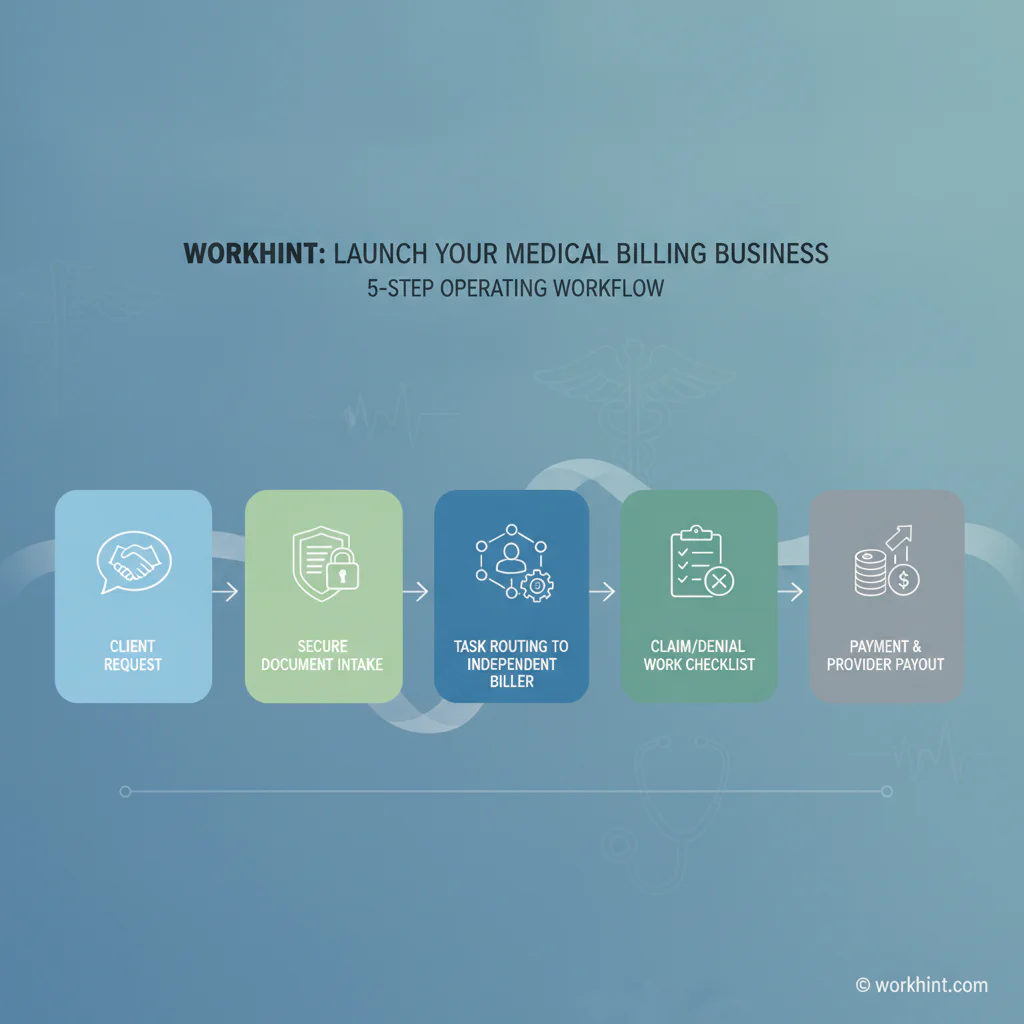
Workhint lets the founder build the business platform before investing in a permanent team. A medical billing company can launch with a branded client portal where practices request support, upload required documents, approve scope, track billing tasks, and review updates.
Behind the scenes, Workhint can route each request to independent billers or billing partners based on specialty, availability, access level, and task type. A denial follow-up task, a claim submission task, and a payment posting task can each move through its own checklist, approval step, and status update.
The founder can use Workhint to manage provider onboarding, business associate documentation, role-based permissions, client communication, service packages, invoices, payments, contractor payouts, and operational reporting. That gives the business a real operating system from day one without stitching together forms, spreadsheets, task tools, payment links, and manual follow-ups.
This matters because medical billing is trust-heavy. Clients need to see that their requests, documents, deadlines, and updates are controlled. Providers need clear assignments and payout rules. Workhint becomes the operational foundation that lets the founder focus on demand, relationships, and quality control.
First 7-day launch plan
- Day 1: Choose one healthcare niche, one launch market, and one starter offer.
- Day 2: Set up the branded Workhint platform with client intake, provider onboarding, task statuses, and secure request flows.
- Day 3: Define pricing, contracts, business associate agreement workflow, quote approval, invoicing, and provider payout rules.
- Day 4: Recruit three to five experienced independent billers, coders, or revenue cycle partners for your first provider network.
- Day 5: Build a list of local or niche practices and contact practice managers with a focused pain-led offer.
- Day 6: Route first conversations, sample requests, or audits through the platform instead of handling them manually.
- Day 7: Review demand, provider capacity, pricing assumptions, and compliance gaps before spending more money.
Final launch checklist
- Pick a narrow healthcare niche and billing problem
- Register the business and prepare client contracts
- Confirm HIPAA, security, insurance, and business associate agreement requirements
- Create one clear service package and pricing model
- Configure the branded Workhint client portal and operations dashboard
- Recruit independent billing providers or specialist partners
- Create intake, assignment, checklist, approval, invoice, payment, and payout flows
- Contact first practices and validate demand before hiring employees
FAQ
How much does it cost to start a medical billing business?
A lean launch can often start with a few thousand dollars for registration, training, insurance, compliance support, marketing, and platform setup. Costs rise if you buy expensive software, hire employees, or build a large operation before proving demand.
Do I need certification to start a medical billing business?
Certification is not always legally required, but clients expect competence. If you do not have billing or coding experience, get training, partner with experienced billers, and avoid selling services you cannot supervise responsibly.
Do medical billing businesses need to be HIPAA compliant?
Yes. If you handle protected health information for healthcare clients, HIPAA compliance, secure systems, data access controls, and business associate agreements are essential.
Can I start a medical billing business with no employees?
Yes, if you structure the company around a provider network. You can recruit independent billers, coders, and denial specialists while you manage sales, client relationships, quality control, and operations through a branded platform.
How do medical billing businesses get clients?
Most early clients come from niche outreach, referrals, healthcare networking, practice manager relationships, and solving a specific pain such as claim denials, slow follow-up, or lack of billing coverage.
What should I avoid when starting?
Avoid buying expensive systems, hiring employees, or promising full-service revenue cycle management before you validate demand, understand workload, and know which providers can deliver the work.
Conclusion
A medical billing business can be launched with low overhead if the founder starts narrow, validates demand, and builds a trusted provider network before hiring a team. The early business is not about looking large. It is about proving that practices will trust you with a focused billing problem.
Workhint gives that lean model the operating foundation it needs: a branded client platform, provider onboarding, secure task routing, approvals, payments, payouts, and reporting. That lets you launch faster, stay organized, and invest only after real demand appears.
Leave a Reply