


Contractor screening should reduce business risk without turning every external worker into an employee-style hiring process.
Independent contractor background checks help businesses screen freelancers, consultants, vendors, subcontractors, and other external workers before giving them access to customers, worksites, systems, data, equipment, or sensitive responsibilities. The goal is not to make contractor onboarding as heavy as employee hiring. The goal is to match the check to the risk of the work, obtain proper consent, review results consistently, and connect the decision to onboarding and access controls.
This topic is compliance-sensitive. Use this article as an operating guide, not legal advice, and review federal, state, local, and industry rules with qualified counsel.
What’s in this article?
- When independent contractor background checks make sense
- What to decide before screening a contractor
- A practical background check workflow for external workers
- Common mistakes that create compliance or contractor-experience problems
- Where Workhint fits when screening is part of a broader contractor operating system
Why independent contractor background checks matter
Contractors often sit outside the employee system but still touch important parts of the business. A freelance developer may access source code. A field technician may enter customer sites. A delivery contractor may drive under the company’s brand. A consultant may see financial data. A caregiver, tutor, or event worker may interact with vulnerable people.
That risk profile makes screening a business control, not just an HR task. The Federal Trade Commission explains that employment background checks can be consumer reports under the Fair Credit Reporting Act, and employers using those reports must follow steps such as disclosure, written permission, and adverse-action notices. The EEOC also warns that screening practices must comply with anti-discrimination laws.
For contractors, there is one extra operational tension: the business needs risk controls, but too much employee-style control can muddy the relationship. Screening should be tied to the work being performed, the access required, and the contract terms, not a blanket habit applied casually to every external person.
What to decide before screening a contractor
Start with the work, not the vendor portal. A background check for a remote design freelancer should not look the same as screening a driver, healthcare contractor, site technician, financial consultant, or worker with access to minors.
| Decision | Practical question | Why it matters |
|---|---|---|
| Work risk | Will the contractor access customers, facilities, vehicles, money, regulated data, or vulnerable populations? | Higher-risk work may justify deeper screening and tighter approval controls. |
| Check type | Do you need criminal, driving, credential, license, sanctions, identity, or reference checks? | Each check should have a business reason tied to the work. |
| Legal path | What federal, state, local, contract, union, privacy, or industry rules apply? | Background-check rules vary, and some locations restrict timing or use of records. |
| Decision owner | Who reviews results, who can approve exceptions, and who handles adverse-action steps? | Managers should not improvise decisions based on sensitive report details. |
| Record handling | Where will consent, status, outcome, expiration, and disposal rules be stored? | Screening creates sensitive records that need limited access and retention discipline. |
Independent contractor background check workflow
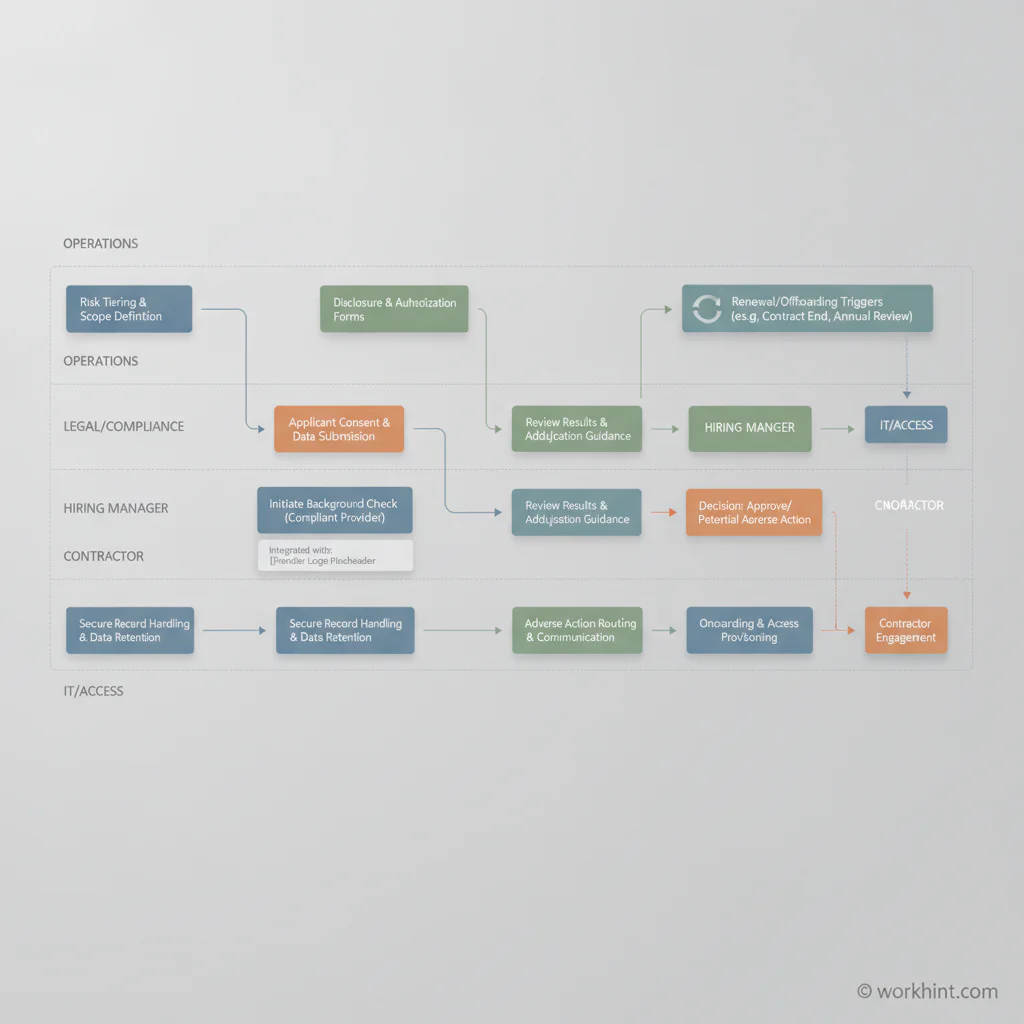
A usable workflow has seven steps. First, classify the contractor engagement by risk. Use criteria such as site access, customer interaction, financial exposure, data sensitivity, driving, regulated work, length of assignment, and whether the contractor works through a vendor or directly with the company.
Second, define the required checks for that risk tier. Keep the package narrow. For example, driving work may need motor vehicle records, while a finance consultant may need identity, sanctions, and credential checks. A UNC policy example ties contractor background checks to assignment duration and sensitive access; the useful lesson is to define triggers before requests arrive.
Third, provide the required disclosure and obtain authorization before ordering a third-party report. The FTC guidance says the notice should be written and stand-alone, and written permission must be obtained before getting a consumer report. If the process may involve investigative reports or ongoing checks, review the extra requirements before using that approach.
Fourth, run the check through an approved provider or defined internal process. Do not let each manager choose a different vendor or ask contractors to email sensitive documents into an inbox.
Fifth, review results against pre-defined criteria. A result should be evaluated for relevance to the work, timing, accuracy, and legal use. If the business may deny work, remove access, or change the engagement based on a consumer report, follow the required pre-adverse and adverse-action process before finalizing the decision.
Sixth, connect the screening outcome to onboarding and access. A passed check may release contract signing, system access, badge approval, schedule assignment, or customer-site eligibility.
Seventh, set renewal, expiration, and offboarding triggers. When the contractor’s work changes from low-risk to high-risk, screening requirements may change too.
Common mistakes in contractor screening
The first mistake is screening everyone the same way. Blanket checks feel simple, but they can create unnecessary cost, delay, privacy exposure, and legal risk. A risk-based matrix is usually cleaner than a one-size-fits-all policy.
The second mistake is mixing contractor screening with employee hiring without thinking about classification. California’s independent contractor FAQ, for example, explains that worker classification can depend on legal tests and facts about the relationship. Screening alone does not make someone an employee, but the overall process should avoid unnecessary employee-style control when the company intends a true contractor relationship.
The third mistake is storing too much information in too many places. Managers usually need to know whether the contractor is cleared, pending, expired, or not approved for a specific work type. They usually do not need broad access to the full report.
The fourth mistake is forgetting the contractor experience. A clear process protects the business and makes the contractor relationship easier to begin.
Where Workhint fits
Workhint fits when contractor background checks are one part of a larger external workforce workflow. A business can use Workhint to turn the policy into a live operating process: intake, risk tier, required checks, consent status, approval owner, document collection, onboarding tasks, role-based access, assignment readiness, renewal reminders, and offboarding steps.
That matters because screening is rarely isolated. It connects to who requested the contractor, what work they will do, which systems they need, whether legal or compliance needs review, when the contractor can start, and whether finance can approve payment. Workhint helps keep those steps connected without making the article’s advice dependent on one tool. For compliance-sensitive contractor work, contractor compliance software can keep classification, required documents, approvals, audit trails, and renewal checks organized.
FAQ
Can businesses run background checks on independent contractors?
In many situations, yes, but the process must follow applicable background-check, privacy, discrimination, state, local, and industry rules. If a third-party consumer report is used, FCRA requirements may apply.
What background checks should contractors complete?
It depends on the work. Common checks may include identity, criminal history, motor vehicle records, credential or license verification, sanctions screening, or reference checks. The check should be relevant to the contractor’s duties and access.
Should every contractor go through the same screening process?
Usually no. A risk-based process is more practical. Contractors with customer, site, driving, financial, regulated, or sensitive-data access may require different screening than low-risk project contributors.
Who should own contractor background checks?
Operations, HR, legal, compliance, procurement, or security may own different parts. The best owner is the function that can enforce a consistent workflow across contractor intake, screening, access, onboarding, and records.
Conclusion
Independent contractor background checks work best when they are specific, consistent, and connected to the contractor lifecycle. Define risk tiers, choose relevant checks, get proper consent, review results carefully, protect sensitive records, and tie clearance to onboarding and access. The result is a process that protects the business without slowing every external worker through unnecessary bureaucracy.
Leave a Reply