


Process governance keeps workflows from becoming stale documents, political debates, or invisible rules only one person understands.
A process governance framework is the operating structure that keeps important workflows owned, reviewed, measured, and improved. It answers practical questions: who owns the process, who can change it, how often it is reviewed, what metrics prove it works, and what happens when the process no longer matches reality.
This matters because most process work fails after the workshop. A team maps a workflow, agrees on steps, publishes a document, and then the real work drifts. New exceptions appear. Approvers change. Tools get replaced. People build side channels because the official process is too slow. Without governance, documentation becomes a memory of how work used to happen.
What’s in this article?
- What process governance means in day-to-day operations
- The core components of a practical framework
- A step-by-step rollout plan for operations teams
- A governance table you can adapt for your own workflows
- Common failure points and where Workhint fits
Why process governance matters
Business process management is not a one-time documentation exercise. IBM describes BPM as an iterative discipline for examining, improving, monitoring, and optimizing workflows across people, process, and technology. That is the key idea: the process must keep changing as the business changes.
Governance gives that change a controlled path. It prevents two opposite problems. The first is chaos, where anyone can change the workflow informally. The second is bureaucracy, where every improvement waits for a committee too far from the work. Good governance sits in the middle: clear enough to control risk, light enough to keep work moving.
A practical process governance framework
The simplest useful framework has seven parts. Start with these before creating committees, maturity models, or a process center of excellence.
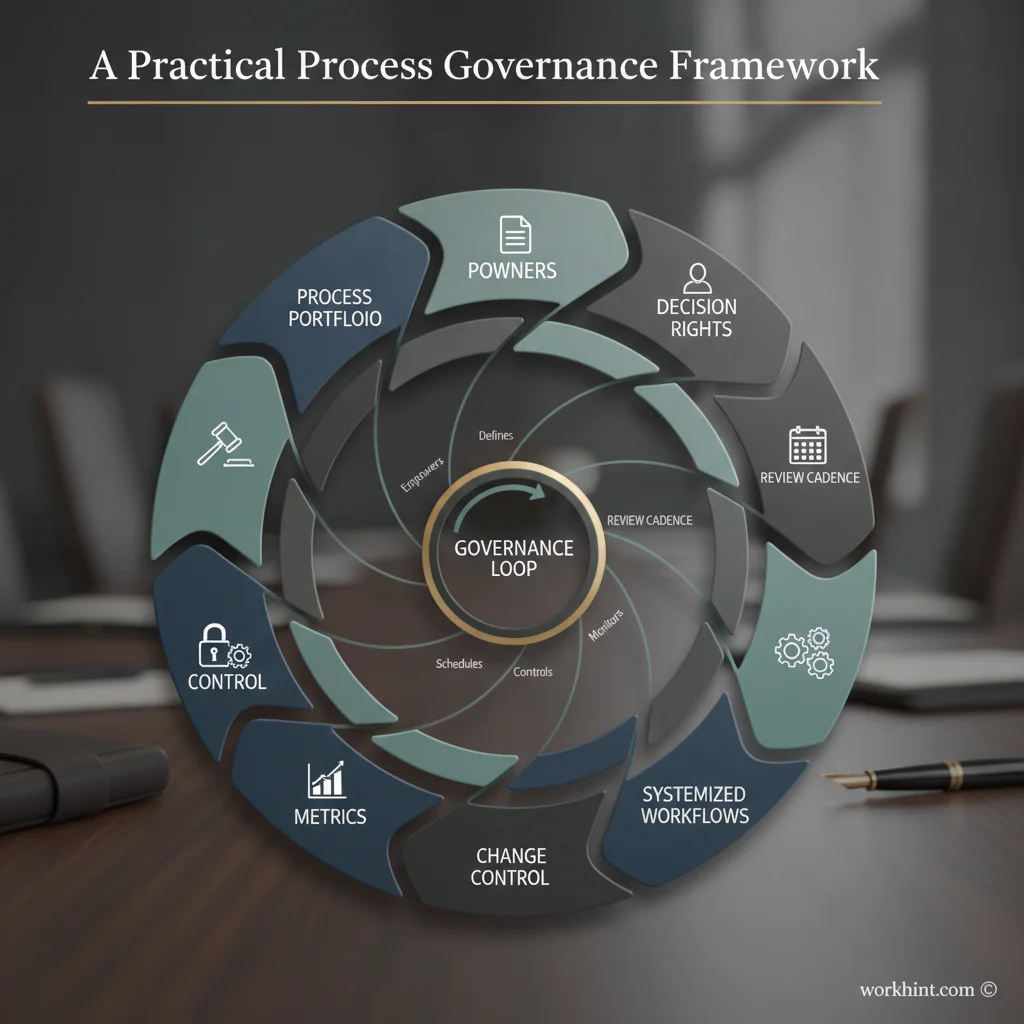
| Component | What it defines | Why it matters |
|---|---|---|
| Process portfolio | The list of workflows that matter most | Prevents governance from spreading across low-value process clutter |
| Process owner | One accountable person for design and performance | Stops workflows from becoming nobody’s job |
| Decision rights | Who can approve changes, exceptions, and escalations | Reduces debate when work crosses teams |
| Review cadence | How often the workflow is checked against reality | Keeps documentation current |
| Change control | How proposed changes are assessed and released | Protects customers, controls, and downstream teams |
| Metrics | How performance and drift are measured | Turns governance into improvement, not paperwork |
| System controls | Permissions, automation, audit history, and reporting | Makes the process executable and observable |
How to build a process governance framework
1. Choose the workflows worth governing
Do not start by governing everything. Pick five to ten workflows where failure is expensive, visible, or recurring. Good candidates include customer onboarding, vendor approval, employee onboarding, access requests, invoice approvals, incident response, service delivery, and high-volume internal requests.
Use three filters: business impact, operational pain, and risk. A workflow with high volume, repeated exceptions, unclear ownership, or compliance exposure should rank higher than a process that is merely annoying.
2. Assign a real process owner
A process owner is not always the person doing the work. The owner is accountable for the design, accuracy, performance, and improvement of the workflow. They can answer why the process works this way, what should change, and who must be consulted before a change goes live.
Microsoft’s process governance guidance frames governance as the way processes are designed, executed, and monitored effectively. That requires a named owner. Without one, every exception becomes a negotiation between functions.
3. Define decision rights and escalation rules
List the decisions the workflow creates. Who can approve a new vendor? Who can bypass a normal review? Who can change a required field? Who decides when an exception needs executive review?
Keep the matrix simple. For each decision type, name the requester, approver, consulted parties, and escalation owner. If the workflow touches sensitive data, financial approval, HR records, or system access, include permission rules early. NIST’s SP 800-53 control catalog is a useful reminder that access should be limited to authorized users and processes based on need, not convenience.
4. Set the review cadence
Every governed process needs a review rhythm. High-change, customer-facing, or regulated workflows may need quarterly review. Stable back-office workflows may be fine with annual review. The review should answer four questions:
- Does the documented workflow still match how work actually happens?
- Which exceptions are recurring often enough to become standard paths?
- Where are handoffs, approvals, or queues slowing execution?
- Which changes should be released, tested, or rejected?
ISO 9001 emphasizes maintaining and continually improving a quality management system, including documented information, operation, performance evaluation, and improvement. Even if your company is not pursuing certification, that logic applies: a process that is never reviewed is not really governed.
5. Create a lightweight change-control path
Change control does not need to be heavy. It needs to be explicit. A practical path is: submit change, assess impact, approve or reject, update the workflow, communicate the change, and monitor results.
Use impact questions before approving the change. Does it affect customers? Does it change a control? Does it require a new integration? Does it move work to another team? Does it create a new approval step? Does it remove evidence someone needs later?
6. Measure the process like a system
Governance should improve execution, not just make documentation tidy. Track a small set of metrics: cycle time, queue age, SLA compliance, rework rate, exception volume, approval time, error rate, and completion quality. Add qualitative signals too, such as requester confusion or repeated manual follow-up.
The owner should review these metrics during the cadence meeting and decide whether the workflow needs tuning, redesign, automation, or better training.
Common mistakes
- Governing too much too early: start with critical workflows, then expand.
- Confusing documentation with governance: a diagram without ownership and review cadence will decay.
- Creating committees without decision rights: meetings do not help unless people know what they can decide.
- Ignoring system permissions: workflow governance should include who can see, change, approve, and export data.
- Measuring activity instead of flow: count delays, rework, queues, and exceptions, not just tasks completed.
Where Workhint fits
Workhint helps teams turn a process governance framework into a live operating system. Instead of leaving the framework in a slide deck, a team can describe the workflow, roles, approvals, permissions, forms, automations, dashboards, and reporting they need. Workhint can help structure the work system around those governance choices.
That matters when governance crosses teams. The process owner can define the workflow. Requesters can submit structured intake. Approvers can act from clear queues. Operators can see assignments and exceptions. Leaders can monitor cycle time, backlog, and SLA performance. Changes can be reflected in the workflow itself instead of scattered across documents, spreadsheets, and chat threads.
FAQ
What is a process governance framework?
A process governance framework is the set of roles, rules, review cycles, decision rights, metrics, and system controls that keep business processes accurate, accountable, and continuously improving.
Who should own process governance?
Each important process should have a named process owner. In larger organizations, an operations leader, process excellence lead, or business systems leader may own the overall governance framework.
How often should processes be reviewed?
Review high-change or customer-facing processes quarterly, cross-functional workflows semi-annually, and stable back-office workflows annually. Increase the cadence when exceptions, rework, or risk rise.
Is process governance only for large companies?
No. Small companies need lightweight governance because informal workflows break quickly as headcount, customers, vendors, and tools increase. The framework can be simple as long as ownership and review are clear.
Conclusion
A process governance framework keeps work systems alive. It gives every important workflow an owner, a review rhythm, decision rights, change control, metrics, and system controls. The goal is not more bureaucracy. The goal is a workflow that stays current, scales with the business, and improves when the evidence says it should.
Leave a Reply