


Use classification as an operating checkpoint, not paperwork you clean up after the contractor has already started.
An independent contractor classification checklist helps a business decide whether a worker can be engaged as a contractor before the relationship creates tax, wage, benefits, or control risk. The point is not to turn managers into lawyers. It is to force the right questions early: who controls the work, who owns the method, how the person gets paid, what tools they use, and whether the relationship looks like an independent business relationship in practice.
This article is practical guidance for business teams, not legal advice. Classification rules vary by law, jurisdiction, and worker relationship. For U.S. federal tax purposes, the IRS says businesses should consider all evidence of control and independence. Under wage-and-hour law, the Department of Labor focuses on economic reality. State rules may be stricter, so high-risk cases should be reviewed with counsel.
What’s in this article?
- A practical checklist for reviewing contractor classification before work starts.
- The operating signals that create misclassification risk.
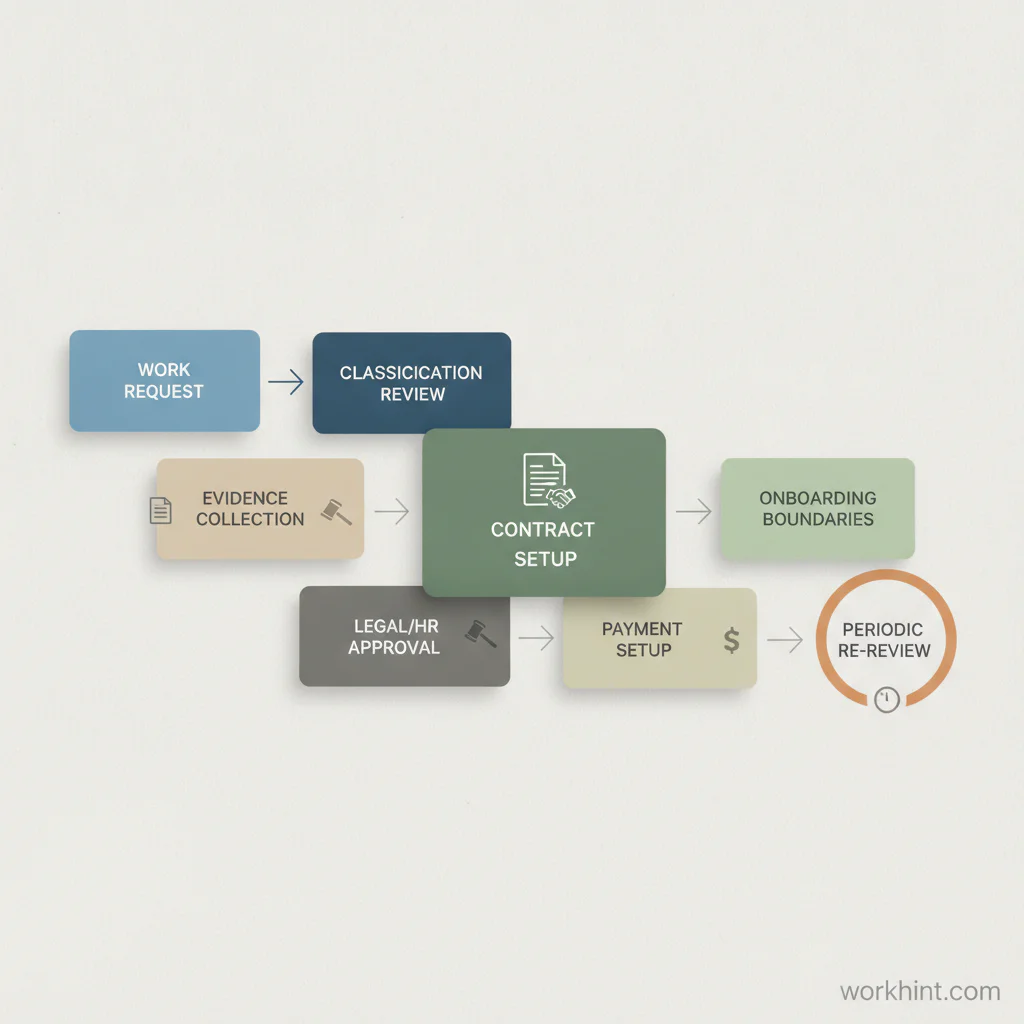
- A workflow for intake, approval, documentation, onboarding, payment setup, and re-review.
- A simple table business teams can use to separate low, medium, and high-risk engagements.
Why contractor classification matters
Misclassification usually starts with a reasonable business need: a team wants specialist help, a project is moving fast, or a manager already knows someone who can do the work. The risk appears later when the contractor is managed like an employee, added to normal staff routines, given open-ended responsibilities, or paid without clear scope and documentation.
The IRS separates classification evidence into behavioral control, financial control, and the relationship of the parties. Its Worker Classification 101 guidance explains that a business should look at what the company has the right to control, not only what it actually controls day to day. The IRS also notes that no single factor automatically decides the answer.
That is why a checklist is useful. It creates a consistent record before the engagement starts and gives HR, legal, finance, procurement, and operations the same facts to review.
A practical classification checklist
Use this checklist before approving a new independent contractor, freelancer, consultant, agency worker, or sole proprietor. If several answers point toward company control or economic dependence, pause and route the engagement for legal or HR review.
| Checklist area | Lower-risk contractor signal | Higher-risk employee signal |
|---|---|---|
| Control over work | The contractor controls how the work is performed and is judged by deliverables. | The manager directs hours, methods, tools, scripts, or daily execution. |
| Financial independence | The contractor sets rates, serves other clients, carries business costs, and can profit or lose. | The person depends on one company, is reimbursed like staff, or has little business risk. |
| Relationship terms | The agreement defines scope, term, fees, IP, confidentiality, and acceptance criteria. | The work is indefinite, core to an internal role, or paired with employee-style benefits. |
| Tools and access | Access is limited to what the scope requires and removed when work ends. | The contractor receives broad staff access, internal systems, and ongoing team privileges. |
| Management cadence | Check-ins focus on milestones, blockers, deliverables, and approvals. | The contractor joins daily staff meetings and is supervised like a direct report. |
Run classification as a workflow
A good classification process is short, repeatable, and hard to bypass. The workflow should start before anyone sends a contract or grants system access.
- Start with the work request. Capture the business need, project owner, budget, expected term, deliverables, location, tools, and whether the person will work with customers, employees, data, or regulated systems.
- Review the control model. Ask whether the company is buying an outcome or directing labor. Contractor relationships are easier to support when the business defines results, not day-to-day methods.
- Check financial independence. Document whether the contractor has a business entity, serves multiple clients, sets pricing, provides equipment, carries insurance where relevant, and can manage profit or loss.
- Review relationship facts. Confirm the engagement has a defined scope, term, payment method, ownership terms, confidentiality terms, and end date or renewal point.
- Route exceptions. Send high-risk cases to HR, legal, finance, or procurement before approval. Examples include long-term full-time work, former employees, critical internal roles, or managers who want to control working hours.
- Set onboarding boundaries. Give only the access, documents, communication channels, and approvals needed for the scope. Avoid employee-style onboarding unless counsel has approved the model.
- Schedule a re-review. Classification can drift. Recheck when the scope expands, the term extends, the contractor becomes embedded with a team, or payment terms change.
Common mistakes that increase risk
The biggest mistake is treating the agreement as the whole classification analysis. A contract matters, but the working relationship matters too. A contractor agreement will not help much if the person is managed like an employee every day.
- Approving contractors through email without an intake record.
- Using the same onboarding path for employees and contractors.
- Giving contractors broad access instead of scope-based access.
- Paying by time while also controlling the person’s schedule and methods.
- Letting short projects become open-ended staff augmentation without re-review.
- Forgetting that state, local, tax, wage, unemployment, and industry-specific rules may differ.
Federal guidance also changes. The Department of Labor has had active 2026 rulemaking activity around independent contractor classification, which is another reason to keep the process documented and review current standards before relying on an old checklist.
Where Workhint fits
Workhint fits after a team decides it needs an external worker and before the engagement turns into scattered emails, spreadsheets, and informal approvals. A business can use Workhint to turn the classification checklist into a live workflow: intake form, role-based review, required documents, approval routing, contract status, access boundaries, assignment details, payment status, reminders, and re-review triggers. For compliance-sensitive contractor work, contractor compliance software can keep classification, required documents, approvals, audit trails, and renewal checks organized.
That does not replace legal judgment. It makes the operating process visible so the right people can review the right evidence before the contractor starts work. For companies using many freelancers, contractors, vendors, or agencies, the value is consistency: every engagement follows the same path, exceptions are visible, and documentation is not buried in someone else’s inbox.
FAQ
Is a signed contractor agreement enough to prove contractor status?
No. A signed agreement is important, but classification depends on the full relationship. Control, financial independence, relationship terms, and actual working practices all matter.
Who should own contractor classification?
Usually HR, legal, finance, or procurement should own the policy, while the business owner provides the facts about the work. Operations should make sure the intake, approvals, onboarding, and payment workflow is followed.
How often should contractors be re-reviewed?
Review at renewal, scope expansion, role change, location change, or whenever a contractor starts looking like a standing member of an internal team. Long-running engagements should have a scheduled review even when nothing obvious changes.
What should we do if the classification is unclear?
Pause before work starts, collect more facts, and involve qualified counsel or the relevant internal owner. For U.S. federal tax questions, the IRS notes that Form SS-8 can be used when status is unclear, although determinations can take time.
Conclusion
An independent contractor classification checklist should help the business make a better decision before risk is built into the relationship. The checklist is strongest when it is connected to the operating system around the work: intake, evidence, approvals, contract setup, onboarding limits, payment setup, and periodic review. If those steps are visible and consistent, contractor programs can move faster without relying on informal judgment every time a team needs outside help.
Leave a Reply